
In order to preclude the above-mentioned scenario and prolong its dominant world status, Washington has obviously opted for a policy of “preemptive strike,” as it always has done in modern history. The essence of this policy is to give approval to the new “polycentric” world order, where Russia has (or continues) to be one of these power centers.[12] The status of the “power pole” in the post-Soviet space and Eastern Europe will inevitably force Moscow to view leading European powers, primarily France and Germany, but also China, as strong rivals in its traditional areas of domination rather than as trade/economic partners. On the other hand, one should expect a similar reaction from Europe and China once the United States gives Russia a kind of carte blanche for providing almost unimpeded policy in the mentioned regions. The European powers and Beijing will immediately activate their efforts to restrain Moscow’s ambitions on the continent.
We have already witnessed such activation from the European side in the not-distant past. The reluctance of the Bush administration in the summer of 2008 to undertake concrete measures to curb Russia’s “aggression” against Georgia resulted in immediate interference by France and Germany, which was successful enough and actually prevented further escalation of the conflict. As for China, it’s developing economic ties with Central Asian states—an area of strategic importance for Russia—and therefore the strengthening political influence of Beijing in this region is undoubtedly a worrisome issue for policy makers in the Kremlin. All these points provide us enough ground to assert that once the United States starts developing closer ties with Russia, changes in the nature of the latter’s relations with united Europe and China (from partnership to rivalry) will be in the observable future rather than in the long-term perspective.
Thus, by proposing Russia a political dominance in the regions strategically important to Moscow, Washington significantly reduces the likelihood of Russia’s alignment with any power center in Eurasia (be it Europe or China) and therefore reduces the likelihood of any emergent power center to become capable of challenging the United States’ current world status. In other words, Washington makes serious concessions in order to split up the forces of the Old World.
Roughly 10 years ago, Washington’s consent to Russia’s dominance in the post-Soviet space and Eastern Europe was unthinkable. The United States felt no threat to its world dominance in economic, political, or especially military spheres. However, dramatic economic growth and rising defense expenditures in the European Union, China, India, and Brazil (which have become comparable with America’s), as well as growing concern by American analysts over inevitable future (and already observable) heightened tension with the U.S. as the only world superpower, dictated to policy makers in Washington the only way out: to attract the most powerful (both economically and militarily) states to global regulation and grant them the function of adjusting their regional subsystems.[13]
By this move, the United States solves two problems: (1) It lightens the burden of global management that Washington has assumed, and (2) it strengthens the rivalry between other regional power center aspirants in the future multipolar world.
It is worth mentioning that according to some Russian analysts, the above-mentioned scheme of U.S.-Russia relations is not anything new in the post-Soviet period.[14] They suggest that there was a somewhat informal agreement between the Clinton and Yeltsin administrations in the 1990s recognizing Russia’s dominance in the post-Soviet area. This sounds plausible, taking into account Yeltsin’s success in freezing the conflicts of the South Caucasus, Tajikistan, and Transdnistria.
Nevertheless, as Russians assure, the administration of George W. Bush broke the above-mentioned “gentlemen’s agreement” by organizing so-called colored revolutions in Georgia and Ukraine in the beginning of 2000 and by destabilizing the political situations first in Uzbekistan and then in Kyrgyzstan. This reportedly resulted in the transition of U.S.-Russia relations in the post-Soviet space from partner-oriented to conflict-oriented.
Geopolitics
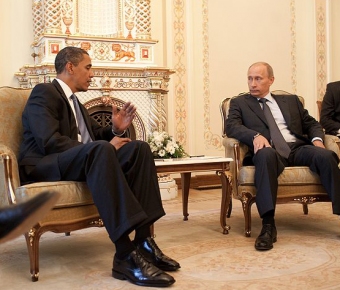
All this is in the past, official Washington says. As President Barack Obama put it in 2009 during his visit to Moscow, America wants to see Russia strong, peaceful, prosperous, and self-confident, because the United States needs exactly this kind of partner in the twenty-first century. The words of U.S. Ambassador to Russia John R. Beyrle on the same subject are even more emotional: “We are not interested in weak Russia. Weak Russia is the worst nightmare for the US. We understand perfectly what challenges we are faced with…and we must cope with them in alliance with strong partners. Thanks to its geostrategic position, immense resources and human capital, Russia may be exactly…such a partner”.[15]
Indeed, Russia has the historical experience, the human and material resources, and the political will necessary for controlling and even managing regional processes. However, is Russia comfortable with the role of “regional regulator” after being a global actor for 150 years? Most probably it is. First, it has learned to assess its capabilities realistically, especially in the economic sphere, and it understands perfectly its subordinate position compared to other rising powers of Eurasia, let alone the United States. Secondly, it has not only offered to coordinate the situation in the post-Soviet space, but also to become a rightful (in some cases even irreplaceable) mediator in solving the most acute problems with neighboring regions (the Middle East, Central Asia) and states (Iran, North Korea, and others), which contemporary Russian strategy considers extremely important in terms of the country’s national security interests. Furthermore, under the circumstances, when Russian political thought continues searching for a new geopolitical identity, even the role of regional regulator not only satisfies Russia’s imperial ambitions but also facilitates the realization of the post-Soviet area integration project within the Eurasian Economic Community (EAEC).[16]
However, the question arises, why does the United States need Russia to realize its imperial ambitions? The most obvious reasons are as follows:
First, Russia is capable and willing to assume the role of regional regulator. Throughout the last 20 years (i.e., after the collapse of the Soviet Union), Moscow has de facto played the role of regional coordinator, despite Russia’s economic chaos, political reorganization, weakness of its central government, and demoralization of its armed forces in the 1990s. Russia continued holding the keys to resolution or at least freezing of regional interethnic (the South Caucasus, Transdnistria) and civil conflicts (Tajikistan, Uzbekistan, Kyrgyzstan) in the post-Soviet area. Moreover, the states that have had acute conflicts with the West (e.g., Iran, North Korea) were always more willing to have contact with Russia rather than other powers; even the most radical movements of the Arab East continue maintaining contacts with her.
Today, when Russia has overcome (although with tremendous material, moral, and political losses) one of the most difficult periods of her history—when the power vertical has been rebuilt, significant financial recourses have been accumulated allowing the country to proceed with economic and technological modernization, and the armed forces are reviving—it is more beneficial for the United States to have Russia as a partner rather than a rival in the extremely complicated region of Eurasia.
Americans have not forgotten the many unexpected problems they were faced with after the demise of the USSR: the WMD proliferation threat, uncontrolled trade of conventional weapons, separatism, illegal drug trafficking, terrorism, human trafficking on an immense scale, and so forth. Most of these remain serious issues even today. Among all countries pretending to regional leadership, only two have enough historical experience and appropriate capabilities for solving these problems—namely, Russia and China. However, China still refrains from partaking in solving such issues (perhaps except through mediation in negotiations with North Korea). Some experts insist that this is because Beijing is still mainly focused on expanding its potential.[17] As for our judgment, perhaps arguably enough, Chinese political culture is less predisposed to expansionism, whereas it still dominates in Russia. This is exactly the reason the role of regional “gendarme” suits her mentality very well, as it in essence remains imperial.
Second, economically, Russia is much weaker than the European Union or China. Given this fact, the United States’ desire to see Russia in a position of regional political manager appears quite logical. Given its economic and technological weakness, Russia in the foreseeable future will not be able to compete with the U.S. on a global scale. Meanwhile, Europe and China can definitely do so.
As for Russia’s nuclear potential, which is still comparable with America’s, it is hardly a source of serious concern for the only world superpower. In contrast to the nervous “dilettantes” that are present on the nuclear scene, Moscow has been a tested, predictable, and responsible partner-adversary since Cold War times. For this reason, it is much more beneficial and also easier for Washington (and acceptable for Moscow) to channel their military might—the world’s biggest arsenals of nuclear arms—toward deterring such dilettantes instead of exerting pressure on each other. If such consensus between Washington and Moscow is achieved, Russia, with its nuclear potential, may acquire a new function: as a balancing force between Eastern and Western, and Northern and Southern parts of the vast Eurasian continent.
