
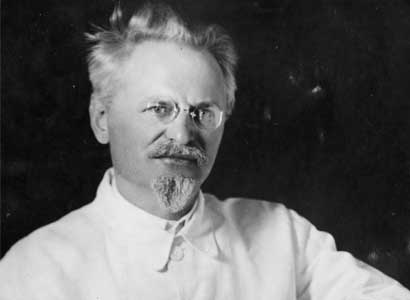
Moscow Trials in Accord with Soviet System
If the Trotskyites and their liberal and social democratic allies, as well as historians generally, regard the Moscow Trials as a modern-day “witch hunt,” it was one that proceeded in accordance with the system that Trotsky and the other defendants had fought to implement. The real source of the outrage comes from Stalin having outmaneuvered his rivals, many such as Zinoviev and Kamenev having been opportunists who became the victims of their own system. Trotsky, when in authority, was as vehement as Stalin about the need to eliminate saboteurs, plotters, and conspirators. Trotsky had stated in 1918: “By suppressing the Constituent Assembly the Soviets first and foremost broke politically the backbone of the intelligentsia’s sabotage. … We have broken the old sabotage and cleared out most of the old officials….[124]
At this early period of the Bolshevik regime Trotsky was already alluding to “counter-revolutionary” plots within his own Red Army, yet when the same situation was suggested twenty years later in regard to Trotsky et al at the Moscow Trials, Trotsky fumed that any such suggestion was a lie. When Trotsky had the power he spoke and acted in ways that he and others – including mainstream historians – would describe as “Stalinism.” Trotsky wrote of these “plots”:
Running on ahead somewhat, I must mention that certain of our own Party comrades are afraid that the Army may become an instrument or a focus for counter-revolutionary plots. This danger, in so far as there is some justification for it, must compel us as a whole to direct our attention to the lower levels, to the rank-and-file soldiers of the Red Army. Here we can and must create a foundation such that any attempt to transform the Red Army into an instrument of counter-revolution will prove fruitless….[125]
Yet it was precisely a strategy of Trotsky to try and form cadres within the Red Army, in particular during the course of war with Germany, which would enable him to reassume authority through a “police action” or coup that would replace the Stalinist apparatus.
Trotsky, when in a position of authority, was full of dark forebodings about sabotage and counter-revolution. One of the more shameful episodes was Trotsky’s falsifying evidence and fabricating charges against the commander of the Baltic Fleet, Aleksei Shchatsny. With impending capture of Helsingfors by German and Finnish White forces, and the order from the Commissariat of Naval Affairs under Trotsky to comply with the terms of the Brest-Litovsk Treaty, Shchatsny managed to get the Fleet to Kronstadt, a colossal achievement celebrated as the “Ice March of the Baltic Fleet.” Rabinowitch remarks of this: “Following this feat … He was now a popular hero, revered by the rank-and-file sailors as much as by his officers.”[126] However, the German threat to Kronstadt, Petrograd and the Baltic Fleet remained.[127] As German forces approached, there was a widespread belief that the Soviet authorities were complying with German demands and that Petrograd would be occupied. For the Soviet authorities in Moscow under Lenin and Trotsky the defense of Petrograd and of the Baltic Fleet were of secondary concern. [128]
Trotsky and Shchatsny were in conflict over Trotsky’s orders to scuttle the Baltic Fleet and demolish Fort Ino, “should the situation appear hopeless.” Shchatsny circulated Trotsky’s secret orders regarding the scuttling of the Fleet,[129] which put Trotsky in a poor light publicly. Trotsky protested indignantly at Shchatny’s trial, which he had instigated as a show trial against the acclaimed hero:
When, soon afterward, I received from Shchastny, who was at Kronstadt, a report that Fort Ino was, allegedly, threatened by a suddenly approaching German fleet, I replied, in conformity with my general directive, that, if the situation thus created became hopeless, the fort must be blown up. What did Shchastny do? He passed on this conditional directive in the form of a direct order from me for blowing up the fort, although there was no need for this to be done.[130]
Rabinowitch writes:
Information in Cheka and Naval archives indicates that Shchatsny was largely or wholly blameless in these matters, most importantly that he himself had prepared the fleet for demolition in the event of necessity and that his dissemination of Trotsky’s orders was less an effort to undermine Trotsky than a reflection of his close collaboration with the Baltic Fleet officer and sailor committees.[131]
Shchatsny submitted his resignation, but Trotsky refused it, ordered him to Moscow and,
set him up for arrest, and single-handedly organized an investigation, sham trial and death sentence on the spurious charge of attempting to overthrow the Petrograd Commune with the longer-term goal of overthrowing the Soviet republic.[132]
Trotsky condemned Shchatsny with allegations of “sowing panic,” “conspiracy,” having a “savior” complex, and seeking power for himself:
Shchastny persistently and steadily deepened the gulf between the fleet and the Soviet power. Sowing panic, he steadily promoted his candidature for the role of savior. The vanguard of the conspiracy – the officers of the destroyer division – openly raised the slogan of a “dictatorship of the Baltic fleet.”
This was a definite political game – a great game, the goal of which was the seizure of power. When Messrs. Admirals and Generals start, during a revolution, to play their own personal political game, they must always be prepared to take responsibility for this game, if it should miscarry. Admiral Shchastny’s game has miscarried.[133]
Given the nature of Trotsky’s own agitation against the Stalinist regime, which includes a time when aggressive anti-Soviet powers were on the rise, a less deferential Dewey Commission might have asked of Trotsky, should he not “take responsibility for this game, if it should miscarry?” Trotsky in his own words had stated that his aim was the “seizure of power” through a palace coup, by infiltrating the police and armed forces. He had devoted years to agitating for the overthrow of the Soviet regime and creating a revolutionary organization for that purpose. Yet when faced with charges of the type that he had once trumped up against Shchastny in order to save have own position, Trotsky feigned great moral outage on the world stage, an outrage which extended beyond his own life and has had a permanent influence on the way much of the world perceives Russia, not only after the death of Stalin, but even after the demise of the USSR. Additionally, it appears that Trotsky, Zinoviev, Kamenev, Radek, Bukharin, and the others had a fairer and more judicial hearing than that received by Shchastny; or the many summarily executed during the years when Trotsky had authority in the Soviet state.
What can also be said about the Moscow Trials was that the confessions of the defendants, which are generally criticized and ridiculed as being delivered by rote as if the product of intense brainwashing and even torture, were also completely in accord with Bolshevik methodology. The character of these confessions was not unique to the Stalinist regime, and was an innate part of the Bolshevik mentality. To admit guilt even in the most abject manner not only before the tribunal of the Soviets but before what many of the defendants regarded as the tribunal of history did not require torture or brainwashing. Of these abject confessions for example, during the 1936 trial Kamenev, stated:
For ten years, if not more, I waged a struggle against the Party, against the government of the land of Soviets, and against Stalin personally. In this struggle, it seems to me, I utilized every weapon in the political arsenal known to me – open political discussion, attempts to penetrate into factories and works, illegal leaflets, secret printing presses, deception of the Party, the organization of street demonstrations, conspiracy and, finally, terrorism.[134]
Zinoviev stated:
We entered into an alliance with Trotsky. We filled the place of the Mensheviks, Socialist-Revolutionaries and white guards who could not come out openly in our country. We took the place of the terrorism of the Socialist-Revolutionaries. Not the pre-revolutionary terrorism which was directed against the autocracy, but the Right Socialist Revolutionaries’ terrorism of the period of the Civil War, when the S-R’s shot at Lenin. My defective Bolshevism became transformed into anti-Bolshevism, and through Trotskyism I arrived at fascism. Trotskyism is a variety of fascism, and Zinovievism is a variety of Trotskyism.[135]
If these confessions are looked at on their own merits, there is nothing outlandish about them. Rogovin has shown that there was such an Opposition bloc, that there were illegal printing presses operative; and Trotsky himself records the extent of the opposition, in alliance with Zinoviev and Kamenev, to the extent that they were able to mobilize thousands to disrupt the official October parades. While the Bolsheviks, whether Leninists or Stalinists or Trotskyites, were, and are, rather loose with the smear-word “fascism” that is leveled at their opponents, “through Trotskyism” many did arrive at what was called in the USSR “fascism,” or more accurately avid support for US foreign policy during and after the Cold War, to the present time; to the point of Trotsky’s widow, Natalya Sedova, supporting the USA in Korea; and the entire Shachtmanite movement metamorphosing into anti-Sovietism and eventually the “neo-con” movement. The Stalinist analysis was in principle correct and prescient. History shows that the Stalinists saw in Trotskyism a movement that would end up being aligned with the most anti-Soviet elements, and there is nothing bizarre about the suspicion that Trotskyites and other oppositionists would seek alliance with actual “fascist” powers at a time when those powers were looking at for lebensraum. In the historical circumstances it would have been foolish for Stalin to ignore these trends, and to given them a tolerance that was not even accorded to “Christian pacifists” during World War II by the Western democracies, including those that were not in danger of invasion.
The abject natures of the defendants’ final pleas before the Court are comprehensible if we examine the Bolshevik method of self-criticism. They are prompted by an intense sense of self-guilt or shame regarding recognition of their own invidiousness when confronted with facts. Such abjectness is not unheard of by murderers and others in the West in the present day. This could be called “The Judas Syndrome,” in regard to the legend of Judas having hanged himself in remorse for his betrayal of Christ.[136] Since 1929 the Soviet Union had embarked on a method known as Sama Kritica (“self-criticism”), which has its equivalent in the West known by such terms as “group therapy,” “sensitivity training” or “group encounters,” that became popular since the 1960s among corporations and government departments, in the USA especially, and has been promoted as therapeutic by “humanistic psychology.”[137] In the USSR in 1929 the slogan first appeared: “through Bolshevist self-criticism we will enforce the dictatorship of the proletariat.”[138] The population was divided into “collectives” of ten to twenty, who held meetings set in a circle where participants face one another, and each would undertake self-criticism and the confession of faults. However ‘self-criticism” was part of the Soviet system which was endorsed by Trotsky himself when he was in a position of authority, when he stated: “Without any doubt we are passing through a period of internal confusion, of great difficulty, and, what is most important, of self-criticism, which, let us hope, will lead to an inner cleansing and a new upsurge of the revolutionary movement.”[139] The abject nature of the confessions and final pleas of the Moscow defendants is hence not reliant on alleged threats, promises, torture or brainwashing. Trotsky was an advocate of “Marxist self-criticism” as early as 1904, at a time when he was closer to the Mensheviks. Robert Services comments on this: “outraging many Mensheviks he called for ‘Marxist self-criticism’ instead of ‘orthodox self-satisfaction.'”[140]
