A Need for Cohesive Counter-Narcotics Policy
[108] Id. at 39

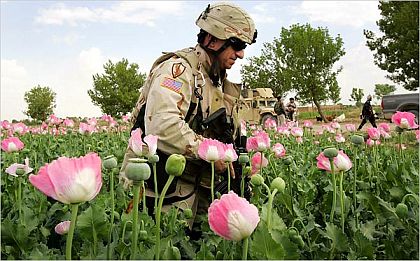
A Need for Cohesive Counter-Narcotics Policy
[108] Id. at 39
[109] [UNODC], Addiction, Crime, and Insurgency: The Transnational Threat of Afghan Opium, 1 (United Nations Publications 2009)
[110] See, U.N. Office on Drugs and Crime [UNODC], 2008 World Drug Report (United Nations Publications 2008)
[111] Other things not discussed in this paper for their sheer depth, that are of equal importance, involve the intertwining of tribal groups throughout the trafficking routes that do not lack any sense of extremism like Al-Queda cells and the diversion of pharmaceutical opiates into the illicit realm The intertwining of tribal groups along the trafficking routes makes it more difficult for persecution of such persons, and increases the probability of attaining more common consensus among the groups that do not just involve profitability, but may also involve the common thoughts and/or acts of extremism. Please see Strategic Studies Institute, John A. Glaze, Opium and Afghanistan: Reassessing U.S. Counter-narcotics Strategy (Oct. 2007); and See Also, U.N. Office of Drugs and Crime [UNODC], Afghanistan’s Drug Industry Structure, Functioning, Dynamics, and Implications for Counter-Narcotics Policy 155-213 (2006)
[112] U.N. Office of Drugs and Crime [UNODC], 2010 World Drug Report 11-12 (United Nations Publications 2010) (“In 1998, a special session of the UN General Assembly decided to work towards the “elimination or significant reduction” of illicit drug production and abuse by 2008”) (Citing: United Nations General Assembly Special Session on the World Drug Problem (UNGASS), New York, 8-10 June, 1998 (A/S-20/4, chapter V, section A))
[113] Id. (“Gathered at the end of the 10-year period, Member States were not satisfied with the results … and it was decided that the effort would continue for another decade.” ) (Citing: High-level Segment to the 2009 United Nations Commission on Narcotic Drugs, Political Declaration and Plan of Action on International Cooperation towards an Integrated and Balanced Strategy to Counter the World Drug Problem, March 2009 (E/2009/28 – E/ CN.7/2009/12)).
[115] U.N. Economic and Social Council, Report on the fifty-second session, E/2009/28 E/CN.7/2009/12, Mar. 14, 2008 & Mar. 11-20, 2009 Political Declaration and Plan of Action on International Cooperation towards an Integrated and Balanced Strategy to Counter the World Drug Problem (2009)
[116] Id. at 38 (“Fully aware that the world drug problem remains a common and shared responsibility that requires effective and increased international cooperation and demands an integrated, multidisciplinary, mutually reinforcing and balanced paproaced to supply and demand reduction strategies.”)
[117] SEE 2008 WDR
[118] U.N. Office of Drugs and Crime [UNODC], 2010 World Drug Report 38 (United Nations Publications 2010)
[119] See, U.N. Office of Drugs and Crime [UNODC], 2010 World Drug Report 31 (United Nations Publications 2010); See Also, U.N. Office of Drugs and Crime [UNODC], 2009 World Drug Report 10 (United Nations Publications 2009) (depicting 98-08 Afghan, Myanmar, and Laos production of opiates which were only on a light decline in ‘00’, ‘05’, and ’08’ while all other years production increased. And with the exception of 2001 Taliban prohibition on cultivation, Afghanistan increased cultivation from 98-08 with only slight declines in ‘00’, ‘05’ and ‘08’ while Myanmar and Laos were static in cultivation form 98-08 but remained close to one another in regards to hectares cultivated. )
[120] U.N. Office of Drugs and Crime [UNODC], 2010 World Drug Report 35 (United Nations Publications 2010)
[121] Id. at 37.
[122] U.N. Office on Drugs and Crime [UNODC], 2010 Afghan Opium Survey, 16 (United Nations Publications 2010) (“Stockpiles of illicit opium now probably exceed 10,000 tons – enough to satisfy two years of world (heroin) addiction, or three years of medical (morphine) prescription.”)
[123] Int’l Narcotics Control Board [INCB], 2009 Precursors and Chemicals Frequently Used in the Illicit Manufacture of Narcotic Drugs and Psychotropic Substances, 83 (United Nations Publications 2010) (The success of the Golden Triangle may be short lived considering the fact that the area is beginning to see a rise in poppy cultivation by 3.3% as compared with 2007.); See Also, Id. at 87. (“In Myanmar … the total area under illicit opium poppy cultivation increased by 3 per cent (to 28,500 ha) in 2008. The area under illicit opium poppy cultivation in 2008 also increased to 1,600 ha in the Lao People’s Democratic Republic, to 288 ha in Thailand and to 99 ha in Viet Nam.”).
[124] SENLIS Council, Global Drug Policy: Building a New Framework, XV (Lisbon International Symposium on Global Drug Policy 2003) (citing: Tony White, former Chief of Supply Reduction and Law Enforcement at the United Nations Drug Control Programme (“An ill wind?” at 40-42)
