
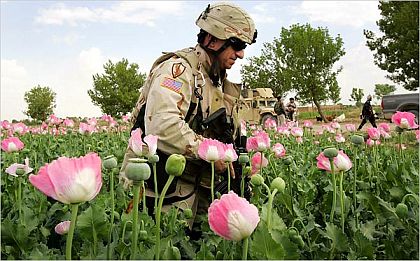
A Need for Cohesive Counter-Narcotics Policy
As has been shown with the Golden Triangle and Afghanistan, when the supply/demand is attacked in only one area, only affecting one portion of the market, the market will flexibly adapt to the situation and shift the supply/demand to another location. These shifts were due to the lack of cohesion among affected states to implement a counternarcotic policy that would prevent the market from exploiting regions not affected by that counternarcotic policy, but still affected by the market. Profitability keeps any business afloat. Whether or not the Golden Triangle or Afghanistan, or any other country, provides the supply is irrelevant: the supply and the demand will always come from somewhere as long as the profitability of providing them is there.
With so many countries playing similar roles within the market, the market has a plethora of choices to exploit if Afghanistan begins to drop its supply of illicit opiates. According to the 2010 World Drug Report:
Turning to the Americas, the average amount of opium estimated to be produced in Latin America and Mexico was around 130 mt per year until 2006. In 2008, a reported 120% increase in opium production in Mexico made it the third biggest opium producing country after Myanmar with 325 mt potentially produced in 2008. Some data also suggest that limited illicit cultivation takes place in other countries, such as Egypt and India. At the time of writing, no information was available on the quantities cultivated and produced, which, in the case of Egypt, may be negligible. Algeria reports the eradication of approximately 80,000 opium poppy plants every year, but this production appears to be limited to supplying the local market.23 Finally, there is illicit cultivation in some CIS countries. Ukraine, the Republic of Moldova and the
Russian Federation for example seem to be self-supplied for their own local market of poppy straw derivative solution (Kompot).[95]
Afghanistan was once like the above stated countries, self-supplying to the local market. Although the countries mentioned in this section are considered to be the main producing, trafficking, and consuming destinations in the Afghan heroin market, with the fall of the Golden Triangle, “Afghan heroin has started to be trafficked to all regions of the world.”[96]
Because counternarcotic policies have only recently been dealing with the demand aspect of the market, although financially speaking supply reduction is the focus of most counternarcotic policies, demand in trafficking regions has increased over the past year, establishing a new area for the demand to come from if Europe were to reduce its demand. If counternarcotic policies are to affect today’s supply of the illicit opiate market, as stated by the World Drug report, the illicit opiate market, specifically the heroin market, is ready and able to shift production sites if Afghanistan loses its place. The question becomes: if counter-narcotics policies successfully reduce the market for today, who will satisfy the roles necessary to maintain the market’s profitability and keep it afloat tomorrow? Because tomorrow’s players are just as important as today’s players in maintaining the illicit opiate market’s profitability.
III. Effects of the Market
Counternarcotic policies have been attempting to reduce or eliminate the spread of opiates since 1909.[97] Although no country has experienced the addiction rate of China,[98] many countries are experiencing things that were not present during the Chinese opium epidemic: heroin and HIV. [99] Heroin is much more addictive than opium, at times injected with contaminated needles leading to the spread of HIV, and able to result in death much quicker than opium.
Although the 2008 World Drug Report claims that the International Drug Control System has improved the situation over the past hundred years,[100] the reality is that what we are comparing to a hundred years ago is not comparable. The substances are different. Opium use is really limited to five countries.[101] The opiate business has expanded its line of products. And one of those products, heroin, is used in all seven continents, far surpassing the five countries that use opium.
The addictiveness of these new products has caused the demand to be a much more loyal clientele than what was experienced during the Chinese opium epidemic. This makes it much more difficult to eliminate, or at least significantly reduce, the demand. Iran, India, USA, and Canada, along with other countries have dramatically increased in opiate use as compared to the dramatic decrease of opiate use in all of China and Southeast Asian countries.[102] Furthermore, as discussed above, the added products to this business inevitably result in an increase of participants intertwining the involvement of more states than ever before.
The purpose of this section is to highlight the extreme severity of today’s situation by giving statistical information behind the grave consequences of not limiting the stronghold that the heroin market has on our society. Other than profitability, the effects of this market involve the spread of addiction, disease, and death. The most vulnerable have been the trafficking countries which have all shown increasing levels of HIV cases and deaths as a result of the Afghan heroin trade. The World Health Organization’s 2010 Aids report specified that in Eastern Europe and Central Asia persons who inject drugs have high HIV transmission rates that have almost tripled since 2000.[103] In fact, of the 1.8 million people who inject drugs in the Russian Federation, it is estimated that more than one third of them are living with HIV.[104] The Ukraine alone has an estimated 39%-50% of its people that inject drugs living with HIV.[105] In Central Asia, “the total number of officially registered HIV cases … has increased 19-fold in the last decade: from 1,641 cases in 2000 to 30,993 cases in late 2008.”[106]
All in all, “[a]n estimated 15.9 million [11.0 million–21.2 million] people inject drugs worldwide; of these, nearly 20%, an estimated 3 million [500 000–5.5 million] are living with HIV.”[107] However, the spread of HIV is not limited to the sharing of needles: “an estimated 35% of women living with HIV probably acquired HIV through injecting drug use, while an additional 50% were probably infected by partners who inject drugs.”[108] The Executive Director of the Afghanistan Insurgency and Crime Report said it best:
Every year, more people die from Afghan opium than any other drug in the world: perhaps 100,000 globally. The number of people who die of heroin overdoses in NATO countries per year (above 10,000) is five times higher than the total number of NATO troops killed in Afghanistan in the past 8 years, namely since the beginning of military operations there in 2001. The number of addicts in the Russian Federation has multiplied by 10 during the past 10 years, and they now consume a staggering 75-80 tons/year of Afghan heroin. More Russian people die from drugs per year (at present 30,000-40,000, according to government estimates) than the total number of Red Army soldiers killed during the Soviet invasion and the ensuing 7-year Afghan campaign. Despite major efforts to cope with drug trafficking, the Islamic Republic of Iran is swamped by Afghan opium: with its estimated 1 million opiate users, Iran faces one of the world’s most serious opiates addiction problem. Central Asia, once only a conduit for Afghan heroin, is now a major consumer- a habit that is resulting in an HIV epidemic caused by injecting drug use.[109]
For hundreds, if not thousands of years,[110] opiates have caused the spread of addiction, disease, and death.[111] The countries involved in today’s illicit opiate market tend to be underdeveloped, impoverished, war torn countries in need of licit substances to exploit. The continuation of these countries’ addiction with illicit opiates will never allow for the elimination, or at least the reduction, of the illicit opiate market, thereby continuing the spread of addiction, disease, and death, and maintaining the market’s profitability, the key to the market’s success.
IV. Conclusion
In 1998 the United Nations’ member states set a goal to “eliminate or significantly reduce” global drug supply and demand over the following 10 years.[112] In 2008, at the end of those 10 years, Member States were still “gravely concerned about the growing threat posed by the world drug problem;”[113] and rightfully so. The United Nations’ main concern, the illicit opiate market, had not been significantly reduced, let alone eliminated.[114]
Traditionally, counternarcotic policies have not been implemented by all affected states in a cohesive manner. Because of this, the market has been able to adapt to these counternarcotic policies by shifting its production area to a region that is not being affected by those counternarcotic policies. Therefore, the cultivation and production of opiates has consistently shifted from one producing region to another. Furthermore, the counternarcotic policies have traditionally been focused on supply reduction only, and not on reducing the entire market as a whole. The market’s demand, and ability to trade with that demand, has stayed consistent. And because of this, the profitability of the market has been sustained by either an increase in price due to a loss of supply and not demand, or by shifting production areas to avoid the effect of counternarcotic policies.

Alternatively, you could take secret drugs lords like the CIA out of the picture by legalising and regulating the drugs trade. But why go for simple, logical solutions when you can undermine the world though an interconnected network of drugs, oil and weapons trade?
Not that simple. To license Afghanistan for the licit manufacture of opiate pharmaceuticals, or at least the licit cultivation of poppy for other countries to manufacture those pharmaceuticals, two things would need to be done. As of now the cultivation, manufacture, export, and import of licit opiates is regulated by the International Narcotics Control Board (INCB). Afghanistan would first have to show that there is a demand for licit opiates, and second, that it could supply that demand without creating an oversupply of licit opiates. The point being, the INCB wants to make sure the medical field is supplied, but does not want an oversupply to leak into the illicit field.
Today, the INCB does not find a need for licit opiates, and instead finds an oversupply of licit opiates. Furthermore, the leading importer of licit opiates, the U.S., is contractually obligated to purchase its opiates from seven specific countries. As of now, the main argument involves having Afghanistan gain entrance into that contractual agreement with the U.S., which will not happen. And the counter-argument for that, which is why it will not happen, is that Afghanistan lacks the security for such a business venture.
Although I am stating the facts for you, based on a licit business argument, my next article will focus on Afghanistan being licensed. What should be noted, which is the main point of the above article, is that even if Afghanistan were to be licensed, that temporary fix would not have any long-term negative effect on the actual heroin market as a whole.
Thank you for your comment.
Amen to that Neo.
For further clarification, the way the system works, the United Nations, under the INCB, would have to approve this business venture. Until the correct argument is made, Afghanistan will continue to provide for the illicit market, not the licit market. And, as stated above, even if Afghanistan were to provide for the licit market, do not underestimate the potential of the heroin market to adapt to such tactics. It will, and has. Its ability to maintain profitability keeps it afloat, and such a quick fix will only affect Afghanistan, not the global market as a hole.
*whole.
Seems the sure way to make opium less profitable as a commodity have an oversupply of it. I know corn is not profitable to grow without government subsidies. There would need to be aggressive media on the dangers of heroin and super easy access to treatment along with this strategy. Heroin is not going to be a mainstream drug no matter what, the stories of it’s destructiveness are pretty much out there. A bigger problem by far is prescription opiates.
Treating drug addiction as a social problem rather than a criminal one would effectively destroy the trade.
The U.S. could start by legalizing marijuana. And medicinal marijuana would be a good substitute in many/most cases for prescription opiates. And we could go from there.
Legalizing marijuana I am likely to favor however, there would be massive economic consequences. Mexico’s main oil field is slowing down and cheap corn via NAFTA put many Mexican farmer out of work. The money from pot is a significant part of the economy there. Plus all the small time traffickers and dealers would be out of luck and keep in mind these lucrative jobs keep opening up for new people as law in enforcement takes folks out of the work force.
I fear what commercialization would do to. Industries are already great at getting people to eat loads of sugar, fat and salt and drinking alcohol. Do we really want businesses to be trying to ever increase their sales of pot while denying the real and common side effects of weight gain from increased appetite and lack of motivation? Because I can see that happening.
I don’t really see any down side to legalizing marijuana. Legalizing it in Mexico, as former President Fox just suggested doing, would help eliminate a violent black market and open up legitimate jobs. Weight gain is a dietary and exercise problem, not caused by smoking pot. and I think it’s an absolute myth that smoking pot causes people to lose their motivation. A lot of lazy people smoke pot. Pot doesn’t make them that way.
Hi Liana
This is wonderfully written.
May I suggest you research the false war on drugs when it was decided
that the CIA would let this be taken over by the new agency called DEA?
Many agents were called in 24 hours to halt their operations.
Then research the so-called drug lord Khun Sa, who was the Golden Triangle
connection. Living larger than life in the Shan mountains with three goverment’s protection. Burma Thailand and USA.
When The DEA put the heat on Burma to start the eradication of the poppy.
They did so reluctantly. There was a promise of assistance, which never came
good agents being sent back to the states, and keeping the Burmese at bay
by carrot and stick threats. While most poppy was being eradicated in accord with the USA wishes, Along comes 9-11 the mother of all wishes to come true.
Now America could get the prices up to snuff and that road from the fields to the cities back to higher yield and profits. With gangsters and drug dealers
as elected officials, and the brother of Afghan president, appointed by the USA
as a bank thief, the new world order of drugs came into play.
While American men and woman died in Afghanistan protecting what?
The career of lawyers who keep the wheel greased in drug cases in courts
through out the USA, and the public companies were building more prisons
to feed small town America’s economy, from the kids dealing on the streets
of inner cities. We were told that the poor Muslim people did not know how
to farm food? Look this is the industrial jobs complex.
First profits are from sales., then there is the Rockerfeller, lead, Methadone
program for addicts, then the 25 years to life sentences for courts and prisons
and the broken families left behind. Prisons get built. farmers sell meat
guards are hired, and you keep the wheel going. Lawyers and courts
make the wheel go round too So there will never be an honest discussion
nor termination of drug in or out of America. By us being in Afghaniland
we have allowed the poppy to yields of 4000% Its a business on one side
its the defense contract, on the other its purported to be assisting in freedom
for the poor people of Afghanistan
Peter Dale Scott’s “American War Machine” is an excellent resource on these matters.
It’s difficult to exercise any control on the narcotics trade when those doing the controlling wear both the “black” and “white” hats. They’ve set this up like they’ve set up US elections: no matter which way you vote, we’ll be led to the same sorry place: the paths look different but the Destination is the same. Speaking of, someone at FPJ may want to take a gander at the Director of National Intelligence’s Destination 2025 papers. It’s the roadmap for our future: global governance.