Middle Ground
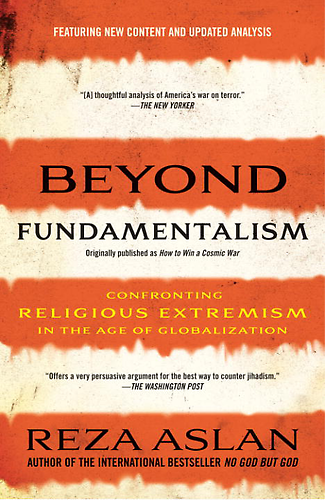
The final chapter points out some significant ideas. First is that “this was never conceived of as a war against terror per se”, otherwise it would have included a much broader range of ideological targets than just Islamic people, and a broader range of physical targets than the oil rich Middle East. Next, if this war is about winning the “hearts and minds of Muslims, there should no longer be any question that the battle has been lost.” Included in Aslan’s list of uncommon perceptions is the brief bout of democracy in 2006 in Lebanon, Palestine, Egypt, and Morocco, described as the U.S. “telling the world that the promise of peaceful political reform through democratic participation was a lie.”
Democracy is the “one issue President Bush was right [about]: only through genuine democratic reform can the appeal of extremist groups be undermined and the tide of Muslim militancy stemmed.” That includes the idea that “radical groups such as Hamas and Hezbollah must be brought into the political fold,” (and concurrently, the Taliban in Afghanistan). Aslan correctly identifies that it was not the promise of democracy, but the “retraction of the promise that led to fracturing of the Palestinians, the blockade of Gaza, the war between Hamas and Israel, and, ultimately the devastation of 1.5 Palestinian lives.
Democracy Now, Refuse to Fight
But there it stops. Aslan does not reiterate his call to “refuse to fight” the war. Nor does he provide the practical physical steps required to do so, so simple at one level – (leave) – and yet more complicated at another, to try and provide the infrastructure and support for true democracy and to accept its results in a region where the entrenched privileges of the transnational corporations tie into the privileges of the current political elites on both sides of the Atlantic. Much could be managed by reversing the manipulation of U.S. money, as has been done in supporting Israel over the years, buying the loyalty of many Arab regimes and insurgent groups over the years.
The ongoing problem of U.S. support for Israeli occupation of Palestinian territory and its brazen double standards when it comes to nuclear weapons and the intent of the Nuclear Non-proliferation Treaty in relation to Israel, Iran, India, and Pakistan (among others), is the symbolic and most significant hot spot requiring a solution before any overall attempts at democracy are able to come into play.True democracy needs to be given its due, not at the barrel of a U.S. military gunship, but from the votes of the people and the participation of all political elements in the area; it should then be . supported, even if the democratic outcome is quite different in style and outlook from what the developed countries envision. It has been seen in Ireland and South Africa – and more recently in Lebanon – that significant changes can be made in drawing together disparate groups who can at least suppress their ideological differences from a warring status to a negotiating status if outside interference and ideologically contrived interventions are avoided.
Aslan’s views in ‘Beyond Fundamentalism’ have some background weaknesses e.g. globalization, the U.S. role in jihad etc. but the specific ideas he presents about terrorism, global jihad, fundamentalism and democratic rights are sound and accurate. It is a brief work with some powerful statements, a bit sensational at times, but mostly well grounded.