
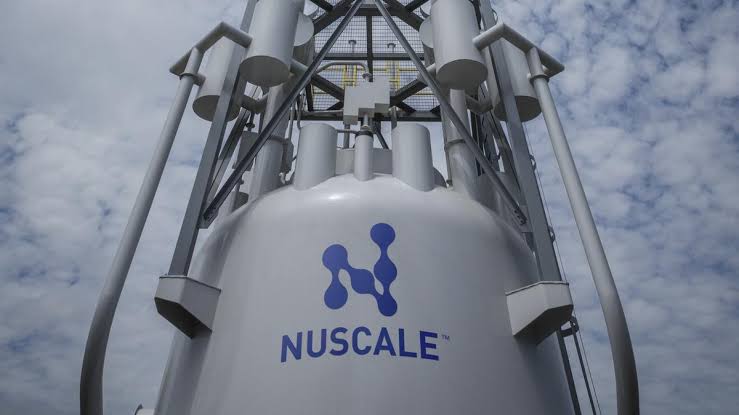
A price target implying 116 times forward sales, more than twice NuScale Power’s (NYSE: SMR) five-year average multiple, is now the most optimistic call on Wall Street for the struggling nuclear startup.
Cantor Fitzgerald trimmed its target to $15 from $20 on Friday while keeping an Overweight rating, leaving the goal still 195% above the stock’s $5.08 closing price.
That $5.08 close itself followed a 16% single-session rally driven by a third-quarter loss that came in smaller than analysts had feared.
The relief rally, however, obscures a deteriorating revenue picture that makes the path to any recovery deeply uncertain.
Quarterly revenue collapsed to just $281,000 in the third quarter, down from $8.2 million in the same period a year earlier, after engineering work tied to Romania’s RoPower project concluded.
With no new contract revenue to replace it, the company is burning roughly $65 million per quarter in operating costs against a cash and investments balance of approximately $1.9 billion.
The entire bull thesis hinges on ENTRA1, NuScale’s exclusive sales partner, finalizing a binding power purchase agreement with the Tennessee Valley Authority covering up to 6 gigawatts of capacity.
CFO Ramsey Hamady described such a deal as “a strong possibility” later in 2026 during May comments, but Barclays downgraded the stock to Underweight in October, warning that negotiations could extend into 2027.
On Thursday’s earnings call, CEO John Hopkins offered little reassurance, describing the TVA process in terms that underlined just how protracted it has become: “It’s been lengthy, we know.”
Even a signed PPA would not immediately translate into module sales, as Hamady clarified on the same call that a PPA would first generate engineering work, with actual module contracts following under a separate agreement between NuScale and ENTRA1.
Cantor analyst Derek Soderberg pressed on exactly this point, asking whether a PPA would trigger a module order, and the two-step answer he received illustrates why $15 may be premature.
Hamady noted that a module order would bring “further clarity on margins,” an acknowledgment that the company still cannot tell investors what it earns on each unit it sells.
Shareholder dilution has compounded the challenge, with Class A shares outstanding rising 29% to 410.5 million between the end of 2025 and September 30.
The broader analyst community has grown steadily more skeptical, with the average price target sliding from $41 to $11 over the year through late October, leaving Cantor’s $15 roughly 40% above the consensus and near the top of the range.
Forward revenue expectations have followed a similar trajectory, with 2027 estimates shrinking from $320.6 million to $120 million, a contraction that makes the implied sales multiple at $15 look increasingly aggressive.
A binding PPA would also trigger a substantial cash outflow before any revenue arrives, as the milestone payment owed to ENTRA1 upon signing would equal 35% of the total agreement value, more than double the first milestone payment of $507.4 million.
At a market capitalization of roughly $2.2 billion, the stock is trading close to its net cash position, which offers a floor but not a catalyst.
Until NuScale signs both a PPA and a follow-on equipment contract that establishes actual module economics, Friday’s jump looks more like a relief trade than the beginning of a sustained recovery.
