
A company reporting 93.2% year-over-year revenue growth that still trades at a forward price-to-earnings ratio of just 8.08 times is a rare combination in any market cycle.
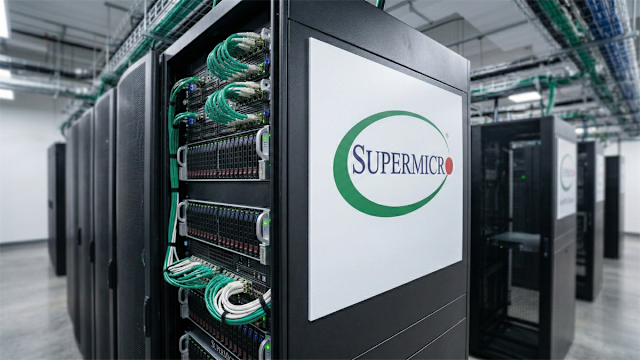
Super Micro Computer (NASDAQ: SMCI) achieved exactly that profile, landing tenth on a screened list of the cheapest AI data center stocks favored by billionaire investors.
Insider Monkey identified 23 billionaire investors holding positions in the company as of the second quarter of 2026, reflecting broad institutional conviction despite the stock’s compressed valuation.
The screen applied to U.S.-listed AI data center operators and suppliers required a positive forward P/E below 20 and quarterly revenue growth of at least 15%, criteria SMCI cleared with considerable room to spare.
Fiscal fourth-quarter sales reached $11.12 billion, up from $5.76 billion in the same period a year earlier, while GAAP diluted earnings per share climbed to $1.62 from just $0.31.
Operating cash flow for the quarter hit $747 million, and gross margin expanded sharply to 17.5% from 9.5% a year prior, with management crediting a stronger enterprise customer mix and wider adoption of its Data Center Building Block Solutions architecture.
The company sells servers and integrated systems installed inside AI data centers, and recently broadened its Open Compute Project portfolio to cover racks, power distribution, networking, and liquid cooling.
That product breadth positions Supermicro to capture a larger share of each installation’s total spend, though customer deployment schedules can still push deliveries into later quarters.
The backdrop driving demand is substantial: the International Energy Agency’s October 2026 report estimates hyperscalers will commit more than $700 billion in capital expenditure this year, directed overwhelmingly at new data center capacity.
The IEA simultaneously flags bottlenecks including constrained electricity grids, lengthy connection queues, and slow permitting processes that could delay when that spending translates into operational revenue.
Power demand alone illustrates the scale of the buildout, with the IEA’s April 2026 analysis projecting that global data center electricity consumption will roughly double from 485 terawatt-hours in 2025 to 950 terawatt-hours by 2030.
On the supply side, CBRE’s first-half 2026 report showed North American primary market capacity rising 33.7% year over year to 10,903 megawatts, yet vacancy compressed to just 1.4%.
Developers have been building aggressively and customers have been committing just as fast, with 80.4% of capacity still under construction already pre-leased according to CBRE’s data.
Average asking rents for deployments in the three-to-ten megawatt range increased 8.3% during the first half of the year, reflecting how little slack exists in the market despite record supply additions.
JLL’s 2026 Global Data Center Market Outlook projects roughly 100 gigawatts of additional capacity will be needed between now and 2030, requiring approximately $1.2 trillion in real estate investment alongside a further $1 trillion to $2 trillion in tenant equipment spending.
Construction economics are tightening as well, with JLL forecasting average shell-and-core costs of $11.3 million per megawatt in 2026, a 6% increase from 2025, before any technology fit-out is included.
AI-focused installations can require an additional equipment fit-out costing up to $25 million per megawatt, meaning the full cost of bringing a single megawatt of AI capacity online can reach multiples of the base construction figure.
For investors evaluating valuation, those cost pressures serve as a reminder that a low forward P/E is only as reliable as the earnings forecast beneath it, and margins can shift quickly when component pricing or customer mix changes.
In SMCI’s case, the most recent quarter showed margin expansion moving in the right direction, with the gross margin improvement of eight full percentage points offering evidence that the company’s product mix is becoming more profitable.
Whether that trajectory continues will depend on how quickly enterprise customers bring new AI installations online and whether Supermicro can maintain its expanded share of each data center’s equipment budget.
