
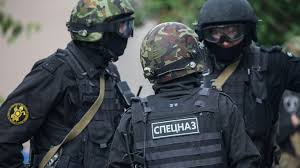
Ukrainian forces struck a Federal Security Service command post in Russian-occupied Donetsk on April 22, killing 12 FSB officers and injuring 15 others in a precision drone operation that targeted one of Russia’s primary intelligence coordination hubs in the region, according to Unmanned Systems Forces commander Robert “Madyar” Brovdi.
A series of explosions shook Donetsk at around 8 a.m. local time, with videos circulating almost immediately on social media showing what appeared to be multiple drones striking a multi-storey unfinished building that had been converted into a command facility by Russian intelligence personnel.
Ukrainian operators used FP-2 drones manufactured by domestic defence company Fire Point, a platform designed for medium-range strikes carrying a payload of between 60 and 100 kilograms, with Brovdi confirming that eight precision strikes were conducted against the target during the operation.
The mission was carried out jointly by the Unmanned Systems Forces and fighters from the 1st Corps of the Ukrainian National Guard’s Azov Brigade, a combined operation that illustrates the increasingly sophisticated coordination between Ukraine’s drone units and conventional ground forces in delivering targeted deep strikes.
The command post that was destroyed was responsible for a wide range of hostile activities inside occupied Ukrainian territory, including coordinating sabotage operations, building intelligence networks, recruiting assets, planning terrorist attacks and arson, and directing Russian proxy forces operating across the region.
Taking out a facility of this nature is strategically significant beyond the immediate casualty count, as FSB command structures of this kind serve as the connective tissue between Moscow’s intelligence directives and the covert operations that have targeted Ukrainian civilian infrastructure, local administrators, and resistance networks throughout the occupation.
The same 24-hour period saw Ukraine mount a separate but equally consequential drone campaign against Russian energy infrastructure, with the Security Service of Ukraine’s Special Operations Center striking the Gorky oil pumping station in Nizhny Novgorod Oblast overnight on April 23, damaging three oil storage tanks and igniting a fire that spread across 20,000 square metres.
An SBU source told the Kyiv Independent that more than 150 Ukrainian drones attacked Russia and the occupied Crimean Peninsula overnight, with local residents in multiple Russian regions reporting explosions, and that the damage to oil infrastructure of this type causes cascading disruption to Russia’s supply logistics, pipeline operations, refinery efficiency, and internal transportation costs.
The city of Tuapse in Russia’s Krasnodar Krai was also contending with worsening environmental conditions on April 23, three days after Ukrainian drones struck a local oil refinery on April 20, with the fire still not contained and thick smoke continuing to rise from the site as residents posted videos describing conditions in the city as nightmarish and complaining there was nothing to breathe.
Images shared by Tuapse residents showed soot deposits on streets and in private yards, pollution visible in the Black Sea, and a pall of smoke that had not dispersed for three consecutive days, giving Russians living far from the front a visceral and sustained experience of the war that official media channels have consistently sought to minimise or suppress.
In a separate development reflecting Ukraine’s ongoing effort to systematically incentivise battlefield effectiveness, Defence Minister Mykhailo Fedorov announced an expansion of the ePoints programme on April 23, a government-run system that awards military units virtual credits for confirmed destruction of Russian equipment and personnel, credits that units can then spend on weapons through the Brave1 Market government platform.
Since the beginning of 2026, military units have ordered drones, unmanned ground vehicles, and electronic warfare equipment worth 14 billion hryvnias, approximately $319 million, through the marketplace using ePoints, with more than 181,000 units of purchased equipment already delivered to the battlefield, Fedorov said, adding that 95 percent of drone units have now joined the programme.
Perhaps the most disturbing revelation from the April 23 reporting period was the disclosure by Ukraine’s Security Service that it had prevented planned attacks on two schools in Kirovohrad and Odesa oblasts, with the perpetrators being Ukrainian teenagers recruited by Russian operatives through Telegram and TikTok who had been given step-by-step instructions to blow up their schools and shoot their classmates.
The SBU confirmed two high school students had been apprehended after Russian handlers, operating entirely through social media messaging platforms, had guided the teenagers through the preparation phase of attacks that would have constituted mass casualty events targeting children inside Ukraine’s own territory, a tactic that reflects the breadth of Russia’s covert destabilisation campaign beyond the conventional battlefield.
