
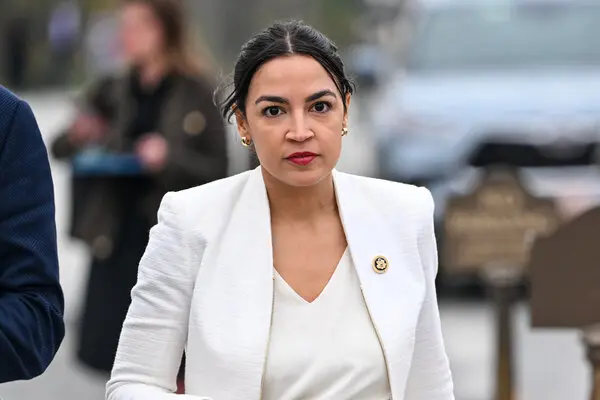
Alexandria Ocasio-Cortez on Monday became the most prominent Democratic voice to frame the allegations against FBI Director Kash Patel not as a personal conduct issue but as an active national security vulnerability, telling a reporter “absolutely” when asked whether Patel’s alleged drinking constituted a threat to the country.
Her specific argument was not simply that a senior official drinking is problematic, but that visible, public intoxication in a position with Patel’s security clearance and intelligence access creates concrete exposure to manipulation by “malign actors” — a framing designed to shift the political terrain from partisanship toward institutional risk.
The reference to the Olympic hockey celebration was deliberate: Ocasio-Cortez called it evidence that Patel conducts himself in a way that is “easily manipulated,” with the viral footage serving as documented public record rather than anonymous sourcing, making the vulnerability argument harder to dismiss as politically motivated.
Her position was echoed by Lieutenant Colonel Alexander Vindman, the impeachment witness who has since become a House member representing Virginia, who said the bipartisan jokes about Pete Hegseth and Patel comprising the administration’s “liquor cabinet” are themselves an indicator of the security problem — arguing that mockery at that level signals the issue has moved beyond rumour.
Representative Suhas Subramanyam offered a more calibrated version, telling reporters that Patel’s “incompetence is more of a national security issue than anything” — deliberately framing the drinking as secondary to the pattern of operational errors, which he described as the deeper structural problem.
Representative Pramila Jayapal noted the allegations of heavy drinking appeared to be “not a very well-kept secret” within Washington, which if accurate raises the additional question of why it was not surfaced through internal chain of command before becoming a public crisis driven by media reporting.
The Republican defence came from Representative Richard Dean McCormick of Georgia, who argued that what public officials do on their personal time is their own business and that the criticism reflects a double standard — a counter-argument that sidesteps the AOC framing entirely since her claim is not about personal choice but about intelligence access and coercive vulnerability.
