
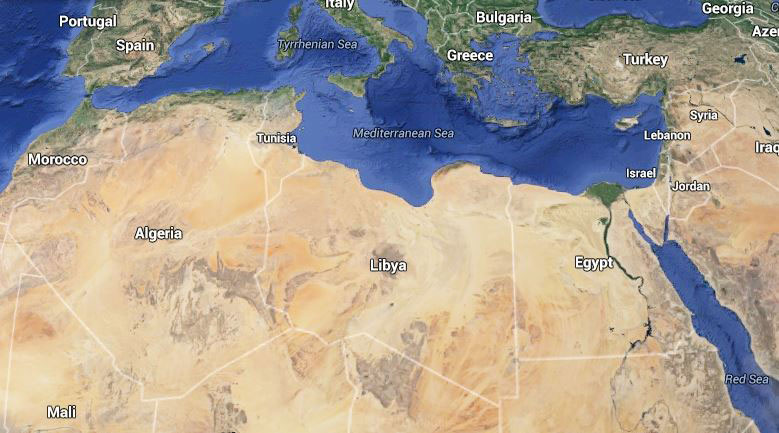
Libya’s parliament has unanimously approved a maritime agreement with Turkey, establishing a direct economic corridor between the two countries across the eastern Mediterranean.
Turkey originally negotiated the corridor with Libya’s UN-recognized Government of National Accord in western Libya back in 2019, but the deal had faced opposition from the rival eastern Libyan government.
The eastern parliament has now reversed its previous opposition, a development welcomed by Turkey’s Foreign Ministry and likely to sharpen tensions with Greece and other regional neighbors.
The agreement carves out a direct maritime corridor between Turkey’s southern coast and Libya’s northern coast, a region where enormous oil and gas deposits have recently been discovered.
Estimates suggest that natural gas reserves worth several hundred billion dollars may lie beneath the seabed, with Turkey and Libya seeking to jointly exploit those resources and secure their respective economic rights.
The planned corridor conspicuously disregards Greek islands including Crete, Karpathos and Rhodes, prompting Athens to announce its firm opposition and assert that a comprehensive exclusive economic zone surrounds each of those islands.
Greece’s Foreign Ministry posted on X that “the European Union has described the Turkish-Libyan memorandum as null and void, stressing that it violates the sovereign rights of third states and is not consistent with the Law of the Sea.”
EU High Representative for Foreign Affairs and Security Policy Kaja Kallas reinforced that position, posting on X that she “raised yesterday’s Libyan vote on a maritime MoU with Türkiye and stressed that it infringes upon the sovereign rights of third states.”
The legal dispute centers on the UN Convention on the Law of the Sea, known as UNCLOS, which Greece cites to argue that inhabited islands supporting their own economic life carry the same EEZ rights as mainland territory.
Athens has also pointed to a 2022 International Court of Justice ruling that found Colombia had violated Nicaragua’s sovereign rights by authorizing fishing in the Central American country’s EEZ, arguing that overlapping interests require fair demarcation based on coastlines and geography.
Turkey counters that granting every small Greek island a full EEZ directly off its coast would effectively cut Ankara off from open-sea access, a geographical reality it argues must weigh heavily in any boundary settlement.
Unlike Greece, Turkey has never signed UNCLOS and therefore does not recognize the jurisdiction of UN arbitration tribunals, leaving the legal dispute without a clear international resolution mechanism.
Turkey’s involvement in Libya dates to 2019, when it intervened militarily in the west to back the Tripoli government against an offensive led by eastern Libyan General Khalifa Hifter.
Turkey’s subsequent diplomatic charm offensive appears to have produced a significant rapprochement with Hifter’s camp, and Ankara now maintains mutually beneficial relations with both sides of the Libyan political divide.
Turkish construction companies have secured contracts worth billions for Libya’s reconstruction, and the Turkish state-owned oil company TPAO and the Libyan National Oil Corporation are already developing joint plans for seismic surveys off Libya’s coast.
Turkey has also positioned itself as a new military partner for Hifter’s forces, supplying weapons and training programs while pushing back against Egyptian and Russian influence in eastern Libya.
The approved agreement also threatens the EastMed pipeline, a still-planned project designed to carry natural gas from Israel and Cyprus through Greece to improve energy security across the European Union.
Turkey and Libya’s newly established corridor cuts directly across the EastMed pipeline’s planned route, and Turkey has argued that any cables or pipelines crossing its claimed continental shelf require its explicit consent.
Analysts warn the standoff could ultimately divide the eastern Mediterranean into two competing energy and defense blocs, with a Turkey-Libya axis on one side and an EU-backed alliance of Greece, Cyprus, Egypt and Israel on the other.
Tensions are expected to intensify further once Turkey and Libya move from agreement to active extraction of oil and gas from the contested maritime zone.
