
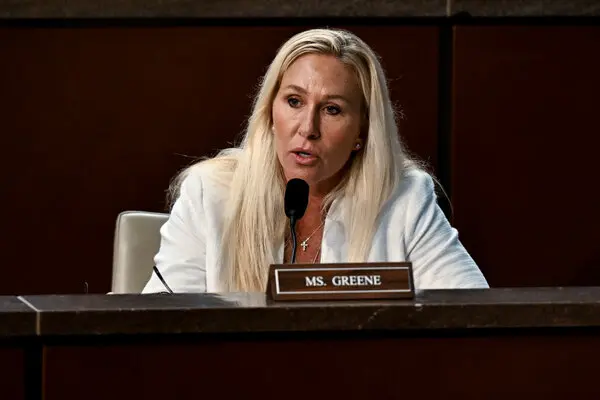
Marjorie Taylor Greene has renewed her pattern of publicly interrogating official accounts of violence connected to Donald Trump, this time turning her attention to the White House Correspondents’ Dinner shooting and asking why information about gunman Cole Tomas Allen was shared by the Trump administration almost immediately while details about the 2024 Butler, Pennsylvania, assassination attempt by Thomas Matthew Crooks remain sealed nearly two years later.
In an X post shared on Sunday April 27, Greene said she had no interest in entertaining conspiracy theories about Saturday’s incident and stated clearly that Cole Allen was a real person who really did try to kill Trump and senior administration officials, before pivoting to the core of her concern.
“Thomas Crooks is dead and actually did shoot Trump in the face (ear which is part of the face),” she wrote, “so why is all of his info/files totally sealed? It shouldn’t be.”
The framing is precise and consequential, because Greene is not claiming the Correspondents’ Dinner shooting was staged or fabricated, a distinction she appears to be drawing deliberately given how quickly conspiracy theories of precisely that kind spread across social media in the hours after the Washington Hilton incident on Saturday night.
Her concern is the asymmetry: an administration that has resisted releasing the full Crooks file for twenty-two months moved within hours to characterise Allen and share detail from his alleged manifesto, and that asymmetry is the specific inconsistency she is challenging.
She also questioned the apparent security failures that allowed Allen to get as close as he did to the ballroom while armed with a shotgun, a handgun, and multiple knives, noting that his manifesto specifically mentioned senior administration officials as targets, a detail that raises legitimate questions about threat assessment and pre-event intelligence sharing.
Greene concluded her post by arguing that those not asking questions are either blindly in a cult or want something bad to happen to Trump, neither of which she agrees with, a formulation designed to position her inquiry as the product of scepticism rather than hostility.
In an earlier post that same day, Greene had said she believed Trump would use the shooting to push Congress to pass an extension of the Foreign Intelligence Surveillance Act, giving the administration expanded surveillance powers that have been a contested legislative priority, a prediction that frames the event within a pattern of political exploitation she has accused the administration of previously.
Trump himself, asked about the conspiracy theories circulating around the dinner shooting, offered a notably relaxed response: “Usually they wait about two or three months to start saying that,” a comment that acknowledged the theories while declining to engage with them substantively, and that reads as either uncharacteristic self-deprecation or a genuine lack of awareness of how quickly the misinformation spread.
The broader social media environment around the shooting produced exactly the kind of misinformation cascade that follows any high-profile political violence incident, with users across platforms seeding doubt about the official account and suggesting the event would be exploited politically, creating a noise environment in which Greene’s more targeted and specific questions about the Crooks comparison risk being conflated with the less grounded theories circulating alongside them.
The political context that makes Greene’s intervention particularly interesting is her post-congressional positioning, where she has moved from MAGA loyalist to a figure willing to challenge Trump and his administration on specific points while maintaining that her underlying concern is transparency and accountability rather than opposition to the president himself, a balance that draws criticism from both directions and gives her a distinctive voice that continues to generate significant media attention.
