
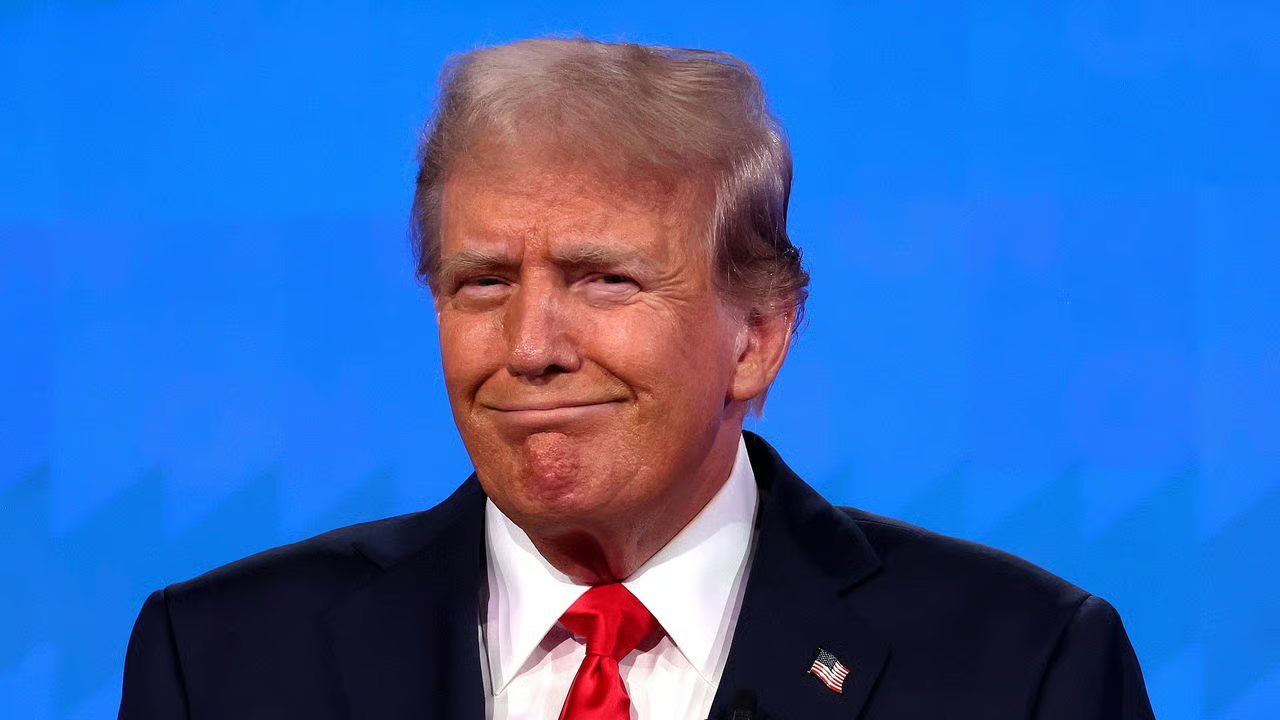
Donald Trump’s approval ratings have reached the lowest point of his two terms in office, with multiple independent polling organisations releasing data across late April 2026 that collectively show an American public growing increasingly dissatisfied with the president’s handling of the economy, the US-Iran conflict, and the cost of living pressures that have become the dominant political story of the spring and are shaping the electoral environment heading into the November midterms.
The CNBC All-America Economic Survey, which polled 1,000 people nationwide, found that 40 percent of Americans approve of Trump’s overall job performance while 58 percent disapprove, a net approval rating of negative 18 that the survey identified as the lowest ever recorded for Trump across both of his presidential terms and a 10-point deterioration from the prior quarterly reading.
On the economy specifically, the same survey recorded a 39 percent approval rate against 60 percent disapproval, a net negative 21 margin that represents the lowest economic approval figure of Trump’s combined terms and sits dramatically below the economic approval readings that characterised his first year back in office when the administration was still able to point to the momentum from the 2024 election as evidence of a public mandate for its agenda.
The CNN poll conducted by SSRS placed Trump’s economic approval even lower at 31 percent, with roughly two-thirds of Americans saying Trump’s policies have worsened economic conditions, a figure that is up 10 points since January, while approval of his handling of inflation specifically sat at just 27 percent against 44 percent one year ago, a 17-point collapse that traces almost precisely to the period when the Iran war began generating sustained energy price increases.
The AP-NORC Center for Public Affairs Research put Trump’s overall approval at 33 percent, Reuters and Ipsos measured it at 36 percent, and UMass-Amherst’s latest polling showed his approval on inflation at 24 percent, down nearly 10 points from a year earlier, creating a convergence of independent measurement around a picture of presidential unpopularity at a scale that political strategists in both parties are treating as historically significant rather than a typical mid-cycle polling fluctuation.
The central mechanism connecting the Iran war to Trump’s polling collapse is straightforward and has historical parallels: gasoline prices hovering around $4 per gallon nationally are the most immediate and visceral measure of economic dissatisfaction available to ordinary voters, and the administration’s own officials predicted prices would fall to under $3 per gallon within weeks of the war’s outbreak, a forecast that has proven comprehensively wrong seven weeks into the conflict and whose failure has left the White House’s economic messaging with almost no credibility on the issue that voters identify as most important.
A Republican respondent to the CNN poll captured the sentiment with unusual clarity, writing: “Prices! Everything is so expensive. Makes it very difficult to do anything other than work and go home. Trips to the grocery store are ridiculous! Between gas and grocery prices, we are poor!” The fact that a self-identified Republican used language that acute about economic hardship in a CNN poll is the statistical detail that most alarmed Republican campaign operatives reviewing the crosstabs.
The erosion within Trump’s own base is the data point that Democratic strategists are most focused on, with the CNBC survey finding that 60 percent of Republicans remain very firmly on the president’s side, but the CNN poll separately noting that the share of Republicans who strongly approve of Trump’s job performance has dropped from 52 percent in January to 43 percent in April, an 11-point deterioration among the voters who form the motivational foundation of Republican electoral performance and whose enthusiasm drives turnout in every House and Senate race.
Micah Roberts, the Republican pollster for the CNBC survey, offered a measured interpretation of the numbers that reflected the tension within GOP political consultancy circles, saying that a 5-point overall drop amid the war, higher inflation, and surging gas prices is not the way you want to go, but that keeping 60 percent of the Republican base very fired up represents a floor that Democrats cannot easily translate into automatic House or Senate gains without a clear alternative economic message that their own polling suggests they have yet to fully develop.
Jay Campbell, the Democratic pollster for the same survey, was less optimistic about Trump’s ability to recover, saying: “It’s hard to imagine a set of policies that could be proposed and implemented between now and Election Day that would have a material enough impact on the American people that they would say, ‘Actually this guy is doing pretty good with the economy,'” framing the polling damage as structural rather than cyclical given the time constraints before November.
The foreign policy dimensions of the polling are equally troubling for the administration, with 63 percent of Americans in the CNN survey saying Trump’s foreign policy decisions have hurt the United States’ standing in the world, up 6 points since January, and a 48 percent plurality in the CNBC survey saying they feel less safe because of the Iran war, compared to 30 percent who feel more safe, with independents aligning more closely with Democrats at 58 percent feeling less safe than with Republicans whose split runs 60 percent feeling more safe.
Americans disapprove of Trump’s handling of the Iran war by a wide margin according to the CNBC data, with majorities saying the conflict is not worth it when measured against four separate metrics: the financial cost, the gasoline price increase, regime change in Iran, and the number of casualties, a four-way negative assessment that makes the war a uniquely difficult political liability because it cannot be reframed around any single popular outcome that the administration can claim compensates for the costs being felt at the pump and the grocery store.
The generic Congressional ballot, which measures preference for Republican versus Democratic control of Congress without naming specific candidates, shows Democrats ahead by four points in the CNBC survey, unchanged from the prior reading, a figure that suggests the presidential approval decline has not yet translated into a transformative electoral shift but that also understates the structural danger to Republicans given that the 38 House members who have announced they will not seek re-election, compared to 23 Democrats, create an open-seat problem in a midterm environment where incumbency advantage is one of the most reliable predictors of electoral outcome.
Trump’s overall approval range of 33 to 40 percent across the major polling organisations, depending on the house and methodology, places him at a historical crossroads: these are levels that have preceded significant midterm losses for sitting presidents in modern electoral history, though the absence of a Democratic Party with clearly superior economic approval ratings and the partisan geographic sorting of the House map creates enough uncertainty that professional forecasters are reluctant to project anything more confident than a highly competitive environment that will be decided by candidate quality, turnout operations, and whether the macro picture improves materially before November.
