
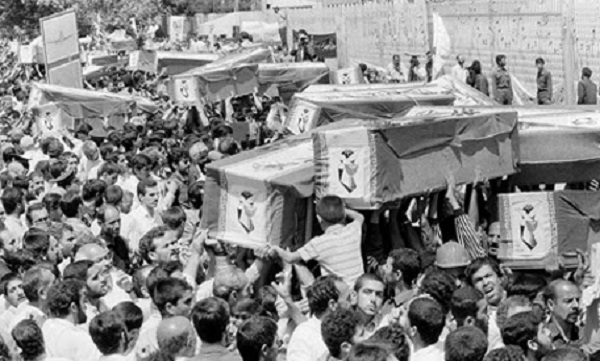
The official story was that the crew of the Vincennes mistook the massive, lumbering Airbus for a small, supersonic F-14 Tomcat making attack maneuvers. The bodies of men, women and children torn apart by American missiles and left floating in the blue waters of the Persian Gulf were simply collateral damage of a correct call to protect a Navy warship from a perceived threat.
The following day, July 4, Reagan issued a report to Congress in which he stated the USS Vincennes had been “operating in international waters of the Persian Gulf” and that following “indications that approximately a dozen Iranian small boats were congregating to attack merchant shipping, the Vincennes sent a Mark III Lamps Helicopter on investigative patrol in international airspace to assess the situation.” The helicopter, Reagan claimed, was fired upon and returned to the ship.
Reagan further declared, “The actions of U.S. forces in response to being attacked by Iranian small boats were taken in accordance with our inherent right of self-defense.” These actions included the downing of Flight 655, which, he said, was “believed to be a hostile Iranian military aircraft.”
In a press briefing on the White House lawn the same day, Reagan claimed that the Iranian airliner had been “lowering its altitude,” indicating an aggressive posture, at the time it was shot down.
The next day, the New York Times editorialized on the annihilation of the civilian airplane, stating that “while horrifying, it was nonetheless an accident,” and concluding, “The onus for avoiding such accidents in the future rests on civilian aircraft: avoid combat zones, fly high, acknowledge warnings.”
At the time, a report by Norman Solomon in Extra! revealed how the U.S. “government’s public relations spin quickly became the mass media’s: A tragic mishap had occurred in the Persian Gulf, amid puzzling behavior of the passenger jet. Blaming the victim was standard fare, as reporters focused on the plight of U.S.S. Vincennes commander Capt. Will Rodgers III, whose picture appeared on tabloid covers (7/5/88) with bold headlines: “Captain’s Anguish” (Newsday) and “Captain’s Agony” (New York Post).”
Naturally, if the Iranian military had blown up a Pan Am flight taking off from Dubai, protestations of self-defense probably wouldn’t find many sympathetic ears in the United States; fewer still would empathize with the personal trauma of murderer who gave the order.
Ten days later, on July 13, 1988, Assistant Secretary of State Richard S. Williamson continued to insist that the Vincennes was “at the time of the incident, in international waters.” The next day, speaking in defense of American actions before the United Nations Security Council, Vice President George H.W. Bush declared, “One thing is clear – that is that the USS Vincennes acted in self-defense.”
Bush also maintained that the decision to shoot down the Flight 655 “occurred in the midst of a naval attacked initiated by Iranian vessels against a neutral vessel and subsequently against the Vincennes when she came to the aid of the innocent ship in distress.”
Iran’s allegations that the warship was far too technologically advanced to make such a catastrophic mistake were dismissed by the American government. When questioned about the incident while on a presidential campaign trail the following month, Bush barked, “I will never apologize for the United States of America, ever. I don’t care what the facts are!”
Nearly all of these claims made by U.S. military and government officials about why Flight 655 was fired upon were lies, and the subsequent investigation was effectively one big cover-up, reports in Newsweek and by Nightline later revealed.
There had been no merchant vessel in distress and no helicopter was ever dispatched from the Vincennes, let alone fired upon. The warnings by Vincennes radio operators had not been broadcast to air traffic control frequencies. There had been no visual confirmation of an approaching or attacking aircraft. Iran Air Flight 655—with its nearly 300 passengers aboard—was well within its flight corridor, flying comfortably at 12,000 feet and steadily climbing. It had been in the air less than seven minutes. At the time it was hit, it was gradually turning away from where the Vincennes was located. It would have landed in Dubai about twenty minutes later. As John Barry reported in 1992:
Captain [Mohsen] Rezaian of Iran Air was calmly reporting to Bandar Abbas that he had reached his first checkpoint crossing the gulf. He heard none of the Vincennes’s warnings. His four radio bands were taken up with air-control chatter. “Have a nice day,” the tower radioed. “Thank you, good day,” replied the pilot. Thirty seconds later, the first missile blew the left wing off his aircraft.
There were other American naval vessels in the area at the time, none of which mistook the Iranian commercial airliner for a jet fighter, but were unable to act quickly enough to save Flight 655. “A few miles away, on the bridge of the Montgomery, crewmen gaped as a large wing of a commercial airliner, with an engine pod still attached, plummeted into the sea,” Barry reported. “Aboard the USS Sides, 19 miles away, Captain [David] Carlson was told that his top radar man reckoned the plane had been a commercial airliner. Carlson almost vomited, he said later.”
Vincennes commander Rogers was himself known to other naval officers as especially trigger-happy. Captain Carlson, who commanded the Sides, a frigate in the same Surface Action Group as the Vincennes, later said that the Flight 655 disaster “marked the horrifying climax to Rogers’ aggressiveness.”
According to the subsequent government review of the downing of Flight 665, and particularly its Aegis targeting system and the “complex network of radar and computers” onboard the Vincennes, TIME magazine reported that “blame fell not on the machines but on the men who were operating them.”
Nevertheless, not a single member of the crew of the Vincennes received official reprimand or opprobrium from the U.S. Navy or government. Moreover, in what can only be described as an act of staggering hubris, following the end of their deployment in 1989, all crew members aboard the Vincennes were awarded combat-action ribbons, while both Commander Rogers and Lieutenant Commander Scott Lustig, the ship’s tactical coordinator for air warfare, were specifically granted the Navy’s Legion of Merit medal for “meritorious service” and “heroic achievement.”
Rogers was honored “for exceptionally meritorious conduct in the performance of outstanding service as commanding officer… from April 1987 to May 1989,” while Lustig received his citation for his “ability to maintain his poise and confidence under fire,” enabling him to “quickly and precisely complete the firing procedure.”
Iran’s only act of retaliation or retribution for the downing of Flight 655 was bringing forth a diplomatic and legal case for responsibility and restitution. Speaking to the UN Security Council shortly after the incident and addressing the international support for Iraq against Iran, Iranian Foreign Minister Ali Akbar Velayati said:
Our people will not be able easily to forget or forgive this series of injustices, which have cost dearly in human and financial terms in the course of the continuation and expansion of the war. But the tragedy of the attack on a civilian airliner and the horrible killing of innocent children and their mothers have so much affected public opinion among our people, as well as world public opinion, that we felt obliged to bring the carnage and its causes and consequences before the judgement of the international community for the sake of humanity and to safeguard international law.
Velayati then proceeded to detail the “true and substantiated story of a painful and unfortunate tragedy,” by which he systematically debunked each and every one of the American claims regarding the events leading to the downing of Flight 655.
Vice President Bush spoke next. He accused Iran of levying “reckless, intemperate charges against my country” and spoke of the “legal right” of the United States “to help ensure the unimpeded flow of oil and to keep neutral commerce moving in the face of a very real threat to innocent shipping.” He also laid the blame for the tragedy on Iran itself, saying, “Iranian authorities failed to divert Iran Air 655 from the combat area. They allowed a civilian aircraft loaded with passengers to proceed on a path over a warship engaged in active battle. That was irresponsible and a tragic error.”
“The United States has never willfully acted to endanger innocent civilians, nor will it ever do so,” Bush insisted, and announced that the United States “will continue to defend our interests and support our friends, while remaining steadfastly neutral in the war.”
“Our naval presence is welcomed by peaceful nations,” Bush said. “It is a threat to no one.”
The International Court of Justice eventually awarded the victims of the attack $61 million in compensation for unwarranted loss of life. The U.S government has still never officially apologized to the Iranian people for this heinous crime.
Last year, the Iranian Foreign Ministry Iranian Foreign Ministry issued a statement in commemoration of the tragedy. “This inhumane crime is clear proof of the innocence of the Iranian nation,” it read, “and (provides) clear evidence that the United States is not committed to any international legal and ethical principles and norms, and (it) will remain in the historical memory of the Iranian nation.”
The Washington Post‘s Max Fisher concludes his column, writing, “Americans might not know about Flight 655. But Iranians surely do—they can hardly forget about it.”
While he—and TIME‘s Michael Crowley—should be commended for reminding (or informing) their readership about the events of July 3, 1988 and its implications today, they should also remember that telling only part of the story—and allowing American aggression, dishonesty and denial to be dismissed uncritically as an “accident”—does a great disservice to the truth.
The 290 innocent victims deserve better.
This article was originally published at at WideAsleepInAmerica.com and has been used here with permission.
