It is achieved through mass advertising. It is achieved through the self-obeisance of the major media networks who self-censor—or in reality never have to self-censor because to get along in the business means one already accepts the self-regulating criteria of the major media supporting the imperial view of the world. It is achieved through cheap entertainment, every day, every minute entertainment, much of it simply silly and ignorant, other parts sensationalistic but neither significant nor earth moving, and the important news is filtered into sound bites taken out of context, with references to ‘sources’ unknown who plant the seeds of disinformation into the news world.
The U.S. empire has been extremely successful with all this. It started with Edward Bernays, a nephew of Freud, before WWII, when he thought, along with many others, that the masses were too stupid to govern. The real government was to be the elites, and it was through the manipulation of the psyche of the masses that would allow the elites to govern and create a world over which they had control and power.
For the U.S. fear of the ‘other’ started with its origins, a country founded on the support of racial fear and prejudice. The black slaves and the indigenous populations felt the brunt of this designation as the fearful ‘other’. Through various other permutations it became fear of Bolshevism at home—fear of the unions—and their increasing power in the workplace before and after WWI. After WWII, it became fear of communism, with all its propaganda about the Soviet Union seeking world dominance when in reality it was the U.S. seeking world dominance. With the collapse of the Soviet Union, the fear factor momentarily found refuge in fear of drugs and fear of crime, waiting only for “another Pearl Harbor.”
Empirical crusades
Lo and behold, another Pearl Harbor occurred, when someone, somehow, managed to destroy the Twin Towers of the World Trade Center along with Tower Seven and with another device hitting the Pentagon. Theoretically, it was the work of Osama bin Laden and twenty or so Saudi citizens, and was greeted with announcements of a “crusade” by George Bush and questions and answers by ignorant pundits and experts answering the question, “Why do they hate us?”
A new and everlasting ‘other’ had been found, the Islamist terrorist, and because it was difficult to differentiate between a simple follower of Islam and those that are terrorists, they all became suspect terrorists.
The imperial rhetoric was ratcheted up, now about freedom and democracy and rule of law, while the very same things were being slowly eroded at home. New imperial wars were started, more millions of peoples have been displaced and killed by U.S. imperial troops and their mercenaries from NATO and private corporations. Internally, the economy has been hollowed out by this war effort, by the slow destruction of unions, by the out-sourcing of manufacturing and employment through “free trade,” by the artificially induced bubbles of technology and housing used to maintain an economy run ever more deeply on consumption financed by debt.
Empirical challenges
This violent empire has demonstrated that it is going to pass violently. It faces serious challenges on several fronts, all intertwined and related.
The first is economic. It is encumbered by its huge debt, a significant portion of which is held by its new arch rival, China, who could unload it at any moment and destroy the value of the dollar and its reserve currency status. Along with its debt, it is also pulled down by the large unemployment rates, much larger than the official version and not likely to substantially change with so many jobs transferred overseas. Interest rates are near zero, they cannot go significantly further down, and any raise in rates will only make the debt woes of the consumer and mortgage holders worse. The economy is in a trap, and the citizens are in a trap of paying off the huge bailouts received by the ‘too big to fail’ banks and financial corporations. The largest sector of the economy is now the military, with over half of discretionary spending going to the military, with the largest military budget in the world, and the main manufacturing sector highly reliant on government funding for military hardware or research.
Another aspect is resources. Much of the wealth of the U.S. came originally from its own natural resources, especially oil. As we ride along the bumpy road of peak oil, with new sources becoming much more difficult and expensive to extract, the cost of everything—food, clothing, transportation, pharmaceuticals, fertile, pesticides —will rise with the cost of oil, unless the economy dips rapidly enough that its price goes down. The U.S. is not completely reliant on outside oil, but it has to import its fair share. Its allies in Europe are completely dependent on Russian and Middle East oil, while China, India, and Brazil of the emerging economies are trying to gain and retain their own markets away from U.S. influence. Canada is attempting to be best friends by offering the toxic tar sands before the Chinese gobble it up, but the overall amount is small and will not significantly affect long term supplies and usage. Other resources—labor, agricultural, mineral—are all in critical demand as the empire extracts wealth from the Third World.
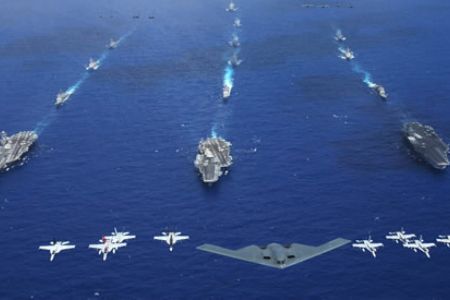
The military is another serious challenge. Even though it is the most powerful and most technologically advanced in the world, it only seems capable of creating more enemies, more people who really do hate the U.S. for what it stands for in action rather than rhetoric. The acceptance of torture, of extra judicial murder, the denial of international standards of law created at Nuremberg, at the U.N. and at the International Criminal Court, the use of drones under the control of the president to assassinate theoretical enemies, takes the empire into a moral territory where only the devil treads lightly. Apart from the judicial aspects, with over eight hundred bases in over one hundred and fifty countries, there is an obvious disconnect between the rhetoric of freedom, liberty, and rule of law when so many other countries are militarily subjugated one way or another to U.S. corporate demands.
The environment is an often unstated challenge to empire, ignored or pushed aside, not considered as an equal component of geopolitical concern. Yet it is the very nature of our consumptive society, our consumption of large amounts of carbon based fossil fuels—coal, oil, natural gas, shale oil, tar sand—that has pushed the CO2 to a recent high of 400 ppm, well over the estimated 350 ppm considered maximum to prevent runaway global climate change. The Arctic sea ice average for June 2012 is already below the record low of 2007, and while this leaves the empire hopeful for more oil and gas exploration, it also will produce large unexpected climatic outcomes.
On the other hand, the nuclear industry is exposing its true nature with the wreck of the Fukushima reactors. Deadly radiation continues to poison the land and water, and the Daishi reactor (No. 4) is on the edge of global catastrophe. With thousands of tons of used nuclear fuel spread worldwide, and no effective means of storing and controlling it long term, sooner or later another mishap will occur.
Geopolitical challenges are a summative effect of the above challenges. As the empire creates its own economic chaos, fights for control of resources, destroys the environment and continues to rely on the military as the necessary solution to its problems, the global chaos spreads accordingly. Its focus is now against recalcitrant resource countries abroad, against those trying to free themselves from dollar dominance, and at home, the police are increasingly militarized against protestors, ecologists, environmentalists, and anyone challenging the status quo of the elites.
Palestine
I first started reading the enormous amount of literature available on the U.S. empire and the Middle East when my curiosity required more information other than what seemed the obviously false, devious, or created information concerning the 9/11 attacks. I had always considered the U.S. to be an aggressor state, and understood more than most in my sphere its adventurism abroad and its poor social record internally. Still, I needed deeper analysis and began reading whatever I could on U.S. foreign policy, history and global history and current events. Superficially I knew a fair bit, but had yet to grasp the significant imperial nature of it all.
At that time, 2002-03, all the reading pointed to oil as the resource, Israel as the outpost, and Palestine as the festering wound that poisoned relationships in Israel, the whole of the Middle East, and much of the rest of the world depending on their alliances and strategic needs vis a vis Israel, the Middle East, and U.S. foreign policy—its imperial policy.
At that time the ‘peace process’ for Israel/Palestine had died although its death went unannounced for a while. Iraq was under attack, again, on trumped up charges of WMD. Afghanistan had already been demolished and then left with a small occupation force while the real target, the oil resources of Iraq and its aggressive position towards Israeli domination of Palestine, came under occupation. Russia had recovered somewhat from the disaster of allowing the west to enter the country and take off with much of its wealth, leaving behind an oligarchy that controlled the remains. The Eurozone was comfortably coasting along as another center of economic power supporting the U.S. The dot com bubble had burst, leaving behind many unemployed rich techno freaks, and the housing bubble was taking off nicely thanks to low interest rates and unscrupulous lending practices. The U.S. economy, now dependent on Chinese imports and Chinese purchases of U.S. debt, hummed along quite nicely for most. The U.S. economy had become based on financialization and China’s economy was a rising star of the global manufacturing economy.
The unease in the Middle East tended to be caused by two related factors. The first was the festering wound of Palestinian resistance, the Second Intifada having recently died out. The people the Middle East knew too well the story of Israeli occupation and subjugation of the Palestinian people. Citizens of the U.S. remained ignorant thanks to a sycophantic media, the AIPAC lobby, and a generalized amnesia of history. Accompanying this was the perceived and real hypocrisy and contradictions of U.S. foreign policy, supporting dictatorships, monarchies, and nominal puppet democracies (Egypt) while calling out for democracy and freedom.