
“At that first meeting,” he said, “there were a lot of accusations passing back and forth. The Israelis blamed the Palestinians for smuggling the drugs. The Palestinians blamed the Israelis for creating both the climate and the market for drug use. There was a lot of tension in the room.” Eventually they were able to find common ground. They agreed that the bottom line was that drugs threatened both communities, and they decided to launch a study to learn the extent and nature of the problem. Dr. Rawson, back in his office at UCLA in 2000, surfed the web and found the MERC program. With his colleagues, he submitted a proposal for a project entitled: “A Substance Abuse Monitoring System for Israeli and Palestinian Communities.”[32] Not long after the beginning of the project, the Second Intifada began. “It became increasingly impossible for the teams of researchers to meet,” Rawson told us. They had to carry on their work separately and remain in touch via email and phone. When they did convene once or twice a year it was on “neutral” ground in places such as Sharm el Sheikh. Dr. Afifi became progressively isolated in Gaza. Nevertheless he persevered, realizing that his commitment kept everyone else going.
Before joining this project, Rawson had only a passing interest in the Middle East. After becoming a participant, he traveled to Israel, Jordan, Palestine and Egypt for the first time. He started to read about drug abuse in Arab countries and learned it was a growing problem throughout the region. He believed that if the project could be expanded to include Egypt, Lebanon and Jordan, it might ease Dr. Afifi’s isolation. He applied for and received a MERC grant that included this wider circle of researchers. However, the logistics involved in bringing these people together became nightmarish. On one occasion the group met in California; three times they met in Istanbul. Nevertheless, according to Rawson, drug-abuse specialists from over twenty countries attended, including Saudi Arabia and Iran. Everyone was extremely cordial, he reported, the Israelis were well received. Following a meeting in Egypt at an especially tense moment in the conflict, Dr. Afifi was prevented for several weeks by Israeli officials from returning to Gaza. Moreover, the Egyptian doctors were pressured to cease their participation by the medical professional organization as well as by radical political groups. The mix of studying a controversial social problem and sharing results with Israelis was a volatile one.
An additional irritant came from an unexpected source. As the project unfolded, according to Rawson, the project leaders received conflicting messages from USAID. On one hand, he was continually criticized for holding meetings in third-party countries; on the other, he was rebuked for not moving the project forward fast enough. Rawson said that no one in Washington or in the USAID mission in Tel Aviv showed any understanding of what was happening “outside of their bubble.” They never attended meetings or observed the actual work in the field. When asked if there was any opportunity for him to share experiences with other participants in other MERC projects, Rawson was bemused by the question. He had no idea who others were, or what were their experiences might be in bringing about cooperation.[33]
Peace and De-development
The overriding question remains: Why was regional cooperation placed under the responsibility of an agency for development? Why were science and technology chosen to be the medium through which long-term enemies were expected to find common cause and seek out mutual understanding? And why, of all the nearly forty projects, does drug abuse study stand out as one of the very few initiatives reaching to the roots of society and offering opportunities for people-to-people exchanges among researchers, youth, and community leaders?
In 1978, when the George Washington University researchers were assigned the task of identifying modalities for post-conflict cooperation for the Middle East region, their 57-page report begins with a warning:
The difference looms large in considering the development of cooperative S[cientific] & T[echnological] relations between Israel and its neighbors…. Israel is essentially a western state, in orientation and philosophy. Egypt and Jordan are Middle East Arab States…. Israeli universities such as Hebrew University, the Weizman Institute and Technion are of world stature in science and technology; nothing comparable is to be found in Egypt or Jordan…. Israelis economically, technologically and culturally (by Western standards) [are] considerably more advanced than Egypt or Jordan. Except in isolated fields the participants will not be on an equal footing when cooperation is initiated.[34]
In fact, the very meaning of what “cooperation” meant when it came to science and technology was brought into question from the outset. The GW report noted that “in a discussion with an Israeli government official who inquired as to what the United States meant by ‘cooperation’, it was agreed that the concept of ‘reciprocal relations’ would serve well.”[35] Encouraging Israel to take the lead in delivering science and technology to its Arab neighbors was fraught with the danger of provoking the accusation that Israel was acting as a surrogate for Western colonial power. Environmentalist Claude Alvares, in a critique of the use of science as an instrument of Western colonialism, gives voice to an accusation that both Israelis and Egyptians were hoping to avoid: “…western science, an associate of colonial power, would function not any less brazenly and effectively: extending its hegemony by intimidation, propaganda, catechism and political force.”[36] Science can become toxic if it is inserted as a touchstone between two groups facing each other across a chasm of social and psychological differences. Supporting elites engaged in scientific and technological endeavors that are framed by massive development projects launched in the name of an ambiguous notion of peace — this could be a recipe for disaster.
Cong. Waxman Takes the Long View
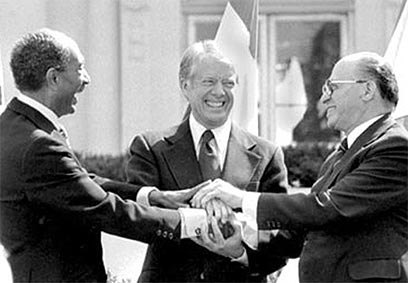
U.S. economic and military aid to Israel and Egypt remain an important platform for fulfilling the vision of the Camp David Accords, even today. But the reality is that relations between the Egyptian and Israeli people are still inhibited by a “cold peace.” Congressman Waxman says he believes that the MERC program continues to offer a much-needed forum for demonstrating the promise of Israeli-Palestinian peace. He goes on to say that he remains “hopeful that activities supported by the new people-to-people exchange program and the evolution of technology will create more informal opportunities for dialogue and understanding outside the governmental sphere…. I consider MERC one of my most creative legislative accomplishments.”[37] Mr. Waxman’s phrase “People to People” echoes the language of the 1995 Interim Agreement between Israel and the Palestinian Authority: “the two sides shall cooperate in enhancing the dialogue and relations between their peoples”.[38] Although the “people-to-people” language persists, there is still no doubt that the science and technology aspect remains paramount. MERC projects may include components such as joint Arab-Israeli educational activities or extension training, but these components are subsidiary and complementary to the technical activities of the research project.[39]
A few cross-border social programs have survived over the past decade of conflict, but none are funded by MERC program. They operate on limited budgets, funded by individuals, private foundations, international organizations and other US government bureaus. These programs have managed to keep the spirit of Oslo alive by supporting people-to-people exchanges — Seeds of Peace, Agents of Change, People to People International, Givat Haviva, and JADE, to name a few.[40] Although these programs engage youth from throughout the Middle East in workshops and other joint projects, when they have applied for MERC funding, they have been referred to other government programs.
In sum, MERC has been swallowed up by the multi-billion dollar USAID development assistance extravaganza. It is nearly impossible to discern the borders between the massive American aid program and the modest fund meant to encourage people-to-people cooperation. Moreover, there is little evidence that science and technology will succeed more than any other approach in winning the hearts and minds of the people on either side. We have little evidence that America’s effort to support cooperation has warmed to the “Cold Peace” between Israel and Egypt. In fact, it may have had the opposite effect of adding fuel to the fire of opposition, anger and resentment across the region. A nagging question arises from the mercurial record of thirty years of US intervention: Can MERC’s message of cooperation and understanding prevail, so long as it is part of an official US development program widely regarded as yet another instrument in America’s search for economic and military hegemony?
