
Beyond Egypt and Israel
In May 1993, after Oslo I, Israel and the PLO signed a mutual recognition pact; in October1994, Israel and Jordan signed a peace accord. As a result, the MERC program greatly changed. Almost immediately, research institutes in Israel and Jordan began studying two common concerns, the Dead Sea and the Red Sea. Two years into their joint effort, they partnered with the Woods Hole Oceanographic Institute by using MERC funding. The project with Woods Hole demonstrated a new pattern of cooperation using MERC funds.
In this new era, MERC was never the carrot; nor were the American institutions the catalyst for initiating collaboration between Israel and its neighbors. Rather, after 1994, MERC funding became just one more well to draw from when seeking support for collaborative projects. Over $7 billion was disbursed between 1994 and 2004 from a variety of international sources for reconstruction and rehabilitation projects in Palestine alone.[21] Over that same period, approximately $60 million of MERC money — slightly less than 1% of the whole — was used to support cooperation activities between Israel and the entire the Arab world including Palestine.
Nevertheless, MERC funding continued to play an active role in cross-border scientific activities and the program took on renewed vigor after 1994, as scientists in institutions in Jordan, Lebanon, Morocco and Tunisia joined their counterparts in Israel and Egypt in preparing proposals for MERC funding. Among these multi-lateral initiatives is the project “Basic and Applied Research in Tropical Diseases of the Middle East.”[22] Scientists from Jordan, Lebanon, Morocco, Palestine and Tunisia benefited from the research protocol and the data collected from the earlier epidemiology project initiated by Israeli, Egyptian and American researchers in the first year of MERC funding in 1979. As the program evolved into multi-lateral participation, the modalities of cooperation also changed. Several USAID project reports suggested that the Arab partners felt more comfortable coming to the larger meetings where the relative size of the Israeli presence was diminished.
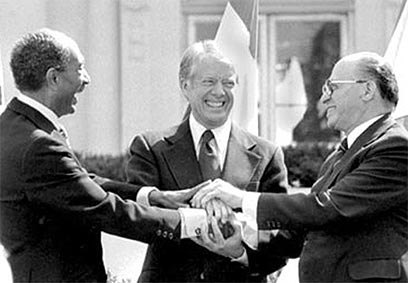
The case of cooperation between Israel and Morocco in the agricultural sphere stands out as an exception. The science produced was far more equilateral and comprehensive than the earlier Israeli-Egyptian exchanges, with both sides receiving important benefits. Israel acquired new products such as argon trees and truffles, while Morocco got new varieties of tomatoes and asparagus. News about the cooperation appeared in the Moroccan press with photos of leaders from both countries shaking hands and congratulating one another over their success. The hypothetical explanation of this difference between Morocco and other Arab states is that Morocco still has a small but important Jewish population, unlike other countries of the Middle East and North Africa, where age-old Jewish communities have disappeared. Israel, of course, has a large and important community originally from Morocco. The two countries have a long history of mutual engagement. Indeed, Morocco under former King Hassan II was an important agent of the peace process leading up to and following the Camp David Accords. Because of these pre-existing ties, both sides were eager to reconnect. USAID benefited by demonstrating an outstanding MERC success, while Israeli and Moroccan scientists were able to tap into MERC funds and move their initiatives forward.[23]
Oslo created a new set of problems for MERC. Cooperation between Israel, on the one hand and Egypt or Jordan on the other is different from cooperation between Israel and the Palestinians. Egypt and Jordan are separated from Israel by clear and undisputed borders; the two sides are able to maintain the polite and distant relationship of frosty neighbors. Academics could meet at conferences, share research protocols, carry on parallel studies and exchange occasional letters and even phone calls. They could do this without drawing attention to themselves, and often without even meeting, while benefitting from generous support funds managed by a third-party US institution.
After Oslo, Israelis and Palestinians were able to enter into similar joint projects, but without the same degree of separation. Israelis and Palestinians are not just in the same neighborhood; they claim the same floor space in a shared condominium. Scores of proposals for MERC-funded projects involving Israelis and Palestinians immediately materialized, but without the standard US referee.[24] These proposals were aimed at specific goals, best described as a long overdue effort to clean up decades of the detritus of what Johann Galtung has called “structural violence, the social and environmental destruction that people are almost inured to because it becomes routine.”[25] A good example is a cluster of projects concerning the ecological blight caused by the olive industry. One project tried to reduce the environmental impact of olive mill wastewater;[26] another created an olive mill composting system,[27] and a third controlled the spread of the olive fly (bactrocera oleae).[28] The Palestinian participants included a mix of Palestinian NGOs, the Palestinian Authority, and Hebron University. They were joined by the Israeli Technion and the Royal Scientific Society of Jordan, along with other Israeli research institutes. One major result of Oslo was the realization that Israelis and Palestinians could join forces against a common enemy: blight and pollution within their shared condominium. This cooperation strategy was conceived in the spirit of the Middle Eastern adage: “The enemy of my enemy is my friend.“
Putting MERC in Context: The “Drug Addiction Research Project”
The role that MERC has played in fostering regional cooperation must be placed in perspective. Measuring the impact of MERC projects within a changing physical and social landscape depends upon the lens that is used. Placed in the shadow of the billions of dollars of aid from other sources, MERC projects totaling just under $7 million per year are barely noticeable. Despite its relatively diminutive size, was the MERC program able to achieve some of the high-minded objectives bestowed on it by its initiators? Has MERC made a difference? Did MERC, for example, meet the goal of advancing “normalization?”
A 1998 USAID study of MERC offers a stark picture of the how the program was faring a few years after Oslo.[29] According to the report:
[T]he overall effect of scientific cooperation on peace building tends to be limited…. [O]nly relatively few scientists are apt to be involved in collaborative pursuits, even under the best of circumstances. Despite expenditures exceeding $100 million during the past two decades, the number of Israeli and Egyptian scientists who came into contact with each other has been small, not more than one hundred.[30]
On the other hand, a few scattered successes point in a more positive direction. The post-Oslo “Drug Addiction Research Project” was the first important MERC-funded social science project since the aborted “Images” project. A closer look at this initiative allows us to observe how Israelis and Palestinians came together to study a shared social problem. During some of the most trying moments in recent Israeli-Palestinian relations, Richard Isralowitz, professor in the Department of Social Work at Ben Gurion University, and Mohamed Al-Afifi, a physician in Gaza, Palestine, persisted in a program of cooperation. The issue that brought them together was a shared concern over the increasing levels of drug abuse in both their communities. Immediately after Oslo, when a brief window made it politically feasible for Israelis and Palestinians to cooperate, these two scientists joined with General Mahmoud Al-Zuhairi of the National Police of the Palestinian Authority to discuss their mutual drug problem. Drs. Isralowitz and Afifi managed to invite over fifty Israelis and Palestinians –police, social workers, and medical personnel — to a meeting in Ramallah. They also invited an American scholar, Dr. Richard Rawson, a noted authority on drug abuse, to help steer the discussion. In a recent phone interview,[31] Dr. Rawson related the story of this first meeting and how it eventually led to the unfolding of the largest social science program ever funded by MERC.
