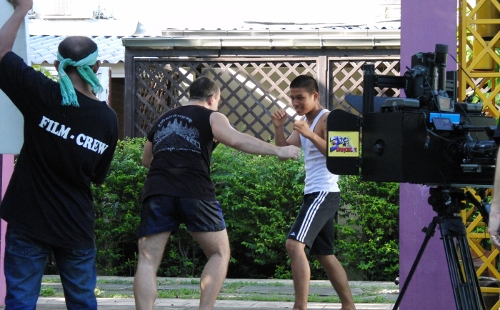
It’s a whole new art, both fighting and filming
“Action!” yelled Al, and we began hitting each other. Two seconds later, he was already yelling “Cut!” Apparently every time we moved or circled we were going out of frame. Al marked the ground where we needed to fight. After one more cut, he tightened up our fighting area. Eventually it got so small he asked us, “Can you guys just grapple?”
I wanted to do a couple of sweeps or throws, but aside from the fact that we were fighting on concrete, the only safety gear I had with me was an oral dam with a hole in it that I use for administering mouth-to-mouth resuscitation. Actually, the sweeps would have been problematic, anyway, because they would have taken us out of frame. The more we filmed, the more I realized how narrow the “in frame” area was and that it was limited not only by breadth but also by depth. Once again, this was 3D, depth TV. Getting too far away from the camera, under the camera, over the camera…left or right, we would go out of frame. But the real no-no was to be half in and half out.
The second half of the fight scene consisted of a chase across the playground and a very cool final fight on the sliding board. On the way to the sliding board, Ulysses was chasing me. He leaped onto a row of park benches, got beside me and jumped, giving me an elbow to the top of the head. I had wanted to shoot the leap from several angles, including from the ground and from bird’s eye perspective, but it just wasn’t possible.
Next, we fought on the sliding board, which worked extremely well for 3D because Ulysses leaped off the board on top of me, dropping both a knee and an elbow on me.
Al said, “We are pushing the envelope today of what has been done with 3D.”
3D really lends itself to action. Shrek was great in 3D because there was constant action with things leaping off the screen at you. “The Office” in 3D, wouldn’t be as exciting. It is an extremely funny show, but you need action to really capitalize on the 3D. So, a martial arts fight scene was perfect for 3D. BUT, there are special problems with shooting in 3D.
For one thing, as I said earlier, the camera weighs a ton. At this point in time, you can’t just pick up a 3D camera and run with it. In our fight scene there was a chase sequence. Normally the cameraman would run in front of us or behind us, but you can’t do that with 3D. The camera has to stay put.
You can move the camera to get multiple angles as you could with a 2D camera. Al says that when you are used to it, moving and re-setting the 3D camera isn’t any harder than doing the same for a 2D camera, and he was very fast. He told me, though, that you have to be really careful about how you do scene cuts.
When you cut the action and then restart, in 3D you have to make sure that the actors are in the same exact positions as they were before. This is true of good 2D filming as well, but for 3D you have to ensure that the actors are on the same relative plane. Remember the camera picks up depth. So, for example, when shooting a 2D fight scene, I can put the two actors facing each other, inches apart, but one is slightly closer to the camera to the other. When the far away guy punches, his fists will appear to go through his opponent. So the opponent reacts, and it looks like he has been hit. With 3D if we had that same layered effect, the audience would be able to see the distance between them.
In fact, in some of the better, clearer shots, the two fighters popped off the screen so well, that you felt you could pass your hand between them. If one punched and the other reacted the audience would just laugh, because you would see that the punch missed him by a mile.
3D is going to create a whole new type of scenery. It will also create a new type of fight choreography, and in the end, it will create a new type of action movie star.
And since I am one of the few who has experience, I just wanted to say, I am available for your next 3D action film.