
An Investigative Report
Then last year, after Davutoglu’s appointment, the Turkish government once again invited al-Bashir, the target of an ICC international arrest warrant. Only after a huge international outcry was the visit eventually canceled. Davutoglu, like his country, has a blind spot when it comes to genocides.
In the meantime, of course, Davutoglu’s Turkey has been busy accusing other countries — notably China and Israel — of genocide. The hypocrisy is incredible. Should not Turkey first acknowledge its own genocides against not only Armenians but also Assyrians, Greeks, and Kurds?
Now we know why some have dubbed Turkey and Sudan the “axis of genocide.”
But Davutoglu and Turkey’s failures involve much more than tantrums, threats, genocide, and hypocrisy.
Davutoglu’s Other Failures
Despite Turkey’s so-called “zero problems with neighbors” policy, Davutoglu has largely continued, not “catalyzed,” his country’s failed policies.
For example, there is no end in sight to Turkey’s 36-year long military occupation of northern Cyprus. “Zero problems with neighbors”?
Turkey’s alleged rapprochement last year with Armenia, which Turkey has blockaded since 1993, also disproves the WWC’s assertions about Davutoglu. When he negotiated and signed a set of controversial protocols with Armenia last year, Turkey said that these would open a new chapter with its eastern neighbor.
Both countries’ parliaments were then supposed to quickly ratify the protocols.
Though many Armenians believe that parts of the protocols are contrary to Armenia’s interests, the Armenian Parliament has been ready to ratify them.
Davutoglu, however, quickly reverted to his government’s old precondition: Turkey would neither ratify the protocols nor open its border with Armenia unless Armenians concluded an agreement with Azerbaijan regarding Karabagh, the Armenian region that Stalin handed to Soviet Azerbaijan and which declared independence from Azerbaijan in 1991.
Turkey’s backpedaling was condemned by the parties that mediated the protocols — the U.S., Russia, and Switzerland — as well as the European Union. Due to Davutoglu’s duplicity, the protocols have stalled and may die. “Zero problems with neighbors”?
And regardless of one’s views on American policy towards Iran and Israel, it is known that Turkey’s overheated, undiplomatic rhetoric is designed primarily to please a Muslim audience at home and in the Middle East. Turkey’s intemperate language has simply poured oil on fires and complicated American efforts in the region.
Turkey’s Kurdish problems, both within the country and across the border in Iraq, remain unsolved. Raids into northern Iraq by Turkish troops are not a solution.
Even Turkey’s offers to “mediate” regional disputes look rather contrived given that Turkey has not faced many of its own problems with neighbors.
“Zero problems with neighbors” is a hollow catchphrase. A more accurate name would be Turkey’s longstanding “zero Armenians as neighbors” policy.
Aside, perhaps, from improved Turkish relations with Syria, and a lot of braggadocio and spin, Davutoglu has “catalyzed” essentially nothing for the better. He is surely grateful, though, to Lee Hamilton and the WWC for implying otherwise.
Let us now examine President Woodrow Wilson’s record to see how the WWC has besmirched his name and violated its Congressional mandate.
Desecrating Wilson’s Ideals and Concerns
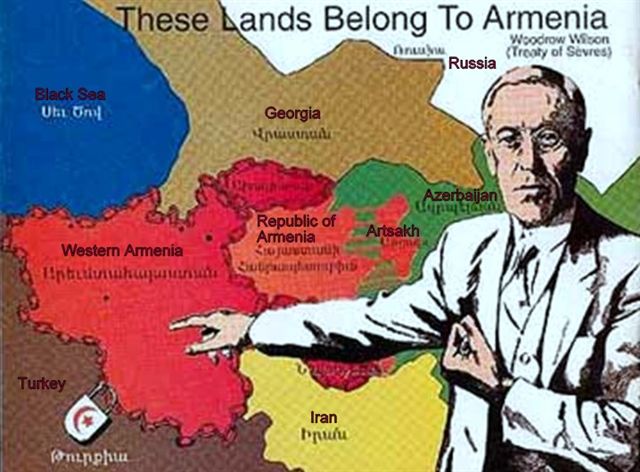
President Wilson advocated the right to self-determination of all the nations, particularly Armenia, which suffered under Turkey’s corrupt, violent yoke.
His and America’s support for Armenians — politically, financially, and verbally — was immense and is well-documented. Yet the WWC chooses to desecrate that record by honoring a Turkish official who denies the Armenian genocide, threatens the American people, plays games with the protocols it signed with Armenia, and continues to blockade Armenia.
Wilson enunciated his famous Fourteen Points, based on a just peace, in 1918, before the end of WW I. Point Twelve left no room for doubt: The non-Turkish “nationalities which are now under Turkish rule should be assured an undoubted security of life and an absolutely unmolested opportunity of autonomous development.” He was referring to Armenians, Arabs, Assyrians, Greeks, Kurds, and others.
Unlike the proposed award to Davutoglu, Wilson’s was well-deserved: He received the Nobel Peace Prize of 1919 because of his Fourteen Points and his advocacy of the League of Nations.
Reporting to Wilson during the genocide was his good friend and ambassador to Turkey, Henry Morgenthau, Sr. The ambassador cabled Washington in 1915 that Turkey was engaged in a “campaign of race extermination” against Armenians. The American Embassy served as a channel for Armenian massacre reports arriving from various parts of the Turkish empire. U.S. Consul Leslie A. Davis, who actually witnessed the genocide in the interior, wrote, “I do not believe there has ever been a massacre in the history of the world so general and thorough.”
At Wilson’s direction, Morgenthau gave to Turkish leaders the British-French-Russian declaration of 1915 that dealt specifically with the Armenian mass murders. “All members of the Ottoman Government and those of its agents who are implicated in such massacres,” read the declaration, will be held “personally responsible” for “the new crimes of Turkey.”
By proposing to honor a genocide denier, the WWC’s Lee Hamilton is implying that Ambassador Morgenthau and American consuls were liars.
This article is a cheap fabrication and total lie.
Shame on “children of genocide” for committing crimes in Garabagh. Don’t forget that 4 UN Security Council resolutions demanding withdrawal of Armenian troops from occupied territories of Azerbaijan are yet to be imposed on criminal “children of genocide”.
There is no lie in this article. The proof is that you could not point to a single one, insted you brought a lie yourseft with an unrelated subject. You know that Gharabakh war is started by azeries with massacring and ethincly cleanising of it’s unarmed and innosant Armenian population from azerbaijan’s major cities, in response of legal and peasfull demonstrations in Gharabagh.
Azeri opposition forces even massacred their own peaple in Khojalli, to blame Armenians. This was reported by several jurnalist including an Azeri jurnalists.
The Czech journalist Jana Mazalova, who by an oversight of the Azerbaijanis was included in both of the groups of press representatives to be shown the bodies mutilated by “the Armenians”, noted a substantial difference in the two cases. When she went to the scene immediately after the events, Mazalova did not see any traces of barbarous treatment of the bodies. Yet a couple of days later the journalists were shown disfigured bodies already “prepared” for taping.
Great article Mr. David Boyajian,
I’m sure it will make Turkish deniers, Turkish Government, lobbyists, and Corporations with money interests upset. Washington DC is rotten to the core it will take a bloody revolution to bring back the moral decency of the people of our Country. Nothing less then a bloody revolution.
Best we can do is to keep writing to to make transparent what these people do to desecrate our President Woodrow Wilson’s name.
Shame on these Turkish boot kissers, they don’t represent America.
The following excerpts may be help the world opinion understand the psychological aspects of the Armenian issue which depends on advocating the thesis of genocide and urging politicians to accept it:
1)‘To complain bitterly about our bad luck, and to seek external causes for our misfortune, that is one of the main aspects of our national psychology from which, of course, the Dashnagzoutiun is not free. One might think we found a spiritual consolidation in the conviction that the Russians behaved villainously towards us
(later it would be the turn of the French, the Americans, the British, the Georgians, Bolsheviks –the whole world- to be so blamed)!’
( From the book ‘Dashnagtzoutiun has Nothing to do Anymore’ by Hovhannes Katchaznouni, Bucarest 1923. Kaynak Yayınları, İstanbul. S. 37). ( Hovhannes Katchaznouni was the first prime minister of Armenia and chief of Dashnagtzoutiun Party):
2) ‘The French helped the Cilician Armenians (Cilicia is a region in Southern Anatolia) return their homes after they had been relocated in 1915’.
‘The Armenians who returned their homes (therefore, unlike it is proposed by the Armenians, they were not massacred) fought in French Army, being promised an independent state in Cilicia’.
‘However, when the French government signed the Treaty of Ankara with Mustafa Kemal (Atatuk) government, these Armenians were very dissappointeda and they started to hold anti French campaigns and vehemently CLAIMED THAT THE FRENCH MASSACRED THE ARMENIANS IN CILICIA’
(US ARCHIVES NARA, 860 J.00/1)
3) A letter of The American Committe for Armenian Independence to the Foreign Affairs of America, dated November 4, 1920, stated that the French punished the Armenians since the Sevres Agreement; so the only friend of the Armenians was America, so they demanded help of America.
4) ‘…..and later there followed the rude awakening. The Senate of the US refused to accept mandate’.
From the book ‘Dashnagtzoutiun has Nothing to do Anymore’ by Hovhannes Katchaznouni, Bucarest 1923. Kaynak Yayınları, İstanbul. p.70)
The Armenian issue has long been plagued with nationalist studies. This has led to an inconsistent history that ignores the time-tested principles of historical research. Yet when the histories of Turks and Armenians are approached with the normal tools of history a logical and consistent account results. “Let the historians decide” is a call for historical study like any other historical study, one that looks at all the facts, studies all the opinions, applies historical principles and comes to logical conclusions.
Historians first ask the most basic question. “Was there an Armenia?” Was there a region within the Ottoman Empire where Armenians were a compact majority that might rightfully demand their own state?
To find the answer, historians look to government statistics for population figures, especially to archival statistics, because governments seldom deliberately lie to themselves. They want to know their populations so they can understand them, watch them, conscript them, and, most importantly to a government, tax them. The Ottomans were no different than any other government in this situation. Like other governments they made mistakes, particularly in under-counting women and children. However, this can be corrected using statistical methods. What results is the most accurate possible picture of the number of Ottoman Armenians. By the beginning of World War I Armenians made up only 17 percent of the area they claimed as ” Ottoman Armenia,” the so called “Six Vilayets.” Judging by population figures, there was no Ottoman Armenia. In fact if all the Armenians in the world had come to Eastern Anatolia, they still would not have been a majority there.(http://www.tallarmeniantale.com/mccarthy-historian-decide.htm)
How come every Turkey article on this site is written by an Armenian? That’s like having Israelis write about Palestine…you’re not going to get a fair representation. The genocide now taking place in Sudan?!?! You might want to visit/research the Darfur conflict more before you you try to use it as supporting evidence for your argument about Turkey’s “genocidal” tendencies….if you did you’d realize how stupid you sound. Does freelance journalist mean you weren’t good enough to get a job anywhere? Woodrow Wilson…the president that introduced the first draft since the Civil War and got America into WWI, enabled the sinking of the Lusitania, encouraged segregation at the federal level, established the War Industries Board and passed the Federal Reserve Act behind Congress’ back, established the League of Nations and couldnt get his nation to join, helped broker the Treaty of Versailles which ultimately led to Hitlers rise and WWII, occupied Haiti, Nicaragua, and the DR? Thats the man whose “ideals” you choose to get upset about? To point out everything wrong with your article would require way more space than I have here so let me end with some advice. Go read a book.
Thank you DK and sebnem for the reference materials
Tayeb,
Quite ironic that you bring up Darfur. After all the Primie Minster Erdogan said “Because a Muslime couldn’t do such things. A Muslim could not commit genocide” in reference to Darfur. Hmm do I sense a pattern here? Ahh I got it–it’s denial!!! 2 million died in Darfur and Erdogan instead of realizing it happened utters the aforementioned nonsensical statement while at the same time backing the OIC claim “its an attack on Islam.” What is really appalling is immediately following the Armenian genocide was TWO MORE genocides targeting the Greeks and Assyrians adding from 500,000 to 800,000 to the body count. Ahh another pattern–they were almost all Christians!!! Now when look at the history of the Ottaman empires continual actions aimed at trying to conquer Europe the proponderance of evidence seems to indicate a pattern of this happening before(you might also want to add to the list the millions enslaved as well.) So deny deny and then deflect with the canard of moral equivalence all you want but the fact remains over 2 million died at the hands of the Turks during the early 1900’s.
If you want some research on this view this site: http://www.hawaii.edu/powerkills/SOD.CHAP5.HTM
Thx
Bill
Tayeb, the reason why no articles about Turkey written by a Turk have been published here is because no Turk has submitted any article about Turkey.
1.
Armenian propagandists have claimed that the Turks mistreated non-Muslims, and in particular Armenians, throughout history in order to provide support for their claims of “Genocide” against the Ottoman Empire, since it would otherwise be difficult for them to explain how the Turks, who had lived side by side with the Armenians in peace for some 600 years, suddenly rose up to massacre them all. The Armenians moreover, have tried to interpret Turkish rule in terms of a constant struggle between Christianity and Islam, thus to assure belief in whatever they say about the Turks on the part of the modern Christian world.
The evidence of history overwhelmingly denies these claims. We already have seen that the contemporary Armenian historians themselves related how the Armenians of Byzantium welcomed the Seljuk conquest with celebrations and thanksgivings to God for having rescued them from Byzantine oppression. The Seljuks gave protection to an Armenian Church, which the Byzantines had been trying to destroy. They abolished the oppressive taxes which the Byzantines had imposed on the Armenian churches, monasteries and priests, and in fact exempted such religious institutions from all taxes.
The Armenian spiritual leaders in fact went to Seljuk Sultan Melikshah to thank him for this protection. The Armenian historian Mathias of Edessa relates that,
“Melikshah’s heart is full of affection and good will for Christians; he has treated the sons of Jesus Christ very well, and he has given the Armenian people affluence, peace, and happiness.”
After the death of the Seljuk Sultan Kilich Arslan, the same historian wrote,
“Kilich Arslan’s death has driven Christians into mourning since he was a charitable person of high character. “
2.
How well the Seljuk Turks treated the Armenians is shown by the fact that some Armenian noble families like the Tashirk family accepted Islam of their own free will and joined the Turks in fighting Byzantium.
Turkish tradition and Muslim law dictated that non-Muslims should be well treated in Turkish and Muslim empires. The conquering Turks therefore made agreements with their non-Muslim subjects by which the latter accepted the status of zhimmi, agreeing to keep order and pay taxes in return for protection of their rights and traditions. People from different religions were treated with an unprecedented tolerance which was reflected into the philosophies based on good will and human values cherished by great philosophers in this era such as Yunus Emre and Mevlana Celaleddin Rumi who are well-known in the Islamic world with their benevolent mottoes such as having the same view for all 72 different nations” and “you will be welcome whoever you are, and whatever you believe in”. This was in stark contrast to the terrible treatment which Christian rulers and conquerors often have meted out to Christians of other sects, let alone non-Christians .such as Muslims and Jews, as for example the Byzantine persecution of the Armenian Gregorians, Venetian persecution of the Greek Orthodox inhabitants of the Morea and the Aegean islands, and Hungarian persecution of the Bogomils.
The establishment and expansion of the Ottoman Empire, and in particular the destruction of Byzantium following Fatih Mehmed’s conquest of Istanbul in 1453 opened a new era of religious, political, social, economic and cultural prosperity for the Armenians as well as the other non-Muslim and Muslim peoples of the new state. The very first Ottoman ruler, Osman Bey (1300 -1326), permitted the Armenians to establish their first religious center in western Anatolia, at Kutahya, to protect them from Byzantine oppression. This center subsequently was moved, along with the Ottoman capital, first to Bursa in 1326 and then to Istanbul in 1461, with Fatih Mehmet issuing a ferman definitively establishing the Armenian Patriarchate there under Patriarch Hovakim and his successors. As a result, thousands of Armenians emigrated to Istanbul from Iran, the Caucasus, eastern and central Anatolia, the Balkans and the Crimea, not because of force or persecution, but because the great Ottoman conqueror had made his empire into a true center of Armenian life. The Armenian community and church thus expanded and prospered as parts of the expansion and prosperity of the Ottoman Empire.
3.
The Gregorian Armenians of the Ottoman Empire, like the other major religious groups, were organized into millet communities under their own religious leaders. Thus the ferman issued by Fatih Mehmet establishing the Armenian Patriarchate of Istanbul specified that the Patriarch was not only the religious leader of the Armenians, but also their secular leader. The Armenians had the same rights as Muslims, but they also had certain special privileges, most important among which was exemption from military service. Armenians and other non-Muslims generally paid the same taxes as Muslims, with the exception of the Poll Tax (Harach or Jizye), which was imposed on them in place of the state taxes based particularly on Muslim religious law, the Alms Tax (Zakat) and the Tithe (�t�r), from which non-Muslims were exempted. The Armenian millet religious leaders themselves assessed and collected the Poll Taxes from their followers and turned the collections over to the Treasury officials of the state.
The Armenians were allowed to establish religious foundations (vakif) to provide financial support for their religious, cultural, educational and charity activities, and when needed the Ottoman state treasury gave additional financial assistance to the Armenian institutions which carried out these activities as well as to the Armenian Patriarchate itself. These Armenian foundations remain in operation to the present day in the Turkish Republic, providing substantial financial support to the operations of the Armenian church.
By Ottoman law all Christian subjects who were not Greek Orthodox were included in the Armenian Gregorian millet. Thus the Paulicians and Yakubites in Anatolia as well as the Bogomils and Gypsies in the Balkans were counted as Armenians, leading to substantial disputes in later times as to the total number of Armenians actually living in the Empire.
4.
The Armenian community expanded and prospered as a result of the freedom granted by the sultans. At the same time Armenians shared, and contributed to, the Turkish-Ottoman culture and ways of life and government to such an extent that they earned the particular trust and confidence of the sultans over the centuries, gaining the attribute “the loyal millet”. Ottoman Armenians became extremely wealthy bankers, merchants, and industrialists, while many at the same time rose to high positions in governmental service. In the 19th century, for example, twenty-nine Armenians achieved the highest governmental rank of Pasha. There were twenty-two Armenian ministers, including the Ministers of Foreign Affairs, Finance, Trade and Post, with other Armenians making major contributions to the departments concerned with agriculture, economic development, and the census. There also were thirty-three Armenian representatives appointed and elected to the Parliaments formed after 1826, seven ambassadors, eleven consul-generals and consuls, eleven university professors, and forty-one other officials of high rank.
Over the centuries Armenians also made major contributions to Ottoman Turkish art, culture and music, producing many artists of first rank who are objects of praise and sources of pride for Turks as well as Armenians in Turkey. The first Armenian printing press was established in the Ottoman Empire in the 16th century.
Thus the Armenians and Turks, and all the various races of the Empire lived in peace and mutual trust over the centuries, with no serious complaints being made against the Ottoman system or administration which made such a situation possible. It is true that, from time to time, internal difficulties did arise within some of the individual millets. Within the Armenian millet disputes arose over the election of the patriarch between the “native” Armenians, who had come to Istanbul from Anatolia and the Crimea, and those called “eastern” or “foreign” Armenians, who came from Iran and the Caucasus. These groups often complained against each other to the Ottomans, trying to gain governmental support for their own candidates and interests, and at the same time complaining about the Ottomans whenever the decisions went against them, despite the long-standing Ottoman insistence on maintaining strict neutrality between the groups. The gradual triumph of the “easterners” led to the appointment of non-religious individuals as Patriarchs, to corruption and misrule within the Armenian millet, and to bloody clashes among conflicting political groups, against which the Ottomans were forced to intervene to prevent the Armenians from annihilating each other.
5.
These internal disputes, as well as the general decline of religious standards within the Gregorian millet led many Armenians to accept the teachings of foreign Catholic and Protestant missionaries sent into the Empire during the 19th century, causing the creation of separate millets for them later in the century. The Armenian Gregorian leaders asked the Ottoman government to intervene and prevent such conversions, but the Ottomans refrained from doing so on the grounds that it was an internal problem which had to be dealt with by the millet and not the state. Bloody clashes followed, with the Gregorian patriarchs Chuhajian and Tahtajian going so far to excommunicate and banish all Armenian protestants. Later on, serious clashes also emerged among the Armenian Catholics as to the nature of their relationship with the Pope, with the latter excommunicating all those who did not accept his supremacy, forcing the Ottomans finally to intervene and reconcile the two Catholic groups in 1888.
The freedom granted and the great tolerance shown by the Ottomans to non-Muslims was so well known throughout Europe that the empire of the sultans became a major place of refuge for those fleeing from religious and political persecution. Starting with the thousands of Jews who fled from persecution in Spain following its re-conquest in 1492, Jews fled to the Ottoman Empire from the regular pogroms to which they were subjected in Central and East Europe and Russia. Catholics and Protestants likewise fled to the Ottoman Empire, often entering the service of the sultans and making major contributions to Ottoman military and governmental life. Many of the political refugees from the reaction that followed the 1848 revolutions in Europe also fled for protection to the Ottoman Empire.
6.
The claims that the Ottomans misruled non-Muslims in general and the Armenians in particular thus are disproved by history, as attested by major western historians, from the Armenians Asoghik and Mathias to Voltaire, Lamartine, Claude Farr�re, Pierre Loti, Nogu�res Ilone Caetani, Philip Marshall Brown, Michelet, Sir Charles Wilson, Politis, Arnold, Bronsart, Roux, Grousset Edgar Granville Garnier, Toynbee, Bernard Lewis, Shaw, Price, Lewis Thomas, Bombaci and others, some of whom could certainly not be labelled as pro-turkish. To cite but a few of them:
Voltaire:
“The great Turk is governing in peace twenty nations from different religions. Turks have taught to Christians how to be moderate in peace and gentle in victory. ”
Philip Marshall Brown
“Despite the great victory they won, Turks have generously granted to the people in the conquered regions the right to administer themselves according to their own rules and traditions. ”
Politis who was the Foreign Minister in the Greek Government led by Prime Minister Venizelos:
“The rights and interests of the Greeks in Turkey could not be better protected by any other power but the Turks. ”
J. W. Arnold:
“It is an undeniable historic fact that the Turkish armies have never interfered in the religious and cultural affairs in the areas they conquered. ”
German General Bronsart:
“Unless they are forced, Turks are the world’s most tolerant people towards those of other religions. ”
Even when Napoleon Bonaparte sought to stir a revolt among the Armenian Catholics of Palestine and Syria to support his invasion in 1798 -1799, his Ambassador in Istanbul General Sebastiani replied that “The Armenians are so content with their lives here that this is impossible.”
http://www.historyoftruth.com/questions-and-answers
Thank you, Mr. Boyajian, for a well-researched investigative report that should outrage anyone who believes in truth, justice and democracy. Anyone who is justifiably outraged is encouraged to contact his/her senators and congressmen to call for an investigation of the financial records of the Woodrow Wilson Center.
I see that this web site censored my (an Armenian’s) factual post that contained not a hint of anger or spite.
Thanks for nothing.
Carol, if you posted a comment that did not get through, it was due to the automatic spam filter, not censorship.
DK you comments are off the subject (Armenian genocide), and predate the relevant era in question.
Your attempt to refute Mr. Boyajian’s article failed.
Give it another try.
Please go to http://www.Armenian-Genocide.org and then click on International Affirmations and other links.
You will see more proof of the Armenian genocide than you ever wanted to know.
What really burns me up is that this Woodrow Wilson center is funded by taxpayers.
I also am ticked off that the Smithsonian is a member of the American Turkish Council. I read about that group in Vanity Fair a few years back, and I know it’s associated with Mark Grossman and lots of stuff that is not very good.
Also I found these two revealing things.
http://www.amconmag.com/article/2008/jan/28/00012/
http://forum.prisonplanet.com/index.php?topic=136361.0
How do they get away with this stuff?
Carol,
I bet the Smithsonian has airport hangers full of artifacts from Native American Indians that was also GENOCIDE perpetrated by the US Government!
The ANCA has prepared an action alert. All you need to do is fill it out and they will send it to your legislator:
http://www.capwiz.com/anca/issues/alert/?alertid=15045776
The points David Boyajian makes to cancel the WWC Award to Turkish Foreign Minister Ahmet Davutoglu are all valid. Turkey, the so-called ally of the US, is following a policy diametrically opposed to US policy and moral stand. Turkey is responsible for the frozen Armenia-Turkey Protocols, as US and European nations have stated; Turkey is an enabler of Sudan’s genocidier government; Turkey continues its blockade of Armenia, despite international law condemning such action; Turkey has launched an anti-Israel campaign in the Moslem world in an attempt to become its leader as in the bad old days of the Ottoman sultans and caliphs; the Turkish army continues its illegal occupation of northern Cyprus; Turkey continues its harassment and persecution of Kurds in Turkey and in Iraq; Turkey announces that it will move its main air-defense network from the Istanbul area to the border with Syria to “defend” the latter from Israeli “aggression”; Turkey is led by a fundamentalist Moslem leader and government whose credo is anti-ethical to US policies, interests, beliefs; Turkey continues to deny the Genocide of Armenians, although genocide scholars, including the membership of the International Association of Genocide Scholars, have denounced Turkey’s denialist policies. It’s surreal that a US organization subsidized by taxpayers and named after President Woodrow Wilson–a friend of the Armenian people in their struggle against Turkey–would honor the same self government’s foreign minister in the name of that president.
Finally, the mainstream media and blogging world has begun covering (in the 11th hour when it was too late to stop it) the Wilson Center’s award to Davutoglu. And what does the press do? The story is presented through an Israeli-filtered lens. ANY mention of Armenians, Assyrians and Greeks (can you find them in the links below?) seems incidental.
What US citizens and journalists can do now is call on Congress to investigate the WWC’s misuse of US taxpayer funds and insist on the WWC establishing a principled program on genocide without interference from its corporate and Turkish sponsors who would like to see otherwise.
http://corner.nationalreview.com/post/?q=ZjMwOTU0ZTQzM2ZjODkwMDRhOTQxMDI…
http://corner.nationalreview.com/post/?q=ZjI2ODkwZGY3YzRkZjU1Mzg5YTljOWI…
http://www.politico.com/news/stories/0610/38672.html