
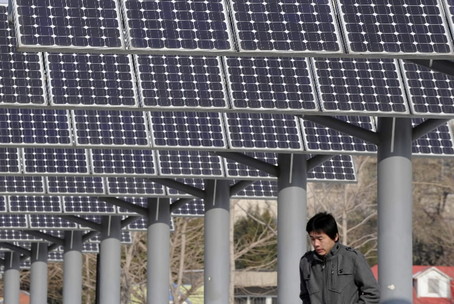
Why China is leading the green revolution and taking the rest of the world with it.
Looking Beyond the Transparency Issue
Copenhagen was a recent testament to China’s ongoing reluctance to risk losing its power over information by becoming more transparent. But transparency issues aside, prioritizing economic transformation has worked for the Chinese government. “One of the benefits of a strong government,” a Shanghai native and employee of a Swiss company operating in China explained to me over lunch at the Royal Meridian Hotel, “is that things just get done.”
And get done they do. A major success story of the Chinese government is their urban infrastructure. Immaculate, wide roads and an extensive subway system have emerged in a matter of a few decades, making the gravelly dirt roads and unwieldy railways of Mumbai, for instance, pale in comparison. Of course, Beijing had the Olympics and Shanghai, the upcoming Shanghai Expo, for which the two major cities have undergone makeovers to impress tourists and investors.
Regardless, the essence of the debate over China – and thus US foreign policy towards China – is whether the questions over transparency and censorship will at some point become an obstacle instead of a facilitator for its growth. In China, rapid economic growth has alleviated poverty but also increased social inequality over the past decades. Yet slums are few in the major cities and social protests are stifled far too quickly to mar the carefully upheld image of Chinese stability.
China’s growth cannot be unbounded and the next few years will reveal whether or not concerns over China’s potentially bubble economy are justified. Still, those in the green sector may have a more tempered perspective toward long-term investment in China, like an American lawyer and vice president of a medium-sized solar company in Shanghai with whom I spoke, who foresees himself staying in China for the rest of his professional career. For, beyond the low production costs, China has state-driven incentives, motivated by long-term concerns like reducing the dangerously pervasive air pollution and securing energy for the wellbeing of its citizens, which promise to nurture a strong market in green energy.
Next Steps: Sino-US Cooperation
A doctoral candidate, Fuzuo Wu, at Fudan University’s Centre for American Studies in Shanghai, Fuzuo Wu recently submitted her dissertation on Sino-Indian and Sino-Japanese cooperation as regards energy security. She talks with a rapid fervour and is irked by the demonization of China as a “red dragon” on the pursuit for global dominance. But, I asked, what about transparency in the government and being accountable for its actions? “I don’t think China will ever be transparent to the whole world…and I’m not sure about whether the USA will be transparent to the whole world,” Fuzuo said emphatically.
She pointed out that China is not a developing nation, nor is it a developed nation that can be equated to the United States. “There are parts of this country where most people are living on under a dollar per day. My parents were farmers; I have seen this poverty.” With more than a billion people to support, she reasons, “Of course the country has to travel the world and look for energy resources, but it is not seeking to replace the United States.”
China is able to evade the moral and ethical questions of partnering with politically questionable governments for two main reasons: it has a massive population to sustain and it has $2 trillion in reserves. While the transparency issue is a valid concern among the international community, in particular when trying to assess the efficacy of policies on the local level, China is the fastest growing economy and has in place economic policymakers that have proven their desire and commitment to continue this trend. Thus, when it demanded external verification from China at the climate summit in Copenhagen last December, the USA touched a nerve and may have further paved the way for China to become the voice for developing nations.
“China does not need the world. The world needs China,” Mario Artaza, the vivacious Trade Representative for China in Chile told me over a phone conversation; we were discussing the role of Chinese investment in Latin American hydrocarbons. But the exception to his axiom may indeed be clean energy. Pan Rui, the Director of the Centre for American Studies and former government official at the Shanghai Municipality’s Foreign Affairs Office, admitted to me that the USA already has a strategic advantage over China with energy security – when it comes to oil and gas – since it has already established partnerships throughout the world. Seeing as energy efficiency in China is among the worst in the world and that the United States has the technology to help them improve it, China wants United States to capitalize on this market opportunity, for the benefit of both countries.
It will take time to assess whether the Chinese government’s seemingly hardball approach – with its massive investment and legislative measure – to renewable energy will be a success. While the governmental policies are largely in favour of developing the renewable energy industry, China will continue to secure traditional sources of fuel as well, as seen through the Turkmenistan – China pipeline and ongoing investment in offshore hydrocarbons, as in Latin America. When it comes to energy security, China is leaving no stone unturned, while ostensibly ensuring economic viability, but China aspires towards a greener future, and they cannot – nor do they want to – realize this goal alone.
