
Today they are heavily funded and supplied with high quality weaponry and equipment by certain foreign interests present or operating in Afghanistan. They use weapons that originate in India, Russia, the U.S., U.K. and Israel to name some sources. Take, for instance, the C4 explosive, sophisticated remote control devices for suicide and other missions, and the latest highly efficient communication equipment. None of them are of Pakistani origin.
Their objective is to serve the interests of those who want to see Pakistan destabilized and fractured, particularly the NWFP and Baluchistan, establish their control over areas of Pakistan, and terrorize the people in general.
How is it otherwise possible for this rag tag group to come in possession of unlimited funds, sophisticated weaponry, and information about the troop movements of the Pakistan military, when NATO forces keep such a close eye on the border between Afghanistan and Pakistan? How else it is possible for them to challenge the state of Pakistan and its military that is reputed to be among the best? How else is Baitullah Mehsud always at a safe place and escapes U.S. drone attacks despite direction from the Pakistan military? And how else can he be so elusive that Pakistan’s ISI [Inter Services Intelligence] and military has not yet been able to nab him – the most wanted man today?
The TTP started off in South Waziristan but has now begun to venture out in major towns and cities of Pakistan. Swat is a case in point.

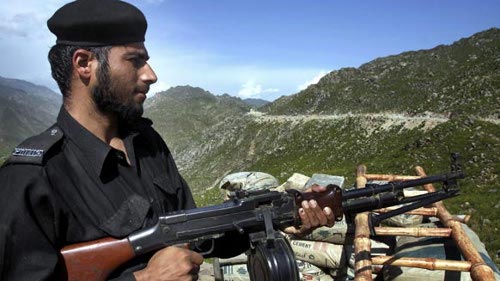
A Pakistani police officer at his post in Buner district (Mohammad Sajjad / AP)
Western media report that the deal broke down because the militants tried to take over Buner in violation of the agreement. But the militants accuse the government of violating the truce agreement. What violation is the government accused of, and is there any legitimacy to this claim? Or is the Pakistan Taliban wholly responsible for causing the deal to break down?
A 14-point deal was reached between the government and the militants after the effort to dislodge them was abandoned. The main cause for abandoning the military option to flush them out was the apprehension of heavy civilian casualties in view of Swat valley being a quite a built up and populated area, which would have allowed the Taliban to melt away into the local population and fight an irregular war. So the military, ISI, and the government decided to give peace deal a chance, with assurances from some other local religious outfits that the Taliban would honor the deal.
Among other conditions, under the deal the militants were to lay arms, shun violence and allow writ of the government to prevail. In return the government promised to implement the Nizam-e-Adal through Qazi courts and some other administrative facilities for the people.
The deal broke down for several reasons. Brutal and ruthless as they were, the militants continued to terrorize people even after the agreement was signed. They refused to lay down their arms and continued their nefarious activities. They destroyed mosques that did not conform to their religious teachings, forcibly closed down barber shops, video stores, girls’ schools and forced women into shrouds (burqas), edicts similar to those imposed by the Afghan Taliban when they ruled Afghanistan. The local administration had virtually disappeared and the militants were issuing edicts of all kinds. Summary executions through slaughter, whipping of young girls, hanging of people by the trees, and killings of those cooperating with government forces were widely reported. Then they finally began to expand into Buner where a wary people organized a lashkar (people’s army) to fight their advances. This caused unrest throughout the region amid fears of clashes.
All this sent a wave of grave concern among the people elsewhere in the country. To them this appeared to be a prelude to what was expected to come to their own neighborhoods. TTP-inspired suicide attacks being almost a daily occurrence, it took a severe toll in terms of people’s lives and confidence in the state and the government. They were anxious for the situation to be brought under control at any cost and pressure on the military and the government for action began to mount.
The militants had driven away the government administration and the law enforcement agencies. To restore its writ in line with the agreement, the government wanted to restore the administration and redeploy the police force. The militants refused to let that happen. They wanted people of their choice to be posted in administrative and law enforcement positions and deploy the police as they thought fit. This was obviously not acceptable to the government.
Then the militants insisted on employing judges of their choice. This was neither provided in the agreement nor could it be allowed.
The people of Swat and Buner were begging for the government intervention to expel the militants. People of Swat even offered to migrate and vacate their homes to enable the military to single-mindedly root out the militant evil once and for all. This and the Western pressure played a role in the decision by the military to make a decisive move.
Both the military and the people were prepared for collateral damage and loss of property that is taking place. In certain areas houses had to be razed to flush the Taliban out but there has been no protest. Mass migration has taken place. Internally Displaced Persons (IDPs) are scattered outside Swat in refugee camps in sweltering heat waiting to return and rebuild their lives without having to live under the fear of the militants. Most of them who have suffered at the hands of the militants have accepted their dislocation as a price for getting rid of militancy.
From the accounts being released, the military is taking huge losses but is succeeding in killing and driving the militants out. The operation Rah-e-Haq (the path of righteousness) in Swat is nearing completion and the military is now preparing to move into South Waziristan with the objective of eliminating the TTP network and Baitullah Mehsud.
From the incoming news it appears the U.S. is now willing to cooperate in doing this. In the past they refused to eliminate Baitullah despite authentic identification of his locations to U.S. commanders in Afghanistan several times by the ISI and to Mike Mullen during his visit to Islamabad by former President Musharraf. What does that mean? I leave it to others to judge.
Is the military action being carried out because Pakistan believes it is in its own best interests, or because of U.S. pressure to take action against militants, or both? Do the people of Pakistan as a whole support the present military action?
They do. There is no voice of dissent. Even the Human Rights Commission of Pakistan says in its report on Swat situation that “military action was unavoidable”. The government, political parties, the media and the people of Pakistan are fully behind the military operations. For them elimination of Taliban is now necessary for their survival and hence a matter of faith.
Every Pakistani believes that TTP is an evil that has no place in Pakistan’s national life. It must be eliminated at all cost.
For some strange reason the U.S. administration has been very vocal recently in demanding that Taliban advance be reversed although informed Pakistanis believe that it is they who let loose the monster in the first place. One school of thought believes that by doing so they were trying to intimidate the Pakistan government and force it to share the command and control system of its nuclear assets with them, something they have wanted to have for a long time. Apparently they have now managed to lay their hands on it. I am not sure to what extent. But If Obama’s speech on the eve of Zardari’s visit to Washington is any indication, the U.S. administration is quite happy.
