
Of his meeting earlier this week with Zardari and Afghan President Hamid Karzai, President Obama said, “we meet today as three sovereign nations joined by a common goal: to disrupt, dismantle, and defeat Al Qaeda and its extremist allies in Pakistan and Afghanistan, and to prevent their ability to operate in either country in the future.”
In other comments, Obama also characterized the U.S. involvement in Afghanistan and Pakistan as a war against Al Qaeda, drawing no apparent distinction between the terrorist organization, the Afghan Taliban, the Pakistan Taliban, or other belligerent militant groups there.
“No matter what happens, we will not be deterred,” Obama said after meeting with Karzai and Zardari. “Every day we see evidence of the future that Al Qaeda and its allies offer. It’s a future filled with violence and despair.”
Fighter jets, gunship helicopters, and artillery pounded parts of the Swat region as the offensive began.
The International Committee of the Red Cross (ICRC) has warned that the Pakistani military operation is intensifying the humanitarian crisis in the Swat region and called for all parties to comply with international law in respecting the lives of civilians.
Authorities in Pakistan’s North West Frontier Province (NWFP) have warned that as many as a half a million civilians are expected to flee the Swat region as fighting intensifies.
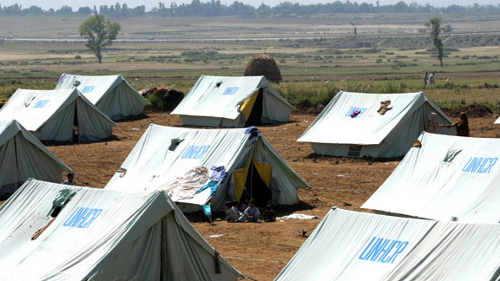
Refugees have already begun streaming out of the area, and refugee camps have been opened in the Swabi and Mardan districts to accommodate displaced persons. The U.N. humanitarian office in Islamabad said more than 2,200 families have already been registered in the camps.
An editorial in Pakistan’s Daily Times on Thursday said, “If the battle in Swat is to be won, Pakistan must be ready for the ‘refugee’ problem. The good sign today is that the Swatis who flee the Taliban are prepared to undergo hardship if it means that the state will take a stand for them and clear out the menace of the Taliban forever.”
The editorial added, “The message to the Taliban should be clear. A large number of IDPs [internally displaced persons] means that possible collateral damage is being minimized in order to face up to the terrorists. The world must focus on the phenomenon of the refugee camps and assist generously in their maintenance…. The IDPs must not only be looked after well but be compensated for the financial losses they have endured so that they are tempted to return, ensured of the repossession and reconstruction of the homes and businesses they have left behind.”
When asked how long the offensive would continue, Zardari answered, “The operation will go on till the situation returns to normal.”
The three-way presidential talks in Washington also resulted in an agreement between Afghanistan and Pakistan to allow for a trade route. A signed memorandum of understanding would effectively allow India to trade with Afghanistan via a trade route through Pakistan.
Pakistan and India are hostile towards one another and there have been frequent border skirmishes and territorial disputes over the Kashmir region.
Secretary of State Clinton said following a meeting with both foreign presidents, “The Trade Transit Agreement memorandum of understanding that was signed today commits both countries to finalizing a trade transit agreement that deals with all of the obstacles and problems of goods and people crossing borders…. The kind of economic development that will spring up if we see increased trade and commerce between the two countries is one of the best ways that we can provide alternatives for those who might otherwise be dragged into this conflict.”
She added that the trade agreement would “finalize the reconstruction opportunity zones that are part of the Kerry-Lugar legislation,” referring to the bill that would increase non-military aid to Pakistan by $7.5 billion.
