Working together with famed war photographer, Richard Butler, who was taking a break from nearly two straight years in combat in Africa and Iraq, we followed up on Khmer Rouge (KR) leads around Phnom Penh.
“DCCAM maintains an archive of three kinds of documentation. These are paper, genocide sites, and testimonies,” explained Youk Chang, director of the Documentation Center of Cambodia (DCCAM).
He went on to say that while victim testimonies were relatively easy to come by, to date only one man had confessed to having committed five murders.
“We keep these archives in order to preserve history, and to be used in the KR Tribunals,” he told us.
We were sitting at a long conference table in the DCCAM offices, near the Independence Monument in Phnom Penh. Finally, my colleague Richard would get to ask the question he saw as key in the upcoming KR related court proceedings.
“Will this be a trial or a tribunal?” asked Richard.
The newspapers had been liberally switching back and forth calling it both and neither. The difference that Richard pointed out to me was that a tribunal may not have the right to sentence anyone.
“Whether it is a trial or a tribunal is not for us to decide. That is a legal question which should be directed at the courts,” answered Youk Chang.
Youk Chang felt that he would be over-stepping his authority or losing his non-partisan position if he made a legal interpretation. “We don’t analyze data here. We only record and store data,” he went on to say. “Both sides, defense and prosecution, are welcome to use the materials stored in the archive.”
“We maintain 600,000 documents, related to 19,521 mass graves, 194 prisons, and 80 memorial sites. Additionally, we have interviewed 30,000 people. We focus on oral history of the KR, and allow this to stand-alone. We don’t interpret it. We don’t do the prosecutor’s job for them.”
The one area of the legal proceedings that Youk Chang was willing to explain, however, was that the defense would be Khmer, but prosecutors would be a mix of Khmer and foreigners.
According to Youk Chang, DCCAM was supported by donations from the USA, France, Sweden, and a number of other countries. “The king also gave us some funding,” he said.
The history of the archives was a fascinating tour through the history of political intrigue which plagues Cambodia’s past.
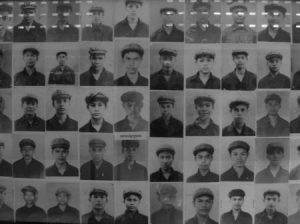
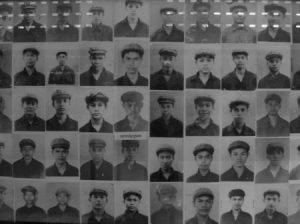
“The KR didn’t destroy the Lon Nol archive, and we still have it. The KR used the archives to investigate people from Lon Nol era. They even used the archives to find teachers and students, in school photos, and kill them. The Vietnamese used the documents to find and kill low level KR.”
“And we use documents to prove genocide. KR used the documents to demonstrate the involvement of the KGB, CIA, and Vietnamese, in Cambodia. These questions came up in the interrogations. They would ask you if you were an agent for the CIA, KGB, or Vietnamese. They would torture you until you said yes. Then they would kill you. If all the confessions were true the CIA had a huge number of agents in Cambodia, many of them under the age of fifteen. They were told that if they confessed they would be permitted to live. But then they were killed.”
When asked if everyone respected DCCAM’s neutrality, he had this to say: “The KR used to threaten us. I used to get death threats all the time, but not in recent times. I think they have just accepted that we aren’t going anywhere.”
Richard asked if there had been revenge attacks, against former KR.
“Yes, in 1980 to 1983 there were. But mostly low rank and file KR were killed.”
As someone who had lot family members in during the KR regime, he had this to say: “It would be difficult for me, after twenty eight years, to go and slap a KR, unless he acted very arrogantly. With human rights education, news and internet, people have opened their eyes.” He suggested people who expressed regret probably wouldn’t be condemned by the average Khmer.
“Bun Chea,” the former KR leader who was convicted of the murder of three backpackers in 1994, “did not express any kind of regret. So, people were angry,” explained Youk Chang.
Richard wouldn’t let go of the idea of revenge killing. “Every week the papers have stories of entire streets erupting in violence, and slaughtering a single victim accused of having committed a crime, such as theft.”
In more than one instance the man was then doused with petrol and lighted on fire. In almost all of these incidents, by the time the police arrived, the man was either dead or so horribly mutilated that he died soon after. I personally had seen a street erupt in violence three times. And in one incident in front of my house, when I asked why the whole street had attacked the man they said because he looked like someone who had stolen something.
I could understand Richard’s inability to let this line of questioning go. With this type of violence lurking behind every Khmer smile, how in the world were the KR able to subjugate them, torture them, and kill their loved ones? And how were Khmers, the most polite people in the world, capable of being KR and murdering a quarter of their own population? Then given the violent history of Khmers during the KR period, and given the violence in Cambodia today, how could torturers and victims live side by side?
Youk Chang’s answer was both chilling and revealing. “My sister died under the KR. But I know that if I kill Nung Chea I would be guilty.”
As amazing as it was that Khmers weren’t taking up arms against their former oppressors, it was also amazing that only two KR were in jail. These included Mok, Commander and Chief of the KR, and Duch, who was the commandant of S21 prison.
Many people expect, or even hope that the upcoming legal proceedings will result in former KR perpetrators being sentenced. But, the tribunals or trials are complicated because in 1994 the government gave amnesty to the KR who came in from the jungle.
“Until that time they were still living in jungle strong holds, especially in Pailin, where they are still located today,” explained Youk Chang.
The word Cambodians used for KR who turned them in was very revealing. They all say, “KR who defected to the government side were given amnesty.” Defected? Isn’t that something that happens between hostile governments of two separate countries? Much of Cambodia’s military and police were made up of these soldiers who defected. Basically they just changed one uniform for another. I personally knew a high ranking officer who had fought in five different armies, Lon Nol’s government, the KR, Khmer Serey, Vietnamese, and later the Cambodian government army.
The story of Duch is inconceivable. In his memoir, Van Nath, one of only two remaining survivors of S 21, describes how, after the Vietnamese invasion, he was serving in the Vietnamese army, and doing some work at the prison, which was now being opened as a tourist attraction. One day, he surveyed the crowd of visitors, and couldn’t believe his eyes when he saw Duch, dressed as a farmer, coming into the prison as a tourist. Van Nath notified the guards, who eventually intervened. By coincidence, on the same day, a French film crew were making a film at the prison. Van Nath insisted that they include Duch in the film. The film is the best part of a visit to the prison. In the film Van Nath walks Duch through his paintings of people being tortured and executed and asks. “I only painted these from my imagination. But is this how you did it?” At first Duch doesn’t want to answer, but Van Nath gets a bit tough with him, and he finally admits that he tortured and killed people in this manner.
“Duch’s whereabouts were completely unknown to us,” began Youk Chang, explaining how Duch eventually wound up in the custody of the Cambodian government. “He was on his way to Thailand. But, the spies turned him in. So he was arrested. The others defected to the government, and got amnesty. Duch had broken KR law article one, arrested before enlightenment.”
“The purpose of this trial is to bring the central leadership to justice,” he concluded.
Duch, who, since the death of Pol Pot, is arguably the mot infamous of the ex-KR administration, is in jail. But there were 194 other prison chiefs who are not.
“The other prisons were worse.” Said Youk Chang. “There were cases of 10,000 prisoners in a prison with no roof. There was no hygiene at all. They were simply tortured and killed, without any procedure, and with no documentation.”
Youk Chang explained that these murders were only known about because of the bodies found in mass graves.
“Only 14 people ever survived Toul Slang,” said Youk Chang, in a chilling voice. “Most of the other prisons had no survivors.”
Youk Chang explained why the provincial prisons were so much worse than S 21. “Prisoners in provinces were considered to be guilty of being enemies of Anka, the Khmer Rouge organization. In S 21, they were seen as traitors or suspects.”
With the potential for a court date in the near future, we asked if there were any execution orders that bore Duch’s signature.
“Most documents were signed by higher authority, ordering an execution,” began Youk Chang. “But Duch signed documents stating that he had carried out the executions.”
“I would love to find a document with Pol Pot’s signature,” joked Richard.
Apparently there were few, if any documents linking Pol Pot directly to any executions. So, the question was, exactly what law had he broken, or what would be the charges leveled against him, posthumously.
“Pol pot didn’t personally kill people. But he made policy which killed people.”
One defense argument has been that the policies of the KR were too broad, and easily misinterpreted or abused. It had also been suggested that central leadership, in Phnom Penh, was unaware of the atrocities being committed in the provinces. There was some logic to this argument. Communication in modern Cambodia is difficult enough; given bad roads and lack of technology in the provinces. How much more difficult must it have been in 1975 to communicate with provinces, especially since the KR were officially anti-technology, and many of them were illiterate.
But a counter argument was that the KR effectively controlled every single aspect of the lives of every Khmer, from waking, to working, to sleeping, and even to thinking. Former prisoners have reported that they were beaten for changing position in their sleep, without permission.
If they could control everything, right up to how people slept, then why couldn’t they control their soldiers who were committing genocide?
There has been speculation that if the proceedings happened at all, that they would be halted before they reached any type of conclusion.
“They will take place through completion,” Youk Chang assured us. “It would be difficult for anyone to oppose the trials.”
His next statement summed up the desperation of the plight of Cambodia. “There are a lot of questions of how the trials will effect the government and other organizations. But no one cares about the people.”
It was apparent that Richard really liked Youk Chang. We both did. It was amazing, how much he knew, and what facts he had off the top of his head. In fact when we asked him about Van Nath, the famous painter of Toul Slang, he had said “Oh, I will give you his phone number.” He began writing on a piece of paper, and we both thought he had the number committed to memory. It turned out he was just writing a post-it note so he would not forget to look up the number after the meeting. But, Youk Chang was so sharp we both believed he had all relevant facts, related to the KR, in his head.
Of all the thousands of writings at DCCAM, there was almost no signage at S-21, the Khmer Rouge prison. And, what signage there was, was written in French. Oddly, there was a government push to paint and refurbish S-21, which most people felt took away from the impact of the place. But, there was no mention of a project to create good signage.
“Rebuilding S-21 is a sin,” Richard told the director, who thoroughly agreed.
“Don’t bother with the Killing Fields,” added the director. “There is no documentation and no information, just walking around in an open field. There are only cattle and beggar children there.”
You would think they would be able to keep both of those out of there, I thought.
The meeting went well, and the director told Richard to come any time, and take any photos he wanted.