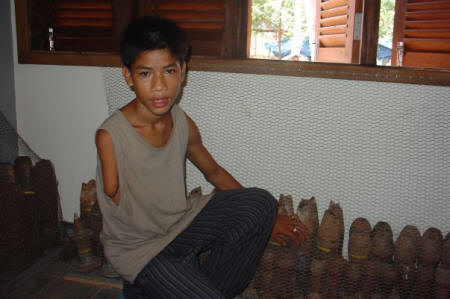
A seventeen year old boy, named Chet, told me he had been living with Aki Ra for three years. In spite of having lost a leg, Chet told me. “I can walk well and play football, but I cannot jump. And, my leg hurts often.”
Chet was an orphan, living on the streets of Phnom Penh, shining shoes. About five years ago, when he was twelve, a man offered Chet a job, cutting trees in Battambong.
“I was walking between the fields and stepped on a mine.”
Once again, there was no hospital. The local people stopped the bleeding by wrapping the wound with Krama, traditional Khmer scarves. After Chet recovered, his employer dropped him back on the streets of Phnom Penh, where he began shining shoes again.
“I didn’t have a plastic leg then. I had to use crutches.” Said Chet, holding out his hands so I could see the permanent scars the crutches had left.

“I didn’t have a house or a family. I slept on the streets. I didn’t go to school. Aki Ra saw me when he came to Phnom Penh, and he asked if I wanted to go live at his house.” Chet smiled. “Now, I go to school, play kick ball, and work as a guide. I also play music. I love the keyboard. We all learned English at the old museum from the volunteer teachers. And here, we have the other children, same as family.”
I asked Chet if he walked the seven kilometers to school every day.
“Yes, I walk. I cannot have a driver.”
Another boy was missing a leg told us that although he was eighteen, he was only in the seventh grade. Going to live with Aki Ra was the only hope any of these children ever had of getting an education, learning English, or in some cases, having a family. When the center is completed, they will be living better than 90% of Khmer kids.
Aki Ra and the Land Mine Relief Fund NGO are doing great things to help these kids. Richard Fitoussi, a war photographer from Canada, is the man most responsible for the existence of the NGO and much of the money which has come in. But once again, the very fact that such an NGO is needed suggests that the local government just doesn’t care about the people.
A tourist lady from England barged into the museum, and tore past all of the displays, without even glancing at them.
“Do you speak English?” She asked me, having given up on the child amputee who was guiding her.
I was a little embarrassed to admit that I did.
“Where is the portrait of Princes Diana?” she asked. “Diana did a lot for these people, I came all the way from England to see her portrait. But no one even seems to know her name.”
It took me a minute, but then I remembered that Princes Diana had been instrumental in founding the HALO Trust, a de-mining NGO. Sadly, I had to tell the British lady that as far as I knew, there was no portrait of the princes in the museum.
The woman turned, brushed past the bombs and wounded children, hoped back in her tuk-tuk and left.
Perhaps the only thing more shocking than the lack of interest shown be the local government is the lack of interest shown by the developed world.
It appears that the de-mining efforts of the Cambodian government are focused on de-mining the development areas and tourist locations, but the farms, which cover the vast majority of the Khmer landscape, are the lowest priority.
Two years ago, while doing stories in Siem Reap, I stopped in, unannounced, at the old landmine museum, to interview Aki Ra.
Since then, things have obviously changed for Aki Ra. For three weeks prior to coming to Siem Reap, I sent email requesting an interview. “There are three documentary film makers in town right now, all of whom want to do interviews with Aki Ra,” a spokesman for the Land Mine relief Fund told me. They finally agreed to let me have an interview with Aki Ra’s second in command, but couldn’t guarantee that I would get to see the man himself. As I pulled up to the museum, I saw Aki Ra in green army fatigues, getting into a jeep. I ran over, and asked for the interview.
“I am sorry.” He said. “I have no time. I am on my way to detonate some mines.”
“Can I come with?” I asked.
He looked me up and down, eventually saying, “Okay, get in.”
In the vehicle were a Khmer driver, a Japanese de-miner, and a Japanese kid who claimed to be a tourist, but behaved like a journalist. Not to promote racial stereotypes, but both of the Japanese had better cameras than me. I, however, had a digital voice recorder. The Japanese did not have a digital voice recorder. Great success!
As the vehicle made its bumpy way to a point out near the airport, Aki Ra explained the operation.
“I now have 150 soldiers working for me, who I trained. We collect unexploded ordnance all month and store it in a safe location.”
By a safe location, he meant a pit twenty meters behind the tents where the soldiers slept. But he was right. The location was safe. No one was going to be able to steal those mines.

“Once or twice a month, when we have enough pieces, we carry them to another safe location and detonate them.”
“Sometimes we have a hundred, sometimes more.”