
UN Resolution 181 neither partitioned Palestine nor conferred any legal authority to the Zionists for their unilateral declaration of Israel's existence.
There is a widely accepted belief that United Nations General Assembly Resolution 181 “created” Israel, based upon an understanding that this resolution partitioned Palestine or otherwise conferred legal authority or legitimacy to the declaration of the existence of the state of Israel. However, despite its popularity, this belief has no basis in fact, as a review of the resolution’s history and examination of legal principles demonstrates incontrovertibly.
Great Britain had occupied Palestine during the First World War, and in July 1922, the League of Nations issued its mandate for Palestine, which recognized the British government as the occupying power and effectively conferred to it the color of legal authority to temporarily administrate the territory.[1] On April 2, 1947, seeking to extract itself from the conflict that had arisen in Palestine between Jews and Arabs as a result of the Zionist movement to establish in Palestine a “national home for the Jewish people”,[2] the United Kingdom submitted a letter to the U.N. requesting the Secretary General “to place the question of Palestine on the Agenda of the General Assembly at its next regular Annual Session”, and requesting the Assembly “to make recommendations, under Article 10 of the Charter, concerning the future government of Palestine.”[3] To that end, on May 15, the General Assembly adopted Resolution 106, which established the U.N. Special Committee on Palestine (UNSCOP) to investigate “the question of Palestine”, to “prepare a report to the General Assembly” based upon its findings, and to “submit such proposals as it may consider appropriate for the solution of the problem of Palestine”.[4]
On September 3, UNSCOP issued its report to the General Assembly declaring its majority recommendation that Palestine be partitioned into separate Jewish and Arab states. It noted that the population of Palestine at the end of 1946 was estimated to be almost 1,846,000, with 1,203,000 Arabs (65 percent) and 608,000 Jews (33 percent). Growth of the Jewish population had been mainly the result of immigration, while growth of the Arab population had been “almost entirely” due to natural increase. It observed that there was “no clear territorial separation of Jews and Arabs by large contiguous areas”, and even in the Jaffa district, which included Tel Aviv, Arabs constituted a majority.[5] Land ownership statistics from 1945 showed that Arabs owned more land than Jews in every single district in Palestine. The district with the highest percentage of Jewish ownership was Jaffa, where 39 percent of the land was owned by Jews, compared to 47 percent owned by Arabs.[6] In the whole of Palestine at the time UNSCOP issued its report, Arabs remained “in possession of approximately 85 percent of the land”,[7] while Jews owned less than 7 percent.[8]
Despite these facts, the UNSCOP proposal was that the Arab state be constituted from only 45.5 percent of the whole of Palestine, while the Jews would be awarded 55.5 percent of the total area for their state.[9] The UNSCOP report acknowledged that
With regard to the principle of self-determination, although international recognition was extended to this principle at the end of the First World War and it was adhered to with regard to the other Arab territories, at the time of the creation of the ‘A’ Mandates, it was not applied to Palestine, obviously because of the intention to make possible the creation of the Jewish National Home there. Actually, it may well be said that the Jewish National Home and the sui generis Mandate for Palestine run counter to that principle.[10]
In other words, the report explicitly recognized that the denial of Palestinian independence in order to pursue the goal of establishing a Jewish state constituted a rejection of the right of the Arab majority to self-determination. And yet, despite this recognition, UNSCOP had accepted this rejection of Arab rights as being within the bounds of a legitimate and reasonable framework for a solution.
Following the issuance of the UNSCOP report, the U.K. issued a statement declaring its agreement with the report’s recommendations, but adding that “if the Assembly should recommend a policy which is not acceptable to both Jews and Arabs, the United Kingdom Government would not feel able to implement it.”[11] The position of the Arabs had been clear from the beginning, but the Arab Higher Committee issued a statement on September 29 reiterating that “the Arabs of Palestine were determined to oppose with all the means at their disposal, any scheme that provided for segregation or partition, or that would give to a minority special and preferential status”. It instead
advocated freedom and independence for an Arab State in the whole of Palestine which would respect human rights, fundamental freedoms and equality of all persons before the law, and would protect the legitimate rights and interests of all minorities whilst guaranteeing freedom of worship and access to the Holy Places.[12]
The U.K. followed with a statement reiterating “that His Majesty’s Government could not play a major part in the implementation of a scheme that was not acceptable to both Arabs and Jews”, but adding “that they would, however, not wish to impede the implementation of a recommendation approved by the General Assembly.”[13]
The Ad Hoc Committee on the Palestinian Question was established by the General Assembly shortly after the issuance of the UNSCOP report in order to continue to study the problem and make recommendations. A sub-committee was established in turn that was tasked with examining the legal issues pertaining to the situation in Palestine, and it released the report of its findings on November 11. It observed that the UNSCOP report had accepted a basic premise “that the claims to Palestine of the Arabs and Jews both possess validity”, which was “not supported by any cogent reasons and is demonstrably against the weight of all available evidence.” With an end to the Mandate and with British withdrawal, “there is no further obstacle to the conversion of Palestine into an independent state”, which “would be the logical culmination of the objectives of the Mandate” and the Covenant of the League of Nations. It found that “the General Assembly is not competent to recommend, still less to enforce, any solution other than the recognition of the independence of Palestine, and that the settlement of the future government of Palestine is a matter solely for the people of Palestine.” It concluded that “no further discussion of the Palestine problem seems to be necessary or appropriate, and this item should be struck off the agenda of the General Assembly”, but that if there was a dispute on that point, “it would be essential to obtain the advisory opinion of the International Court of Justice on this issue”, as had already been requested by several of the Arab states. It concluded further that the partition plan was “contrary to the principles of the Charter, and the United Nations have no power to give effect to it.” The U.N. could not
deprive the majority of the people of Palestine of their territory and transfer it to the exclusive use of a minority in the country…. The United Nations Organization has no power to create a new State. Such a decision can only be taken by the free will of the people of the territories in question. That condition is not fulfilled in the case of the majority proposal, as it involves the establishment of a Jewish State in complete disregard of the wishes and interests of the Arabs of Palestine.[14]
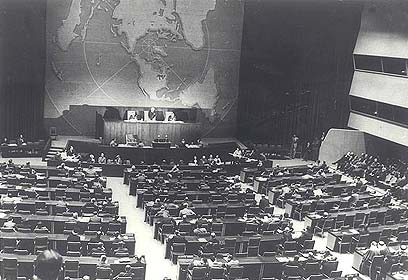
Nevertheless, the General Assembly passed Resolution 181 on November 29, with 33 votes in favor to 13 votes against, and 10 abstentions.[15] The relevant text of the resolution stated:
The General Assembly….
Recommends to the United Kingdom, as the mandatory Power for Palestine, and to all other Members of the United Nations the adoption and implementation, with regard to the future government of Palestine, of the Plan of Partition with Economic Union set out below;
Requests that
(a) The Security Council take the necessary measure as provided for in the plan for its implementation;
(b) The Security Council consider, if circumstances during the transitional period require such consideration, whether the situation in Palestine constitutes a threat to the peace. If it decides that such a threat exists, and in order to maintain international peace and security, the Security Council should supplement the authorization of the General Assembly by taking measure, under Articles 39 and 41 of the Charter, to empower the United Nations Commission, as provided in this resolution, to exercise in Palestine the functions which are assigned to it by this resolution;
(c) The Security Council determine as a threat to the peace, breach of the peace or act of aggression, in accordance with Article 39 of the Charter, any attempt to alter by force the settlement envisaged by this resolution;
(d) The Trusteeship Council be informed of the responsibilities envisaged for it in this plan;
Calls upon the inhabitants of Palestine to take such steps as may be necessary on their part to put this plan into effect;
Appeals to all Governments and all peoples to refrain from taking action which might hamper or delay the carrying out of these recommendations….[16]
A simple reading of the text is enough to show that the resolution did not partition Palestine or offer any legal basis for doing so. It merely recommended that the partition plan be implemented and requested the Security Council to take up the matter from there. It called upon the inhabitants of Palestine to accept the plan, but they were certainly under no obligation to do so.
A Plan Never Implemented
The matter was thus taken up by the Security Council, where, on December 9, the Syrian representative to the U.N., Faris El-Khouri, observed that “the General Assembly is not a world government which can dictate orders, partition countries or impose constitutions, rules, regulations and treaties on people without their consent.” When the Soviet representative Andrei Gromyko stated his government’s opposing view that “The resolution of the General Assembly should be implemented” by the Security Council, El-Khouri replied by noting further that
Certain paragraphs of the resolution of the General Assembly which concern the Security Council are referred to the Council, namely, paragraphs (a), (b) and (c), outlining the functions of the Security Council in respect of the Palestinian question. All of the members of the Security Council are familiar with the Council’s functions, which are well defined and clearly stated in the Charter of the United Nations. I do not believe that the resolution of the General Assembly can add to or delete from these functions. The recommendations of the General Assembly are well known to be recommendations, and Member States are not required by force to accept them. Member States may or may not accept them, and the same applies to the Security Council. [17]
On February 6, 1948, the Arab Higher Committee again communicated to the U.N. Secretary General its position that the partition plan was “contrary to the letter and spirit of the United Nations Charter”. The U.N. “has no jurisdiction to order or recommend the partition of Palestine. There is nothing in the Charter to warrant such authority, consequently the recommendation of partition is ultra vires and therefore null and void.” Additionally, the Arab Higher Committee noted that
The Arab Delegations submitted proposals in the Ad Hoc Committee in order to refer the whole legal issue raised for a ruling by the International Court of Justice. The said proposals were never put to vote by the president in the Assembly. The United Nations is an International body entrusted with the task of enforcing peace and justice in international affairs. How would there be any confidence in such a body if it bluntly and unreasonably refuses to refer such a dispute to the International Court of Justice?
“The Arabs of Palestine will never recognize the validity of the extorted partition recommendations or the authority of the United Nations to make them”, the Arab Higher Committee declared, and they would “consider that any attempt by the Jews or any power or group of powers to establish a Jewish State in Arab territory is an act of aggression which will be resisted in self-defense by force.”[18]
On February 16, the U.N. Palestine Commission, tasked by the General Assembly to prepare for the transfer of authority from the Mandatory Power to the successor governments under the partition plan, issued its first report to the Security Council. It concluded on the basis of the Arab rejection that it “finds itself confronted with an attempt to defect its purposes, and to nullify the resolution of the General Assembly”, and calling upon the Security Council to provide an armed force “which alone would enable the Commission to discharge its responsibilities on the termination of the Mandate”. In effect, the Palestine Commission had determined that the partition plan should be implemented against the will of the majority population of Palestine by force.[19]
In response to that suggestion, Colombia submitted a draft Security Council resolution noting that the U.N. Charter did “not authorize the Security Council to create special forces for the purposes indicated by the United Nations Palestine Commission”.[20] The U.S. delegate, Warren Austin, similarly stated at the 253rd meeting of the Security Council on February 24 that
The Security Council is authorized to take forceful measures with respect to Palestine to remove a threat to international peace. The Charter of the United Nations does not empower the Security Council to enforce a political settlement whether it is pursuant to a recommendation of the General Assembly or of the Security Council itself. What this means is this: The Security Council, under the Charter, can take action to prevent aggression against Palestine from outside. The Security Council, by these same powers, can take action to prevent a threat to international peace and security from inside Palestine. But this action must be directed solely to the maintenance of international peace. The Security Council’s action, in other words, is directed to keeping the peace and not to enforcing partition.[21]
The United States nevertheless submitted its own draft text more ambiguously accepting the requests of the Palestine Commission “subject to the authority of the Security Council under the Charter”.[22] Faris El-Khouri objected to the U.S. draft on the grounds that “before accepting these three requests, it is our duty to ascertain whether they are or are not within the framework of the Security Council as limited by the Charter. If it is found that they are not, we should decline to accept them.” He recalled Austin’s own statement on the lack of authority of the Security Council, saying, “It would follow from this undeniable fact that any recommendation on a political settlement can be implemented only if the parties concerned willingly accept and complement it.” Furthermore, “the partition plan itself constitutes a threat to the peace, being openly rejected by all those at whose expense it was to be executed.”[23] Austin in turn explained the intent of the U.S. draft that its acceptance of Resolution 181 is
subject to the limitation that armed force cannot be used for implementation of the plan, because the Charter limits the use of United Nations force expressly to threats to and breaches of the peace and aggression affecting international peace. Therefore, we must interpret the General Assembly resolution as meaning that the United Nations measures to implement this resolution are peaceful measures.
Moreover, explained Austin, the U.S. draft
does not authorize use of enforcement under Articles 39 and 41 of the Charter to empower the United Nations Commission to exercise in Palestine the functions which are assigned to it by the resolution, because the Charter does not authorize either the General Assembly or the Security Council to do any such thing.[24]
When the Security Council did finally adopt a resolution on March 5, it merely made a note of “Having received General Assembly resolution 181″ and the first monthly Palestine Commission report, and resolved
to call on the permanent members of the Council to consult and to inform the Security Council regarding the situation with respect to Palestine and to make, as the result of such consultations, recommendations to it regarding the guidance and instructions which the Council might usefully give to the Palestine Commission with a view to implementing the resolution of the General Assembly.[25]
During further debates at the Security Council over how to proceed, Austin observed that it had become “clear that the Security Council is not prepared to go ahead with efforts to implement this plan in the existing situation.” At the same time, it was clear that the U.K.’s announced termination of the Mandate on May 15 “would result, in the light of information now available, in chaos, heavy fighting and much loss of life in Palestine.” The U.N. could not permit this, he said, and the Security Council had the responsibility and authority under the Charter to act to prevent such a threat to the peace. The U.S. also proposed establishing a Trusteeship over Palestine to give further opportunity to the Jews and Arabs to reach a mutual agreement. Pending the convening of a special session of the General Assembly to that end, “we believe that the Security Council should instruct the Palestine Commission to suspend its efforts to implement the proposed partition plan.”[26]
The Security Council President, speaking as the representative from China, responded: “The United Nations was created mainly for the maintenance of international peace. It would be tragic indeed if the United Nations, by attempting a political settlement, should be the cause of war. For these reasons, my delegation supports the general principles of the proposal of the United States delegation.”[27] At a further meeting of the Security Council, the Canadian delegate stated that the partition plan “is based on a number of important assumptions”, the first of which was that “it was assumed that the two communities in Palestine would co-operate in putting into effect the solution to the Palestine problem which was recommended by the General Assembly.”[28] The French delegate, while declining to extend either approval for or disapproval of the U.S. proposal, observed that it would allow for any number of alternative solutions from the partition plan, including “a single State with sufficient guarantees for minorities”.[29] The representative from the Jewish Agency for Palestine read a statement categorically rejecting “any plan to set up a trusteeship regime for Palestine”, which “would necessarily entail a denial of the Jewish right to national independence.”[30]
Mindful of the worsening situation in Palestine, and wishing to avoid further debate, the U.S. proposed another draft resolution calling for a truce between Jewish and Arab armed groups that Austin noted “would not prejudice the claims of either group” and which “does not mention trusteeship.”[31] It was adopted as Resolution 43 on April 1.[32] Resolution 44 was also passed the same day requesting “the Secretary-General, in accordance with Article 20 of the United Nations Charter, to convoke a special session of the General Assembly to consider further the question of the future government of Palestine.”[33] Resolution 46 reiterated the Security Council’s call for the cessation of hostilities in Palestine,[34] and Resolution 48 established a “Truce Commission” to further the goal of implementing its resolutions calling for an end to the violence.[35]
On May 14, the Zionist leadership unilaterally declared the existence of the State of Israel, citing Resolution 181 as constituting “recognition by the United Nations of the right of the Jewish people to establish their State”.[36] As anticipated, war ensued.
The Authority of the U.N. with Regard to Partition
Chapter 1, Article 1 of the U.N. Charter defines its purposes and principles, which are to “maintain international peace and security”, to “develop friendly relations among nations based on respect for the principle of equal rights and self-determination of peoples”, and to “achieve international co-operation” on various issues and “promoting and encouraging respect for human rights and for fundamental freedoms for all”.
The functions and powers of the General Assembly are listed under Chapter IV, Articles 10 through 17. It is tasked to initiate studies and make recommendations to promote international cooperation and the development of international law, to receive reports from the Security Council and other organs of the U.N., and to consider and approve the organization’s budget. It is also tasked with performing functions under the international trusteeship system. Its authority is otherwise limited to considering and discussing matters within the scope of the Charter, making recommendations to Member States or the Security Council, or calling attention of matters to the Security Council.
Chapter V, Articles 24 through 26, states the functions and powers of the Security Council. It is tasked with maintaining peace and security in accordance with the purposes and principles of the U.N. The specific powers granted to the Security Council are stated in Chapters VI, VII, VIII, and XII. Under Chapter VI, the Security Council may call upon parties to settle disputes by peaceful means, investigate, and make a determination as to whether a dispute or situation constitutes a threat to peace and security. It may recommend appropriate procedures to resolve disputes, taking into consideration that “legal disputes should as a general rule be referred by the parties to the International Court of Justice”. Under Chapter VII, the Security Council may determine the existence of a threat to peace and make recommendations or decide what measures are to be taken to maintain or restore peace and security. It may call upon concerned parties to take provisional measures “without prejudice to the rights, claims, or position of the parties concerned.” It may call upon member states to employ “measures not involving the use of armed force” to apply such measures. Should such measures be inadequate, it may authorize the use of armed forces “to maintain or restore international peace and security”. Chapter VIII states that the Security Council “shall encourage the development of pacific settlements of local disputes” through regional arrangements or agencies, and utilize such to enforce actions under its authority.
The functions and powers of the International Trusteeship System are listed under Chapter XII, Articles 75 through 85. The purpose of the system is to administer and supervise territories placed therein by agreement with the goal of “development towards self-government or independence as may be appropriate to the particular circumstances of each territory and its peoples and the freely expressed wishes of the peoples concerned”. The system is to operate in accordance with the purposes of the U.N. stated in Article 1, including respect for the right of self-determination. The General Assembly is tasked with all functions “not designated as strategic”, which are designated to the Security Council. A Trusteeship Council is established to assist the General Assembly and the Security Council to perform their functions under the system.
Chapter XIII, Article 87 states the functions and powers of the Trusteeship Council, which are shared by the General Assembly. Authority is granted to consider reports, accept and examine petitions, provide for visits to trust territories, and “take these and other actions in conformity with the terms of the trusteeship agreements.”
Another relevant section is Chapter XI, entitled the “Declaration Regarding Non-Self-Governing Territories”, which states that
Members of the United Nations which have or assume responsibilities for the administration of territories whose peoples have not yet attained a full measure of self-government recognize the principle that the interests of the inhabitants of these territories are paramount, and accept as a sacred trust the obligation to promote to the utmost, within the system of international peace and security established by the present Charter, the well-being of the inhabitants of these territories…
To that end, Member states are “to develop self-government, to take due account of the political aspirations of the peoples, and to assist them in the progressive development of their free political institutions”.
Conclusion
The partition plan put forth by UNSCOP sought to create within Palestine a Jewish state contrary to the express will of the majority of its inhabitants. Despite constituting only a third of the population and owning less than 7 percent of the land, it sought to grant to the Jews more than half of Palestine for purpose of creating that Jewish state. It would, in other words, take land from the Arabs and give it to the Jews. The inherent injustice of the partition plan stands in stark contrast to alternative plan proposed by the Arabs, of an independent state of Palestine in which the rights of the Jewish minority would be recognized and respected, and which would afford the Jewish population representation in a democratic government. The partition plan was blatantly prejudicial to the rights of the majority Arab population, and was premised on the rejection of their right to self-determination. This is all the more uncontroversial inasmuch as the UNSCOP report itself explicitly acknowledged that the proposal to create a Jewish state in Palestine was contrary to the principle of self-determination. The plan was also premised upon the erroneous assumption that the Arabs would simply acquiesce to having their land taken from them and voluntarily surrender their majority rights, including their right to self-determination.
U.N. General Assembly Resolution 181 neither legally partitioned Palestine nor conferred upon the Zionist leadership any legal authority to unilaterally declare the existence of the Jewish state of Israel. It merely recommended that the UNSCOP partition plan be accepted and implemented by the concerned parties. Naturally, to have any weight of law, the plan, like any contract, would have to have been formally agreed upon by both parties, which it was not. Nor could the General Assembly have legally partitioned Palestine or otherwise conferred legal authority for the creation of Israel to the Zionist leadership, as it simply had no such authority to confer. When the Security Council took up the matter referred to it by the General Assembly, it could come to no consensus on how to proceed with implementing the partition plan. It being apparent that the plan could not be implemented by peaceful means, the suggestion that it be implemented by force was rejected by members of the Security Council. The simple fact of the matter is that the plan was never implemented. Numerous delegates from member states, including the U.S., arrived at the conclusion that the plan was impracticable, and, furthermore, that the Security Council had no authority to implement such a plan except by mutual consent by concerned parties, which was absent in this case.
The U.S., Syria, and other member nations were correct in their observations that, while the Security Council did have authority to declare a threat to the peace and authorize the use of force to deal with that and maintain or restore peace and security, it did not have any authority to implement by force a plan to partition Palestine contrary to the will of most of its inhabitants. Any attempt to usurp such authority by either the General Assembly or the Security Council would have been a prima facie violation of the Charter’s founding principle of respect for the right to self-determination of all peoples, and thus null and void under international law.
In sum, the popular claim that the U.N. “created” Israel is a myth, and Israel’s own claim in its founding document that U.N. Resolution 181 constituted legal authority for Israel’s creation, or otherwise constituted “recognition” by the U.N. of the “right” of the Zionist Jews to expropriate for themselves Arab land and deny to the majority Arab population of that land their own right to self-determination, is a patent fraud.
Further corollaries may be drawn. The disaster inflicted upon Palestine was not inevitable. The U.N. was created for the purpose of preventing such catastrophes. Yet it failed miserably to do so, on numerous counts. It failed in its duty to refer the legal questions of the claims to Palestine to the International Court of Justice, despite requests from member states to do so. It failed to use all means within its authority, including the use of armed forces, to maintain peace and prevent the war that was predicted would occur upon the termination of the Mandate. And most importantly, far from upholding its founding principles, the U.N. effectively acted to prevent the establishment of an independent and democratic state of Palestine, in direct violation of the principles of its own Charter. The consequences of these and other failures are still witnessed by the world today on a daily basis. Recognition of the grave injustice perpetrated against the Palestinian people in this regard and dispelling such historical myths is essential if a way forward towards peace and reconciliation is to be found.
[Correction (May 8, 2017): As originally published, this article stated that “In the whole of Palestine at the time UNSCOP issued its report, Arabs owned 85 percent of the land, while Jews owned less than 7 percent.” The UNSCOP report did not say Arabs owned 85 percent of the land, but that they were “in possession of” 85 percent of the land. The text has been corrected.]
Notes
[1] The Palestine Mandate of the Council of the League of Nations, July 24, 1922, http://avalon.law.yale.edu/20th_century/palmanda.asp.
[2] Great Britain had contributed to the conflict by making contradictory promises to both Jews and Arabs, including a declaration approved by the British Cabinet that read, “His Majesty’s Government view with favour the establishment in Palestine of a national home for the Jewish people, and will use their best endeavours to facilitate the achievement of this object, it being clearly understood that nothing shall be done which may prejudice the civil and religious rights of existing non-Jewish communities in Palestine, or the rights and political status enjoyed by Jews in any other country.” This declaration was delivered by Foreign Secretary Arthur James Balfour to representative of the Zionist movement Lord Lionel Walter Rothschild in a letter on November 2, 1917, and thus came to be known as “The Balfour Declaration”, http://avalon.law.yale.edu/20th_century/balfour.asp.
[3] Letter from the United Kingdom Delegation to the United Nations to the U.N. Secretary-General, April 2, 1947, http://unispal.un.org/unispal.nsf/9a798adbf322aff38525617b006d88d7/87aaa6be8a3a7015802564ad0037ef57?OpenDocument.
[4] U.N. General Assembly Resolution 106, May 15, 1947, http://unispal.un.org/unispal.nsf/9a798adbf322aff38525617b006d88d7/f5a49e57095c35b685256bcf0075d9c2?OpenDocument.
[5] United Nations Special Committee on Palestine Report to the General Assembly, September 3, 1947, http://unispal.un.org/unispal.nsf/9a798adbf322aff38525617b006d88d7/07175de9fa2de563852568d3006e10f3?OpenDocument.
[6] “Palestine Land Ownership by Sub-Districts (1945)”, United Nations, August 1950, http://domino.un.org/maps/m0094.jpg. The map was prepared on the instructions of Sub-Committee 2 of the Ad Hoc Committee on the Palestinian question and presented as Map No. 94(b). Statistics were as follows (Arab/Jewish land ownership in percentages): Safad: 68/18; Acre: 87/3; Tiberias: 51/38; Haifa: 42/35; Nazareth: 52/28; Beisan: 44/34; Jenin: 84/1, Tulkarm: 78/17; Nablus: 87/1; Jaffa: 47/39; Ramle: 77/14; Ramallah: 99/less than 1; Jerusalem: 84/2; Gaza: 75/4; Hebron: 96/less than 1; Beersheeba: 15/less than 1.
[7] UNSCOP Report.
[8] Walid Khalidi, “Revisiting the UNGA Partition Resolution”, Journal of Palestine Studies XXVII, no. 1 (Autumn 1997), p. 11, http://www.palestine-studies.org/enakba/diplomacy/Khalidi,%20Revisiting%20the%201947%20UN%20Partition%20Resolution.pdf. Edward W. Said, The Question of Palestine (New York: Vintage Books Edition, 1992), pp. 23, 98.
[9] Khalidi, p. 11.
[10] UNSCOP Report.
[11] “U.K. Accepts UNSCOP General Recommendations; Will Not Implement Policy Unacceptable by Both Arabs and Jews”, Press Release, Ad Hoc Committee on Palestinian Question 2nd Meeting, September 26, 1947, http://unispal.un.org/unispal.nsf/9a798adbf322aff38525617b006d88d7/ecb5eae2e1d29ed08525686d00529256?OpenDocument.
[12] “The Arab Case Stated by Mr. Jamal Husseini”, Press Release, Ad Hoc Committee on Palestinian Question 3rd Meeting, United Nations, September 29, 1947, http://unispal.un.org/unispal.nsf/9a798adbf322aff38525617b006d88d7/a8c17fca1b8cf5338525691b0063f769?OpenDocument.
[13] “Palestine Committee Hears U.K. Stand and Adjourns; Sub-Committees Meet”, Press Release, Ad Hoc Committee on Palestine 24th Meeting, United Nations, November 20, 1947, http://unispal.un.org/unispal.nsf/9a798adbf322aff38525617b006d88d7/12966c9f443583e085256a7200661aab?OpenDocument.
[14] “Ad Hoc Committee on the Palestinian Question Report of Sub-Committee 2”, United Nations, November 11 1947, http://unispal.un.org/pdfs/AAC1432.pdf.
[15] United Nations General Assembly 128th Plenary Meeting, United Nations, November 29, 1947, http://unispal.un.org/unispal.nsf/9a798adbf322aff38525617b006d88d7/46815f76b9d9270085256ce600522c9e?OpenDocument.
[16] United Nations General Assembly Resolution 181, November 29, 1947, http://unispal.un.org/unispal.nsf/9a798adbf322aff38525617b006d88d7/7f0af2bd897689b785256c330061d253?OpenDocument.
[17] United Nations Security Council 222nd Meeting, December 9, 1947, http://unispal.un.org/unispal.nsf/9a798adbf322aff38525617b006d88d7/ce37bc968122a33985256e6900649bf6?OpenDocument.
[18] “First Special Report to the Security Council: The Problem of Security in Palestine”, United Nations Palestine Commission, February 16, 1948, http://domino.un.org/unispal.nsf/5ba47a5c6cef541b802563e000493b8c/fdf734eb76c39d6385256c4c004cdba7?OpenDocument.
[19] Ibid.
[20] Draft Resolution on the Palestinian Question Submitted by the Representative of Colombia at the 254th Meeting of the Security Council, February 24, 1948, http://unispal.un.org/pdfs/S684.pdf.
[21] U.N. Security Council 253rd Meeting (S/PV.253), February 24, 1948, http://documents.un.org.
[22] Draft Resolution on the Palestinian Question Submitted by the Representative of the United States at the Two Hundred and Fifty Fifth Meeting of the Security Council, February 25, 1948, http://unispal.un.org/pdfs/S685.pdf.
[23] United Nations Security Council 260th Meeting, March 2, 1948, http://domino.un.org/unispal.nsf/9a798adbf322aff38525617b006d88d7/fcbe849f43cbb7158525764f00537dcb?OpenDocument.
[24] Ibid.
[25] United Nations Security Council Resolution 42, March 5, 1948, http://domino.un.org/unispal.nsf/9a798adbf322aff38525617b006d88d7/d0f3291a30a2bc30852560ba006cfb88?OpenDocument.
[26] U.N. Security Council 271st Meeting, March 19, 1948, http://domino.un.org/unispal.nsf/9a798adbf322aff38525617b006d88d7/5072db486adf13d0802564ad00394160?OpenDocument.
[27] Ibid.
[28] United Nations Security Council 274th Meeting, March 24, 1948, http://daccess-dds-ny.un.org/doc/UNDOC/GEN/NL4/812/32/PDF/NL481232.pdf?OpenElement.
[29] Ibid.
[30] Ibid.
[31] United Nations Security Council 275th Meeting, March 30, 1948, http://daccess-dds-ny.un.org/doc/UNDOC/GEN/NL4/812/32/PDF/NL481232.pdf?OpenElement.
[32] United Nations Security Council Resolution 43, April 1, 1948, http://domino.un.org/unispal.nsf/9a798adbf322aff38525617b006d88d7/676bb71de92db89b852560ba006748d4?OpenDocument.
[33] United Nations Security Council Resolution 44, April 1, 1948, http://domino.un.org/unispal.nsf/9a798adbf322aff38525617b006d88d7/1b13eb4af9118629852560ba0067c5ad?OpenDocument.
[34] United Nations Security Council Resolution 46, April 17, 1948, http://domino.un.org/unispal.nsf/9a798adbf322aff38525617b006d88d7/9612b691fc54f280852560ba006da8c8?OpenDocument.
[35] United Nations Security Council Resolution 48, April 23, 1948, http://domino.un.org/unispal.nsf/9a798adbf322aff38525617b006d88d7/d9c60b4a589766af852560ba006ddd95?OpenDocument.
[36] The Declaration of the Establishment of the State of Israel, May 14, 1948, http://www.mfa.gov.il/mfa/peace%20process/guide%20to%20the%20peace%20process/declaration%20of%20establishment%20of%20state%20of%20israel.
