
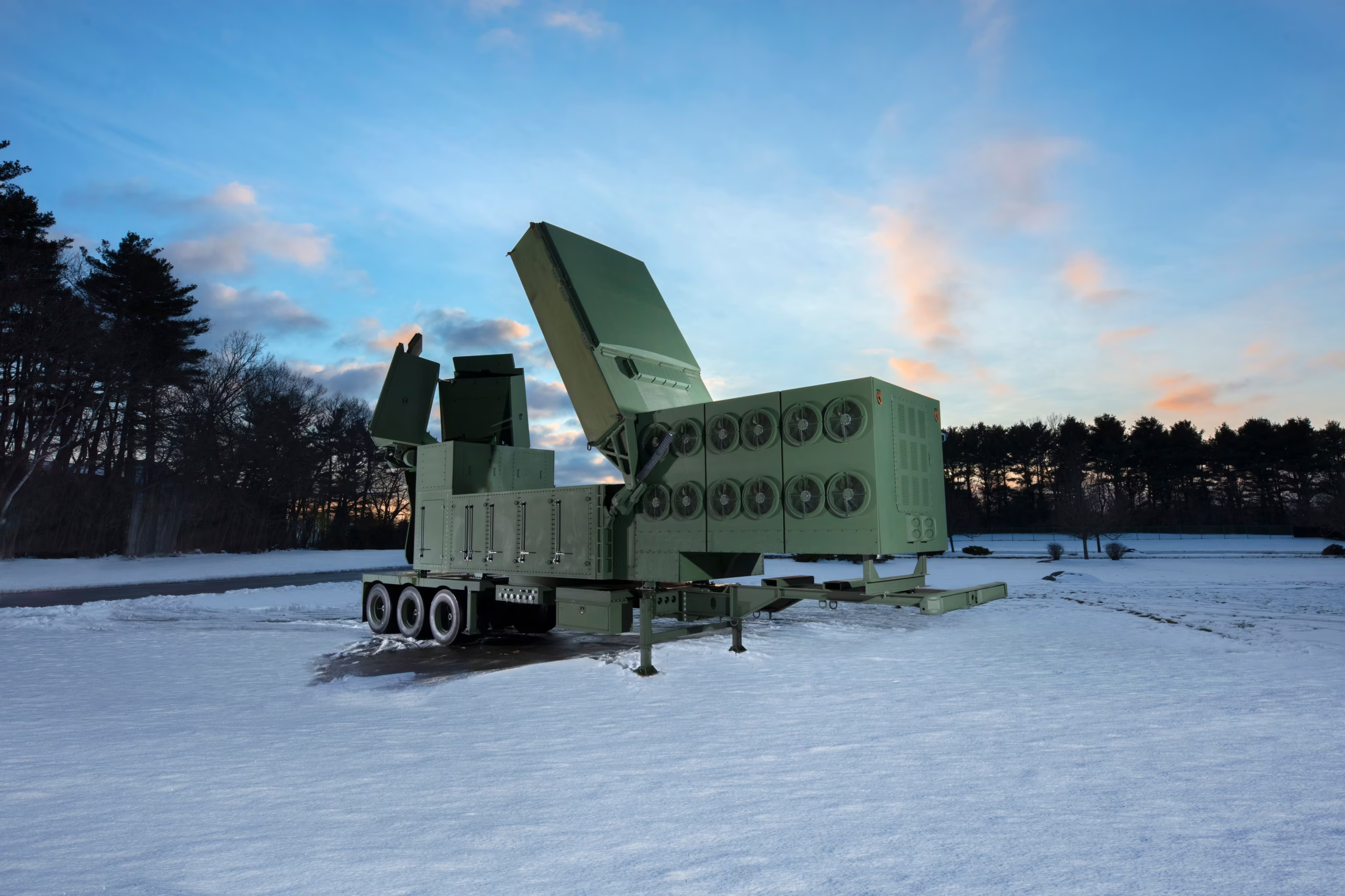
RTX Corporation (NYSE: RTX) and Redwire Corporation (NYSE: RDW) are both riding powerful long-term tailwinds as defense budgets grow and space exploration investment accelerates globally.
Growing geopolitical tensions continue to generate meaningful opportunities across the aerospace and defense industry, positioning both companies for sustained demand in their respective markets.
RTX operates as a diversified aerospace and defense leader with deep exposure to commercial aviation and military programs, supported by its Pratt & Whitney, Collins Aerospace and advanced defense divisions.
Redwire occupies a different part of the market as a fast-growing space infrastructure company serving national security, civil space and commercial space customers through satellite components, space manufacturing, digital engineering and avionics.
In July 2026, RTX’s Collins Aerospace unit entered a joint venture with Etihad Airways Engineering to provide maintenance, repair and overhaul services for Airbus A350 and Boeing 787 aircraft in Abu Dhabi, which will double Collins’ nacelle MRO footprint in the Middle East.
The new Collins Aerospace facility resulting from that partnership is expected to become operational in the first quarter of 2027, extending RTX’s global aerospace services reach at a critical time.
RTX reported second-quarter 2026 revenues of $24.7 billion, representing a 14.5% year-over-year increase driven by strong commercial aftermarket performance and robust defense demand across its business segments.
The company’s order backlog expanded 22% to a record $289 billion, providing exceptional revenue visibility and underscoring the sustained demand environment across commercial aviation and defense markets.
Redwire announced a major expansion of its Huntsville, Alabama campus in July 2026, adding 164,000 square feet of manufacturing and engineering capacity focused on mission-critical space and defense technologies for the U.S. military and its allies.
The company also opened a new 30,000-square-foot, vertically integrated research and microgravity payload development facility in Georgetown, Indiana, designed to serve as a global hub supporting NASA, pharmaceutical, biotechnology and advanced materials customers.
The Zacks Consensus Estimate for RTX’s 2026 sales and earnings per share implies growth of 8.4% and 14%, respectively, from the prior year, with annual bottom-line estimates moving higher over the past 60 days.
Redwire’s 2026 consensus estimates are considerably more aggressive, pointing to sales growth of 40.6% and EPS improvement of 50.6%, though the company’s execution record raises legitimate questions about its ability to deliver on those projections.
RTX delivered an average earnings surprise of 14.21% across the last four quarters, while Redwire posted a deeply negative average earnings surprise of 115.20% over the same period, a stark contrast in execution quality.
Over the past year, RTX shares surged 36.7% while Redwire lost 38.9%, a divergence that reflects the market’s preference for consistent execution and financial visibility over speculative high-growth narratives.
On valuation, Redwire trades at a forward price-to-sales multiple of 3.74, above RTX’s forward sales multiple of 2.96, meaning investors are paying a premium for Redwire despite its weaker earnings track record.
RTX currently carries a Zacks Rank of 2, categorized as a Buy, while Redwire holds a Zacks Rank of 3, categorized as a Hold, giving RTX a clear edge in near-term investment appeal.
While Redwire’s expanding space infrastructure business offers higher theoretical growth potential, RTX’s combination of a record backlog, disciplined execution and attractive valuation makes it the more compelling investment choice at this stage.
