
The question is not how Turkey can be integrated into Europe, but rather how the Turks can become Europeans
New Turks are needed to achieve a new Turkey
The formation of the Turkish nation—that is, of the Turkish identity—is a process that has not yet ended, and the West should not lose the chance to get actively involved to help the Turkish nation become more modern.
Today, there really are three geographical and three political Turkeys. The “European” Turkey has the greatest potential to integrate with Europe. If Turkey was comprised solely of Istanbul, Eastern Thrace, and Izmir, and a population of 25-30 million, it would have fewer problems in terms of its integration with Europe. However, Turkey’s central and eastern parts are burdensome in this regard to its western parts.

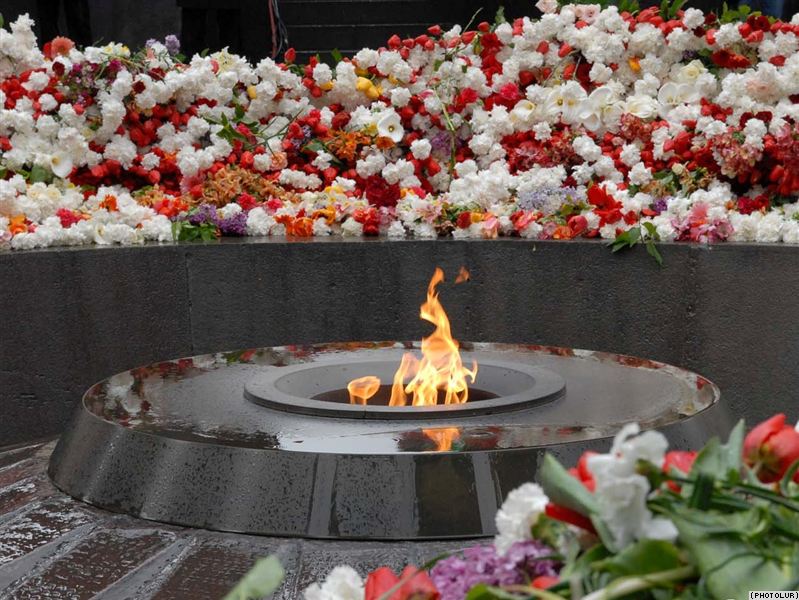
The Armenian Genocide Memorial in Yerevan. April 24 marked the 95th anniversary of the genocide perpetrated against Armenians in Ottoman Turkey (Photo: RFE/RL)
The “political” Turkey, too, is divided into three parts. The Islamists, who dominate the modern-day Turkish society, have taken advantage of the opportunity endowed by democracy and are gradually “conquering” the secular nationalists, who were in power until 2002. The latter are the second major power in the political domain. The followers of Kemal Ataturk still have an overwhelming influence on the army and within the “deep state”.[1] And third, the weakest political division is comprised of the liberals and the Kurds who, even though they have different objectives, are nonetheless united against the clerical-nationalist political elite that rules the country, and against this elite’s characteristic mentality. And those who think that the creation of an independent Kurdistan in southeast Turkey can resolve this country’s main political and ethnic problems need to consider the fact that if this happens, Turkey’s progressive society could lose an ally in the form of the Kurds.
So, which of these Turkeys will the West support? What kind of a Turkey do the United States and the European Union want to encourage? That of Orhan Pamuk and Hrant Dink, Ibrahim Baylan and Yilmaz Kerimo, or that of Talat and Erdogan?[2]
After eight years of governance by the Islamists, it has become clear that their mindset does not differ all that much from that of the nationalists. Perhaps the most significant difference, however, is the fact that the modern-day Turkish republic has renewed its nationalist foundation with a clerical influence, which existed under Ottoman rule but has now become even stronger. Turkey, to that end, is not even hesitating to take steps that run counter to the interests of the democratic world. The Turkish diplomats continue to “urinate”—in both the literal and figurative sense—on the walls of Western embassies.[3]
Former Sovietologists must deal with Turkey
In actual fact, the former powerful empire, today’s Turkey still remains—albeit smaller—an empire; and its working mechanisms are virtually similar to those of the former USSR. Turkey has to go through the path of social democratization, ridding of ideological rhetoric, and the decolonization of its nations and nationalities, which the USSR went through by way of honoring and defending the rights of national, religious, and other minorities. Therefore the former Western Sovietologists and those new Turkologues who have received political and academic schooling from these Sovietologists can more efficiently deal with Turkey’s problems.
Despite the fact that in 2009 the Armenian-Turkish Protocols were signed with the goal of improving relations, the correlations between the two countries and peoples were much better in the past than today. This demonstrates how important it is, and specifically for its neighbors, that Turkey faces its history and that its citizens fundamentally change their way of thinking.
Some Western political scientists are hopeful that democracy will sooner or later come to Turkey, that its two extreme poles will ultimately discredit one another, and that, until then, the moderates will remain Turkey’s partners with the West.[4] But the true picture in Turkey shows something different: its society is becoming more fundamental, both in terms of Islam and nationalism.
The West failed in Turkey’s social and human modernization
In fact, in the past 65 years, the West has not been able to comprehensively assist in instilling civilizational and human values in Turkey. Hence, out of Turkey’s current population of 70 million, its liberal and civil societies are comprised of a mere 4-5 million, at best. And if we factor in the verity that this number is greatly constituted of the different national, religious and other minorities, just like at the turn of the past century, the fiasco for the West becomes especially apparent. Thus, when the Turkish Prime Minister Erdogan declares that he might deport all Armenian citizens living in Turkey, the protests against such statements coming from within Turkey are hardly audible.
The fact is that, even after Turkey’s 65-year permanent presence in the Euro-Atlantic mainstream, open-minded writers, journalists, and social and political figures are still being persecuted in that country, such as the prominent liberal-thinking Armenian journalist Hrant Dink, who was murdered. Before arresting his murderer, police officers first took their photographs with that killer, seen as a national hero. After all this, several tens of thousands of freethinking Turks took to the Istanbul streets to protest, shouting “We are Hrant Dink,” and “We are Armenian.” But the fact that such relatively few numbers of people spoke out leaves a lot to think about.
Moreover, the tremendous amounts that Western democratic funds have spent in order to “Europeanize” this Asian nation have in effect brought discomforting results, and this is a basis for concern. The strong “machine” of the “United” Europe, which is able to assimilate Iranian, Afghan, Indian and Lebanese immigrants even to this day, has, over the course of numerous years, demonstrated its incapability to assimilate the Turkish immigrant minority. It is not surprising that the Europeans are not in a hurry to grant Turkey access into the EU; otherwise what will the concept of a “European” transform into?
It is apparent that immediate and fundamental measures are needed to resolve this problematic issue. A new and effective plan is indispensable, or else the problem will become more complicated. And Turkey is already doing this. Based on the death of several scores of people during the street clashes in China’s Xinjiang province, it is accusing China of carrying out genocide against the Uighurs and Israel of organizing genocide in Gaza, but at the same time it is considering as absurd the fact of genocide in Darfur, where the Sudanese government—which is cordial to the Turkish government—and its lackeys have exterminated hundreds of thousands. And after all this, how can we hope that modern-day Turkey will acknowledge the sin of the Ottoman leaders, in 1915, of not only organizing and executing the genocide of the Armenians, but also of leaving the genocide survivors without ninety percent of their homeland, where the Armenian people had continuously lived for over three millennia?
So, let us call it like it is. The majority of Turkey’s ruling elites need to overcome nationalism. Will “political correctness” force the social and political figures of the West to persistently remain silent? Wouldn’t this tolerance cause the further deepening of nationalism, which we have already seen in Europe many years ago? In the event its demands are not implemented, Turkey is already threatening the world with destabilization in the Caucasus; that is to say, with instigating its “younger brother” Azerbaijan to start a war against Armenia. Azerbaijan is already spending more for just its military needs than all of Armenia’s state budget, and Turkish military instructors are teaching their Azerbaijani kinsmen everything they have learned from their Western partners. Do we have to wait until a segment of today’s Turkish elite turns into new Taliban, and talk and take action only after that?[5]
The Turkish prime minister’s statement that if the Armenian communities of the Western countries continue their campaign toward the recognition of the 1915 Armenian genocide, all Armenian nationals living in Turkey can be deported—(incidentally, the genocide of 1915 likewise had begun with the deportation of the Armenians)—is, unfortunately, wholly pragmatic in light of domestic politics and the upcoming elections in Turkey. Erdogan knows all too well what must be said so as to be liked by the majority of Turks, and he knows which dispositions must be complied with in order not to lose the electorate and to remain at the helm of power. He is simply satisfying the domestic social demand for the chauvinistic and xenophobic political product.
