
The question is not how Turkey can be integrated into Europe, but rather how the Turks can become Europeans
This is a demand that is growing by the year under the international community’s silent encouragement and the continued attempt, in the framework of the false “political correctness,” to not notice it. The facts are telling. Covering a sociological survey, the Hurriyet Daily News notes that 50-70 percent of Turks do not want to have an American, Jewish or a Christian neighbor, while 54 percent either tolerate torture or finds that it should be legalized.[6] This survey, which was conducted under the leadership of two professors from Turkey’s Sabanci University, clearly demonstrates that a mere 12 percent of Turks have a positive view of Christians; 10 percent, concerning the Jews; and 7 percent, with respect to the atheists. The absolute majority of Turks do not share Western values. According to the opinion poll conducted in 2009 by the PEW Research Center, 69 percent of Turks stated that he or she “does not like” the United States, and only 14 percent had warm disposition toward that country. In addition, 37.5 percent of Turks consider the United Sates to be Turkey’s main foreign political adversary. Fifty-nine percent of Turks confess that they do not like the European Union, and this is significant since 55 percent of Turks want to see their country in the EU.
In line with the 2009 Report of the European Court of Human Rights, Turkey was in first place—with 2395 petitions—in the number of petitions the Court had received concerning the violation of human rights. On top of that, the 2009 indicator had increased by 27 percent in comparison with the 2008 indicator.
Turkey’s Ministry of Culture and Tourism has launched an extensive plan aiming at restoring and renovating the monuments belonging to the Ottoman Empire’s cultural heritage in the Balkans. This is so even while thousands of monuments belonging to the Armenian cultural heritage are either being or have already been destroyed. In all probability as an act of “compensation,” just one Armenian cultural treasure, the church on Akhtamar Island in Lake Van, was renovated—but it was prohibited to place a cross on it.
Today numerous Western funds are spending tens of millions of dollars and euros to convince Turkey’s neighbors, and in particular the Armenians, that this country is no longer what it was back in 1915, that it has now become humanistic and fairly democratic. Perhaps it would be more effective if those amounts were spent on really changing the Turks.
Thanks to the ushering in of a new purpose that had started from Gandhism, the British colonialism of the 20th Century changed into global political responsibility toward the end of the last century and, attributable to the Denazification of 1945, the German colonialism turned into global repentance and atonement. The Ottoman colonialism, on the other hand, because of the superpowers’ centuries-long and still continuing coaxing and encouragement, became a global neo-Ottoman, multi-vector, and pretentious arrogance and hatred.
The matter concerning the surmounting of nationalism in Turkey has remained contemporary since 1915, and the aforesaid denazification methodology is probably applicable and effective.
Is a liberal Turkey possible?
Throughout the eight centuries of its existence, by having assimilated the millions of Greeks, Armenians, Jews, Laz, Kurds, northern Caucasians, Albanians, and Arabs who lived in it, the Turkish nation truly possesses a sufficient potential to become more modern, democratic, secure and predictable. However, this can take place not thanks to, but in spite of the nationalists and the radical Islamists. Turkey’s newly-forming, yet still small liberal-democratic civil society, which is primarily concentrated in Istanbul, can reveal the hidden civilizational potential of this young ethnos. It is not a happenstance that, over the course of its several-century existence, Turkey for the first time gave to this world a fairly estimable cultural figure, in the person of Orhan Pamuk.
If today the West does not become successful in substantially supporting and defending the movement by the progressive segment of the Turkish society, it is clear that this possibility will not exist tomorrow, when official Ankara finishes its geopolitical positioning change in the Greater Near East in the opposite direction of the universal human values.
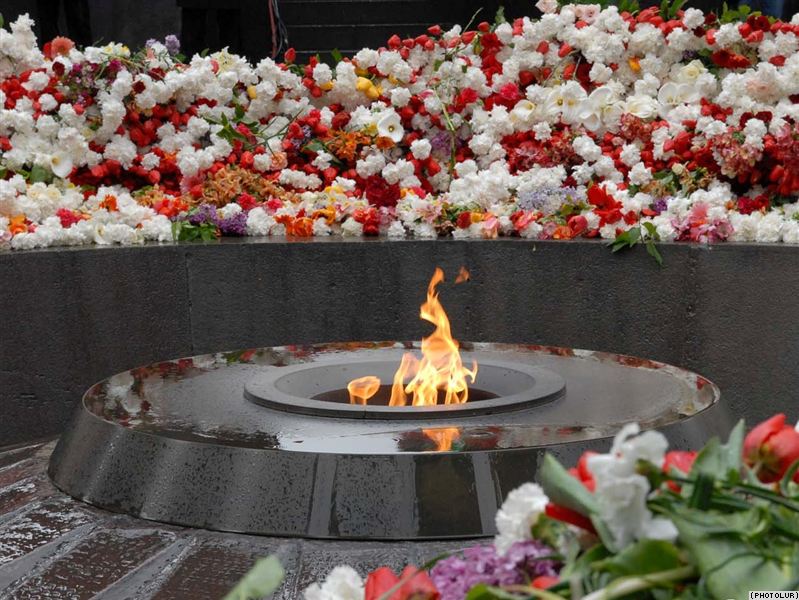
On the verge of the anniversary of the 1915 genocide of the Armenians in Ottoman Turkey, we are compelled to accept the fact that the Armenian people, who have become the victims of that terrible tragedy and have been left without their homeland, still do have all the grounds to be concerned. And it is not only the Armenians who should be concerned.
__________
[1] The typical expression of this phenomenon is the “Ergenekon” organization.
[2] Orhan Pamuk is a progressive Turkish writer and a Nobelist; Hrant Dink was the editor-in-chief of the Agos independent Armenian weekly newspaper, and he was killed by a Turkish nationalist in 2007; Ibrahim Baylan and Yilmaz Kerimo are the Swedish parliament’s Turkish-origin MPs who voted in favor of that country’s recognition of the 1915 Armenian; Talat Pasha was the minister of the interior of the Young Turk government during World War I and one of the organizers for the Armenian genocide; Recep Tayyip Erdogan has been the head of Turkey’s Islamist government since 2002.
[3] An incident took place on April 7, 2010 in which the Turkish ambassador to Afghanistan urinated on the wall of the U.S. embassy in that country.
[4] Nick Danforth, “How the West Lost Turkey”, Foreign Policy, November 25, 2009 http://www.foreignpolicy.com/articles/2009/11/25/how_the_west_lost_turkey?page=0,1
[5] Let us remember that the Taliban, too, had gained strength due to efforts by the West.
[6] http://www.hurriyetdailynews.com/n.php?n=mamma-li-turchi-2009-11-19
