1 2 3 Single Page

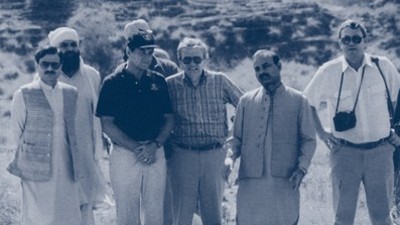
Then Maj. Gen. Hamid Gul, Director General of the ISI (far left), with William Webster, Director of Central Intelligence, Clair George, Deputy Director for Operations, and Milt Bearden, CIA station chief, at a training camp for the mujahedeen in Pakistan's North-West Frontier Province in 1987 (RAWA.org)
In an exclusive interview with Foreign Policy Journal, retired Lt. Gen. Hamid Gul responds to charges that he supports terrorism, discusses 9/11 and ulterior motives for the war on Afghanistan, claims that the U.S., Israel, and India are behind efforts to destabilize Pakistan, and charges the U.S. and its allies with responsibility for the lucrative Afghan drug trade.
Retired Lieutenant General Hamid Gul was the Director General of Pakistan’s Inter-Services Intelligence (ISI) from 1987 to 1989, during which time he worked closely with the CIA to provide support for the mujahedeen fighting the Soviet occupation of Afghanistan. Though once deemed a close ally of the United States, in more recent years his name has been the subject of considerable controversy. He has been outspoken with the claim that the terrorist attacks of September 11, 2001 were an “inside job”. He has been called “the most dangerous man in Pakistan”, and the U.S. government has accused him of supporting the Taliban, even recommending him to the United Nations Security Council for inclusion on the list of international terrorists.
In an exclusive interview with Foreign Policy Journal, I asked the former ISI chief what his response was to these allegations. He replied, “Well, it’s laughable I would say, because I’ve worked with the CIA and I know they were never so bad as they are now.” He said this was “a pity for the American people” since the CIA is supposed to act “as the eyes and ears” of the country. As for the charge of him supporting the Taliban, “it is utterly baseless. I have no contact with the Taliban, nor with Osama bin Laden and his colleagues.” He added, “I have no means, I have no way that I could support them, that I could help them.”
After the Clinton administration’s failed attempt to assassinate Osama bin Laden in 1998, some U.S. officials alleged that bin Laden had been tipped off by someone in Pakistan to the fact that the U.S. was able to track his movements through his satellite phone. Counter-terrorism advisor to the National Security Council Richard Clarke said, “I have reason to believe that a retired head of the ISI was able to pass information along to Al Qaeda that the attack was coming.” And some have speculated that this “retired head of the ISI” was none other than Lt. Gen. Hamid Gul.
When I put this charge to him, General Gul pointed out to me that he had retired from the ISI on June 1, 1989, and from the army in January, 1992. “Did you share this information with the ISI?” he asked. “And why haven’t you taken the ISI to task for parting this information to its ex-head?” The U.S. had not informed the Pakistan army chief, Jehangir Karamat, of its intentions, he said. So how could he have learned of the plan to be able to warn bin Laden? “Do I have a mole in the CIA? If that is the case, then they should look into the CIA to carry out a probe, find out the mole, rather than trying to charge me. I think these are all baseless charges, and there’s no truth in it…. And if they feel that their failures are to be rubbed off on somebody else, then I think they’re the ones who are guilty, not me.”
General Gul turned our conversation to the subject of 9/11 and the war on Afghanistan. “You know, my position is very clear,” he said. “It’s a moral position that I have taken. And I say that America has launched this aggression without sufficient reasons. They haven’t even proved the case that 9/11 was done by Osama bin Laden and al Qaeda.” He argued that “There are many unanswered questions about 9/11,” citing examples such as the failure to intercept any of the four planes after it had become clear that they had been hijacked. He questioned how Mohammed Atta, “who had had training on a light aircraft in Miami for six months” could have maneuvered a jumbo jet “so accurately” to hit his target (Atta was reportedly the hijacker in control of American Airlines Flight 11, which was the first plane to hit its target, striking the North Tower of the World Trade Center at 8:46 am). And he made reference to the flight that hit the Pentagon and the maneuver its pilot had performed, dropping thousands of feet while doing a near 360 degree turn before plowing into its target. “And then, above all,” he added, “why have no heads been rolled? The FBI, the CIA, the air traffic control — why have they not been put to question, put to task?” Describing the 9/11 Commission as a “cover up”, the general added, “I think the American people have been made fools of. I have my sympathies with them. I like Americans. I like America. I appreciate them. I’ve gone there several times.”
At this point in our discussion, General Gul explained how both the U.S. and United Kingdom stopped granting him an entry visa. He said after he was banned from the U.K., “I wrote a letter to the British government, through the High Commissioner here in Islamabad, asking ‘Why do you think that — if I’m a security risk, then it is paradoxical that you should exclude me from your jurisdiction. You should rather nab me, interrogate me, haul me up, take me to the court, whatever you like. I mean, why are you excluding me from the U.K., it’s not understandable.’ I did not receive a reply to that.” He says he sent a second letter inviting the U.K. to send someone to question him in Pakistan, if they had questions about him they wanted to know. If the U.S. wants to include him on the list of international terrorists, Gul reasons, “I am still prepared to let them grant me the visa. And I will go…. If they think that there is something very seriously wrong with me, why don’t you give me the visa and catch me then?”
‘They lack character’
I turned to the war in Afghanistan, observing that the ostensible purpose for the war was to bring the accused mastermind of the 9/11 attacks, Osama bin Laden, to justice. And yet there were plans to overthrow the Taliban regime that predated 9/11. The FBI does not include the 9/11 attacks among the crimes for which bin Laden is wanted. After the war began, General Tommy Franks responded to a question about capturing him by saying, “We have not said that Osama bin Laden is a target of this effort.” The Chairman of the Joint Chiefs of Staff, Richard Myers, similarly said afterward, “Our goal has never been to get bin Laden.” And President George W. Bush himself said, “I truly am not that concerned about him.” These are self-serving statements, obviously, considering the failure to capture bin Laden. But what, I asked General Gul, in his view, were the true reasons for the invasion of Afghanistan, and why the U.S. is still there?
“A very good question,” he responded. “I think you have reached the point precisely.” It is a “principle of war,” he said, “that you never mix objectives. Because when you mix objectives then you end up with egg on your face. You face defeat. And here was a case where the objectives were mixed up. Ostensibly, it was to disperse al Qaeda, to get Osama bin Laden. But latently, the reasons for the offensive, for the attack on Afghanistan, were quite different.”
1 2 3 Single Page
atheo
August 15, 2009 at 12:54 pm
Weber, in case you hadn’t noticed, control of colonies through direct occupation was shown to be uneconomic and the practice was abandoned half a century ago. Contemporary imperial power is exercised through access to finance and trade, a much more advanced and profitable method.
Military occupation around the world to sequester energy? Ridiculous!
There is no reason to presume that the Taliban were not as susceptible to exploitation by transnational interests as any other national leadership. Zip. One failed negotiation over what turns out to be a totally inconsequential pipeline does not explain a decades long occupation. Get your thinking cap on.
atheo
August 15, 2009 at 6:25 pm
Jeremy you have failed absolutely in substantiating your silly belief that energy constitutes a motive for the occupation of Afghanistan.
You have also failed to cite one single example ever of the US depriving China access to energy or indeed what would possibly be a rational motivation to do so.
Perhaps you should simply admit that you accepted a meme without critical analysis.
Jeremy R. Hammond
August 16, 2009 at 1:44 am
Jeremy you have failed absolutely in substantiating your silly belief that energy constitutes a motive for the occupation of Afghanistan.
I’ll remind you that UNOCAL led an American consortium that was competing with an Argentine company in wooing the Taliban. The U.S. had no problem with the Taliban until two things happened: 1) a women’s rights movement arose pressuring the Clinton administration to get tough with them, a cause Madeleine Albright took up, and 2) UNOCAL informed the Congress that no pipeline deal could go forward unless the Taliban regime was replaced. Plans were in place before 9/11 to overthrow their rule.
I recommend you read Zbigniew Brzezinski’s The Grand Chessboard. Of course energy is a major factor in policy makers’ decisions. The U.S. is establishing military bases to exercise hegemony over energy-rich regions. This is a no-brainer, really, atheo. The Iraq war is a further example, needless to say.
You have also failed to cite one single example ever of the US depriving China access to energy or indeed what would possibly be a rational motivation to do so.
You have failed to look at the examples I gave you in the following study (there is of course no shortage of others, but this single study suffices to demonstrate your error): “Managing China-U.S. Energy Competition in the Middle East” http://www.cfr.org/publication/9569/
Webber
August 15, 2009 at 9:27 pm
The US is not “waiting” in Afghanistan to interfere with energy flow to China, it is there to ensure that the natural resources – oil and gas – flow uninterrupted through Turkmenistan and Tajikistan out to Europe.
The U.S. will control the pipelines while selling the oil and gas to Europe, thus containing Europe’s growth, as well as China’s. That was precisly why Iraq was invaded and occupied and why Iran is next. Just look at a map of global oil reserves per country and you’ll see a direct correlation between those figures and US invasions.
The US consumes 20% of the world’s oil supplies. The rational is that it is as essential for the US economy as air is to humans. With peak oil approaching in 2050, why is it so difficult for you to put two and two together and reach a sound conclusion on your own?
As for the evidence, it’s there. A simple Google search will bring up plenty of sources.
Finally, I find it interesting that you chose to isolate one aspect (the TAPI pipeline) while ignoring the bigger picture. Trends matter. For crying out loud, the writing is on the wall, just open your eyes.
That alone, tells me you have an agenda.
How do you explain the mega sized embassies in Iraq and Pakistan?
Are you prepared to talk about those facts, or will you continue to pretend that everything else is irrelevant while obsessing over a pipeline?
And yes, Bush invaded Afghanistan over the TAPI pipeline. The Taliban in 2001 refused to allow the US access to carry out repairs and so the US used 9/11 as an excuse to invade.
atheo
August 15, 2009 at 10:51 pm
Webber, your comment is utterly nonsensical. The US does not need to occupy Afghanistan to guarantee uninterrupted oil and gas flow through Turkmenistan Tajikistan. Furthermore the east-west pipelines, servicing Europe and China, which have been recently built, as well as those under construction, primarily service Chinese and Russian corporate interests although G.E. and Haliburton are contracted to supply pumping stations. Installation of pumping stations hardly contributes to control either though, so your theory seems to be a complete washout.
Throwing in the fact that the US consumes 20% of global production fails to contribute to your argument. The US consumes 20% of most products, shall we then infer that it is the beef that is the motive or perhaps it’s about Chinese silk exports?
If you want to adhere to all these bizarre theories you should study the basics and apply logic to what you uncover, then see if what you find supports the popular meme.
Take off your blinders. ‘Peak Oil” is a hoax. I have already provided good links on the subject earlier in the thread but here is yet another:
Is There an Oil Shortage?
By ISMAEL HOSSEIN-ZADEH
http://atheonews.blogspot.com/2009/08/is-there-oil-shortage.html
Start with that Weber, then we can address your other questions.
Jeremy R. Hammond
August 16, 2009 at 1:55 am
Atheo says: 1) The U.S. and China are not competing for energy resources, and 2) “‘Peak Oil’ is a hoax” (in other words, there will always be a plentiful supply of cheap energy).
I think that about sums up the merits of his argument.
atheo
August 16, 2009 at 2:10 am
Brzezinki’s The Grand Chessboard is straight out of a different era. A bi-polar, cold war world.
Iran is the target here, not China or Russia. If anything Russia and China are natural allies in the suppression of Islamic militancy, repression of national movements by NATO is serving to improve Russian and Chinese state power relative to their minority communities.
It is an expression of Western supremacism though, but not a struggle with China.
Outside of bringing up a Carter era wonk you simply repeat the same TAPI story that we already dealt with. The fact that plans for invasion were in place before 9/11 is a straw man argument. I never claimed that the invasion was a response to 9/11, however it exposes your inability to imagine any other possible motive besides your silly little pipeline agreement. Let’s see, they were tens of millions apart in the last go round of the negotiation, yet the US has spent hundreds of billions occupying the nation for going on a decade. A decade later the opportunity has been eclipsed by alternative developments. Does that seem like what its all about to you Jeremy? Really???
You have still failed to cite one example of the US depriving China access to oil. So you are presenting an entirely imaginary scenario.Outside of total war, oil embargoes don’t work, oil is fungible. That’s why the 70′s Arab oil embargo failed.
The US has expended vastly more in the invasion and ongoing occupation of Iraq than it could possibly ever gain even if it were somehow to amazingly be able to exploit Iraq’s oil. That’s the no-brainer Jeremy. The facts just don’t square with your allegation.
Jeremy R. Hammond
August 16, 2009 at 11:53 pm
Atheo, the war has nothing to do with “suppression of Islamic militancy”. No more than Iraq was about WMD. The fact that there were plans to overthrow the Taliban before 9/11 is not a “strawman”, it serves to demonstrate a) that 9/11 was merely a pretext but the war was fought for other motives, and b) the U.S. wanted the Taliban gone. Why? If you think it had nothing to do with the region’s energy resources (despite the fact that UNOCAL had told the Congress that no deal could go forward under the Taliban regime), then why did the U.S. want to overthrow the Taliban before 9/11? What was the point?
The Grand Chessboard is not from the Cold War era. It’s from 1997. And its highly relevant as it reveals the mindset of policymakers towards the region. Needles to say, energy has everything to do with it.
Now, you asked if I think it was “all about” the energy. No. I told you before that was only one reason. The greater reason is global hegemony. We now have military bases in the region from which to exercise hegemony.
Finally, you continue to deny that the U.S. competes with China for energy. Yes, there is cooperation in some areas, but to deny that two major powers compete in this area is asinine. Does this study deal with reality, or an “imaginary scenario? “Managing China-U.S. Energy Competition in the Middle East” http://www.cfr.org/publication/9569/. There’s nothing “imaginary” about. Read the study.
And now you’re arguing that the Iraq was was also not about oil? Really? So, I suppose if Iraq’s main export was broccoli, we’d still be there, right? Again, the larger goal was hegemony. But we needn’t speculate as to the reasons for the war. Policy makers stated explicitly beforehand that the reasons for wanting regime change in Iraq were a) to reestablish U.S. “credibility” and b) to ensure access to Iraq’s oil resources (typically “U.S. strategic interests” in policy papers, but sometimes the euphemism was dropped, as in the 1992 Defense Planning Guidance document).
atheo
August 16, 2009 at 2:19 am
“Jeremy R. Hammond says:
August 16, 2009 at 1:55 am
Atheo says: 1) The U.S. and China are not competing for energy resources, and 2) “‘Peak Oil’ is a hoax” (in other words, there will always be a plentiful supply of cheap energy).
I think that about sums up the merits of his argument.”
I’m truly embarrassed for you Jeremy, the cited comment could only come from someone that is patently closed minded or an adherent of some blind faith. You are so wrapped up in your absolutely baseless fantasy that there is some energy crisis that is responsible for our foreign policy that you simply shut out the fact that there is no evidence of any of your suppositions. The US has never ever once molested Chinese or Russian oil shipping anywhere throughout the globe. Furthermore, there are many times more proven hydrocarbon fuels than all hydrocarbons used to date. These are historical facts Jeremy.
CHENGHEZ KHAN
August 16, 2009 at 12:54 pm
Gen Hamid Gul is the brilliant person since he had worked with CIA during Soviet invasion in Afghanistan therefore he knows all the tricks in the CIA /Mossad bag.
The problem with Americans are that they like to learn the lesson the hard way and they forget it very soon…for example vietnam..now Iraq and Afghanistan.
If American-Indian-and Israeli nexus don’t stop supporting insurgents in pakistan from Afghanistan then it will be in the best intrest of Pakistan to entangle America,Britain and Nato in prolonged war with Afghan Taliban with the support of other regional player China and Iran…current Economic depression and prolonged war,rising causualties among the foreign troops and the support of regional players are the right ingredients for Afghan Taliban to defeat the western invaders…The history has proved that Afghanistan is slaughterhouse for the foreign invaders.
atheo
August 17, 2009 at 1:47 am
Jeremy,
Your belief that “energy has something to do with it” is entirely your unsubstantiated intuitive feeling.
Brzezinski is just a Russophobic Polish octagenarian crank that has a cold war view.
The West has done everything it can to integrate its economy with China’s. To the point that open hostility would be economically unthinkable. This has been a long deliberate process.
Your contention that the US needed bases in the region is undermined by the fact that the US indeed has had many bases in the region, Qatar, Turkey, Diego Garcia, Azerbaijan, Krgyzstan to name just a few. The US has always had global naval dominance and could always have easily interdicted Chinese oil shipments at sea if the TAPI line had been developed. Indeed, as we may soon witness in aggression toward Iran, naval power is what the US would use in impeding trade.
As to an alternative motive, why not read Oded Yinon’s scheme:
The Prophecy of Oded Yinon
Is the US Waging Israel’s Wars?
By LINDA S. HEARD
April 25, 2006
http://www.counterpunch.org/heard04252006.html
I find it hilarious that you can’t find anything at the link you posted that you can cite in backing up your bizarre claim that the US has sought to deny China access to energy.
Your childish notion of the Iraq occupation being about oil is evidence that you have never taken a look at the fact that the occupation has been costing over ten times the total oil revenues through most of the period of occupation. Imperialism just doesn’t work that way. Another risible conclusion that you have drawn with not a shred of hard evidence to confirm it. By contrast the evidence that the Israel-first architects of US policy have been pursuing the goals of Zionist expansion is abundant, in fact overwhelming.
Jeremy R. Hammond
August 17, 2009 at 7:33 am
Atheo, you don’t seem interested in a serious, honest discussion, evidenced by remarks like, “Your belief that “energy has something to do with it” is entirely your unsubstantiated intuitive feeling.” Again, I refer you to sources I’ve mentioned. What I already gave you is perfectly sufficient, but there’s no shortage of other sources I can point to.
The Grand Chessboard offers many insights into the mind of policy makers, and energy has everything to do with the case he makes there. I’ve given you that; you dismissed it on the grounds that it was a Cold-War era book when in fact it was published in 1997.
I’ve given you the draft 1992 Defense Planning Guidance, which stated that the U.S. would use force to protect its “interests” in the region; “interests” are later defined therein as “primarily Persian Gulf Oil”. I didn’t author that; it’s hardly my “unsubstantiated intuitive feeling”. Yet you simply dismissed this with precisely zero consideration.
PNAC’s Rebuilding America’s Defenses manifesto clearly outlines the desired role of the U.S. as the hegemonic power in the region to “protect” U.S. “interests” as so defined.
Or check out the study, “Strategic Energy Policy Challenges for the 21st Century” from the James A. Baker III Institute for Public Policy of Rice University and the CFR, April 2001, stating that the “report’s central dilemma” is that “the American people continue to demand plentiful and cheap energy without sacrifice or inconvenience. But emerging technologies are not yet commercially viable to fill shortages and will not be for some times.” It states that “U.S. international oil policy has relied on maintenance of free access to Middle East Gulf oil and free access for Gulf exports to world markets”, but that the U.S.’s “Gulf allies are finding their domestic and foreign policy interests” and the “resulting tight markets have increased U.S. global vulnerability to disruption and provided adversaries undue potential influence over the price of oil. Iraq has become a key ‘swing’ producer, posing a difficult situation for the U.S. government.“ It noted that “Both Russia and the Caspian Basin countries show promise as key future suppliers of hydrocarbons…. But, bureaucratic, logistical, and political obstacles remain a hindrance to both the timely development of currently exploitable reserves and new discoveries.” The task force recommended a “supply-side approach” that “would aim to increase the amount of land available in the United States and around the world for resource exploration and exploitation” and stated that “an immediate policy review toward Iraq” should be undertaken, “including military” options. Moreover, “the exports from some oil discoveries in the Caspian Basin could be hastened if a secure, economical export route could be identified swiftly…. To this end, the administration should review policies toward this region. The option exists to downplay diplomatic activities that dictate certain geopolitical goals for specific transportation routes for Caspian oil in favor of immediate commercial solutions that may be sought by individual oil companies for short-term exports of ‘early’ oil, including exports through Iran. These geopolitical goals can later be articulated for longer-term pipeline routing questions into the next decade.” The report recommended an investigation into “whether any changes in U.S. policy would rapidly facilitate higher Caspian Basin oil exports.”
Oh, and on your assertion that the concept of Peak Oil is “a hoax”, the Rice/CFR task force report also noted, “In fact, the world is currently precariously close to utilizing all of its available global oil production capacity, raising the chances of an oil-supply crisis with more substantial consequences than seen in three decades.” “A crisis could erupt at any time from any number of factors and would inevitably affect every country in today’s globalized world. While the origins of a crisis are hard to pinpoint, it is clear that energy disruptions could have a potentially enormous impact on the U.S. and the world economy, and would affect U.S. national security and foreign policy in dramatic ways.”
Surely, you’re familiar with the Bush administration energy task force headed up by Cheney, documents from which, obtained by Judicial Watch by lawsuit, include maps of Iraqi oil fields and potential contract bidders.
Look at National Security Directives from multiple presidents declaring that the U.S. will use force to protect its access to the region’s energy. NSD 26 under President George H. W. Bush, for example, states plainly, “Access to Persian Gulf oil and the security of key friendly states in the area are vital to U.S. national security. The United States remains committed to defend its vital interests in the region, if necessary and appropriate through the use of U.S. military force, against the Soviet Union or any other regional power with interests inimical to our own.” This was repeated in NSD 45: “U.S. interests in the Persian Gulf are vital to the national security. These interests include access to oil and the security and stability of key friendly states in the region. The United States will defend its vital interests in the area, through the use of U.S. military force if necessary and appropriate, against any power with interests inimical to our own.” And NSD 54: “Access to Persian Gulf oil and the security of key friendly states in the area are vital to U.S. national security.”
I would additionally direct your attention once again (I’ve referenced it several times already) to the “U.S. Interests in the Central Asian Republics” hearing before the Subcommittee on Asia and the Pacific of the Committee on International Relations, in the House of Representatives, February 12, 1998, in which Doug Bereuter (Nebraska) opened by saying “the collapse of the Soviet Union has unleashed a new great game, where the interests of the East India Trading Company have been replaced by those of Unocal and Total, and many other organizations and firms. Today the Subcommittee examines the interests of a new contestant in this new great game, the United States…. Stated U.S. policy goals regarding energy resources in this region include fostering the independence of the States and their ties to the West; breaking Russia’s monopoly over oil and gas transport routes; promoting Western energy security through diversified suppliers; encouraging the construction of east-west pipelines that do not transit Iran; and denying Iran dangerous leverage over the Central Asian economies.”
Robert W. Gee, Assistant Secretary for Policy at the U.S. Department of Energy testified that “The U.S. Government’s position is that we support multiple pipelines with the exception of the southern pipeline that would transit Iran. The Unocal pipeline is among those pipelines that would receive our support under that policy. I would caution that while we do support the project, the U.S. Government has not at this point recognized any governing regime of the transit country, one of the transit countries, Afghanistan, through which that pipeline would be routed. But we do support the project.”
John Maresca, vice president fore international relations of UNOCAL, argued “the need for U.S. support for international and regional efforts to achieve balanced and lasting political settlements to the conflicts in the region, including Afghanistan…. Mr. Chairman, the Caspian region contains tremendous untapped hydrocarbon reserves. Just to give an idea of the scale, proven natural gas reserves equal more than 236 trillion cubic feet. The region’s total oil reserves may well reach more than 60 billion barrels of oil. Some estimates are as high as 200 billion barrels…. Because the region’s pipelines were constructed during the Moscow-centered Soviet period, they tend to head north and west toward Russia. There are no connections to the south and east…. At Unocal, we believe that the central factor in planning these pipelines should be the location of the future energy markets that are most likely to need these new supplies [read India and China, among others]…. One option is to go east across China, but this would mean constructing a pipeline of more than 3,000 kilometers just to reach Central China…. The second option is to build a pipeline south from Central Asia to the Indian Ocean. One obvious route south would cross Iran, but this is foreclosed for American companies because of U.S. sanctions legislation. The only other possible route is across Afghanistan, which has of course its own unique challenges. The country has been involved in bitter warfare for almost two decades, and is still divided by civil war. From the outset, we have made it clear that construction of the pipeline we have proposed across Afghanistan could not begin until a recognized government is in place that has the confidence of governments, lenders, and our company…. It’s not going to be built until there is a single Afghan Government. That’s the simple answer…. In any case, because of the financing situation, credits are not going to be available until there is a recognized government of Afghanistan.“
But energy has nothing to do with it, Peak Oil is “a hoax”, the U.S. doesn’t compete with China for access to energy resources, and everything I’ve said to the contrary is just my “unsubstantiated intuitive feeling”. Just let me know, atheo, if you change your mind and want to engage in a seriousdiscussion of the issue. Otherwise, count me out. I’ve no time to further humor such asinine remarks.
Jeremy R. Hammond
August 17, 2009 at 7:41 am
Now, atheo as to “As to an alternative motive, why not read Oded Yinon’s scheme:” We’ve had this discussion, atheo, 2 years ago. I authored this piece in response to your assertions: http://hammond.foreignpolicyjournal.com/2009/07/28/the-reasons-for-regime-change-in-iraq/
Last thing, “I find it hilarious that you can’t find anything at the link you posted that you can cite in backing up your bizarre claim that the US has sought to deny China access to energy.” What I said is that the U.S. competes with China for energy resources. I find it hilarious that you say a report entitled ““Managing China-U.S. Energy Competition in the Middle East” (http://www.cfr.org/publication/9569/) offers nothing to support the “claim” that the U.S. competes with China for energy resources.
Again, atheo, let me know if you change your mind and want to engage in a serious discussion.
CHENGHEZ KHAN
August 17, 2009 at 3:41 am
There is so much hatred against America in Islamic world because of its policies..that it will not be easy to get friendly response from muslims…I am talking about the muslim masses not their puppet leaders.Instead of containment of China America wasted its resources on anti lslamic ventures and identyfting Islam with terror……provoking muslims and labling them as terrorists……now the genie called China got bigger and powerful then it was few decades before…and this is the right time for China-Russia nexus to exlploit the anti-west sentiments in the Islamic worlds and turn the tide agianst west….now it is too late for Brzezinki to pit the Islamic forces against China or Russia even muslim friendly Obama will not make any difference.Brzezinki is checkmated on the Grand chessbaord.
Rehmat
August 17, 2009 at 3:45 pm
In her recent interview on the Mike Malloy Show – the former FBI translator, Sibel Deniz Edmonds (b.1970), who was fired for her objections to some secret dirty work being carried out by the Zionist Administration in the name of US citizens – reveals that the successive Zionist Aministrations under Clinton and Bush have kept intimate relations with Osama Bin Laden until September 11, 2001.
“Washington’s claim that since the fall of Soviet Union it cancelled all its intimate relationship with Bin Laden and Taliban – all those things can be proven lies, very easily, based on the information they classified in my case, because we did carry very intimate relationship with these people and it involves Central Asia, all the way up to September 11, 2001….”
Sibel Deniz Edmonds also believes that there is a close relation between Turkish Jewish Deep State and American neocon Jewish Deep State. She has accused several Pentagon officials working as “mole” for Israel and Turkey….. Lawrence Franklin (a former Pentagon analyst, who was jailed in 2006 for passing US defence information to Israel Lobby and sharing classified information with the Israeli diplomat) was “one of the top people providing information and packages during 2000 and 2001 (Chris Gourlay in TimesOnline, January 6, 2008)”.
Sibel’s testimony to the 9/11 Commission has entirely been suppressed as she explained in her article titled open letter to the 9/11 panel (Anti-War com, August 2, 2004).
Canadian Jewish academic, Henry Makow PhD in his July 23, 2004 article titled 9/11 Traitors Absolve Themselves wrote: “The independent 9/11 investigation is no more independent than Warren Commission. Essentially the perpetrators investigated themselves…..Its chairman Thomas H. Kean, former NJ Governor, is a grandson of Hamilton Fish Kean, who was a banker with JP Morgan (a Jewish investment group)…..The government appropriates $25 billion for Homeland Security but appears incapable of doing more than issue face-saving warnings about the inevitability of another attack. I could provide this service for much less. They are not there to prevent the terror but to administer it…..”
Last year, Leslie Hughes, a veteran journalist from Winnepeg, was honored with the ”anti-Semite” title by the Canadian Jewish Congress (CJC) for her article written in 2003, Get the Truth, claiming that since Israeli government owned Zim shipping company broke its lease and moved its 200 employees from WTC just one week before 9/11 – proved that Israel had foreknowledge of 9/11. Liberal Party leader Stephane Dion refused to issue party ticket to Leslie for the election.
Sibel’s father, Dr. Rasim Deniz (d. 2000), was born in Tebriz (Iran). He spoke in Persian, Turkish and Azerbaijani – the native languages of the part of Iran. He was head of Burn Centre in Tehran’s central hospital. Dr. Deniz was a frequent target of Shah’s secret police SAVAK for his secular and anti-government views. After Islamic Revolution (1979), the family fearing the strict religious agenda of Revolutionary Guards – it fled to Turkey.
Sibel’s high-school competition paper on ‘Turkey’s Censorship Law’ – criticizing Kemalist laws against freedom of speech and literature – outraged her Principal, who asked her father to get her to write on some other topic. At that her uncle, Baykal Deniz, Mayor of Istanbul. The family decided to sent her to the United States based on country’s false image of being a “nation of freedom and democracy”. After her experience at the hands of Zionist mafia, she was quoted as saying: “Now I wonder was it just an illusion?”
Sibel got her Bachelor’s degree at George Washington University in criminal justice and psychology. In 1992, she married Matthew Edmonds, a divorced retail-technology consultant. After September 11, 2001 – she was the first Turkish language translator hired by FBI. Her job was to listen to the wire-taped intelligence information which comes in foreign languages – filter them and decide which one is important (”pertinent” in FBI terms).
After being fired – Sibel did what other earlier whistleblowers (Mike German, John Cole, etc.) had done – she appealed to the Congress. Later Attorney General John Ashcroft tried to wipe out Edmond’s legal action by invoking the state secrets privilege. Sibel’s lawyer has filed a US$10 million suit citing threat to Edmonds’ family, unable to look after her real-state and business interests in Turkey and her vilification in Turkish press.
http://rehmat1.wordpress.com/2009/08/04/sibel-bin-laden-worked-for-the-us-untill-911/
Rowan Berkeley
August 21, 2009 at 9:04 am
i always enjoy Hamid Gul’s interviews. He has wonderful verve. Also, living in the messy real world (unlike you, atheo) he is aware that things occur for multiple simultaneous reasons which get combined opportunistically. It is simply meaningless to ask which comes first in US mid-east policy formulation, Israel or the oil. they are alternately piggy-backed onto one another depending on the intended audience. This is why outcomes in international relations are often so undesired by all parties concerned, I think: each policy is trying to serve multiple goals simultaneously.
taukeer
August 30, 2009 at 2:34 pm
Atheo so what do you think is the grand design? If the objective was encirclement of Iran surely the US would have cut a deal with Taliban.
99
August 31, 2009 at 5:39 am
It’s all capitalism boyz. Peak oil or no peak oil, the current makeup of our oligarchy consists heavily of oil interests and industries that rely heavily on it. Israel provides the perfect excuse for much of the aggression aimed at bringing recalcitrant natives of other countries to agreement that we should have their resources, that they should quit impeding us in our claims to their wealth. It’s all a win/win/win/win/win/… for Western plutocrats because they make pots of money with all this carnage that secures all those resources. The ONLY thing that keeps them from just doing it openly, with no excuses but the basic profit motive, is that the masses can still turn against them if they can’t be put to sleep with righteous-sounding excuses.
And, obviously, it’s NOT ridiculous to try to occupy some countries to sequester energy, because some countries will NOT stay bought off without the barrel of a gun pointed directly at their heads of state and their parliaments. Iraq wasn’t going to budge and Iran isn’t going to budge and Afghanistan under the Taliban wasn’t going to budge either. Why would the Taliban be susceptible to our pecuniary inducements? They had plenty of others eager to do business with them at much greater profit to Afghanistan. The Taliban cut off our drug money. They cut off our access to pipeline building. They only made the classic mistake of brutalizing their people to give us our in. That much is abundantly clear.
Add to this the complete uncertainty of maintaining the wherewithal to be top bidder for control of resources, and it makes the idea of force, and all the lovely profits in it, even more alluring. You gotta have bases shoved up every ass or they WILL get away from you.
We ceded our financial dominance when we ceded our industrial base. What we did not cede was our military dominance. THAT is obviously the thing upon which the American… no, we can’t even call them “American” anymore… better to call them “Western”… oligarchs have relied to keep access to a monopoly on resources.
It doesn’t matter that Israel and pro-Israeli Americans have been avid participants: Israel is precisely the gift that never stops giving, the EXCUSE, the ever-ready excuse. That some Zionists have been power movers all along does not mean all this is Israel’s gig and America is its proxy. It just means some of them try to maneuver it that way, and we hate them for it because we hate their slaughter of innocents and freedom fighters.
And, anyway, all this is the oligarch’s gig and America is their proxy.
I repeat. This is capitalism. This is oligarchy. This is fascism. Globalizing.
And I’m glad to get General Gul’s input. Thanks.
99
August 31, 2009 at 5:54 am
Dammit. The phone rang and a bunch of emails all bonged while I was going to go flesh out a thought and correct a typo, and I zigged then instead of zagging.
I wanted to also point out that use of force and occupation, while killingly expensive for taxpayers, is really not a concern for the oligarchy because that force obviates the need to be the highest bidder. It ensures you have the highest profit margin. We’re not talking about the United States anymore. We’re talking about who runs it.
And the typo was in the line that should read: And, anyway, all this is the oligarchy’s gig and America is their proxy.
Sorry.
Annie ( Homes For Sale ) Wagner
October 7, 2009 at 8:34 am
Excellent site this http://www.foreignpolicyjournal.com and I was really pleased to see what I was looking for… this
It’s taken me literally 2 hours and 31 minutes of searching the web to find you (lol) ;) so I shall be very pleased to become a regular visitor
Thx
Dennis
December 2, 2009 at 8:09 pm
The ISI and the Pakistani military are perhaps the most paranoid organization outside of Burma and North Korea. Their only goal is to continue to engage in some vague survivalist game against the great threat from India.
General Gul’s sentiments simple illustrate the impotent rage the ISI feels at losing their pets in Afghanistan and the “strategic depth” that the Taleban provided in the face of an increasingly powerful India. See back in the 60s the Pakistani Army imagined that being the “martial race” they will easily conquer the Hindu-farmers and whatnot. 40 years of failure later, Pakistan is a basket case and India is on the verge of taking of. What does this do to an elite cradled with a belief that they are the true masters? Well it scares the shit out of them.
See, here we go “the Indians, despite a shrinking economy, have continued to raise their defense budget, by 20 percent last year and an additional 34 percent this year.”
I guess what the General really meant so say is “India, showing 6% growth last year was able to increase its military budget and expand its military arsenal by adding carriers and long range balistic missiles that will provide ultimate deterence to Beijing, thus neutralizing our greatest ally.
Pakistan in the mean time is in the middle of a civil war, incapable of upgrading its weapons because of the total collapse of the economy and not permitted to purchase the kind of weapons we want to face India with — advanced fighter jets and tanks. Instead the Americans might, and I emphasize might, permit us to buy cointer insurgency weaponry that is useless to us against the Hindus”
So yes, of course it is America’s fault and it is America’s ‘devious intent’ to ‘rob’ Pakistan of its rightful place in the sun as ‘the greatest military power in South Asia.’
Kissinger made a huge mistake in backing such an incomptent people just because Nixon hated Indira. Fortunately the US establishment has finally realized, at least in some parts of the third world, America might want to back a winner.
as to the paranoid ranters about 9/11 being an inside job, America destabalizing Pakistan for Israel or this being a replay of the “Great Game” please kindly go back to the comptuer strategy game forums you inhibit to replay your wet dreams of re-creating the 19th century with modern weapons.
Anthony L
May 2, 2010 at 8:51 pm
I have frequented your website before. The more I learn, the more I keep coming back! ;-P
Tulis@hotmail.com
September 23, 2010 at 4:08 am
So i sincerely point out you make many great ideas and I will publish a variety of recommendations to add to soon.
Gulzar Khan
March 5, 2011 at 5:47 am
Very illuminating article and subsequent discussion. This is an eye opener to possible grand designs behind 9/11, Invasion of Iraq and Afghanistan. What we discuss daily, what we are fed daily by our media and what w demand and get from our Government is far from what goes or has gone behind closed curtains. Control of oil, and regional hegemony are the real interests of the US and the west which dtermine US policies towards this region. And so long as there is oil and there is resistance to US presence here the wars will continue.
Shah
November 5, 2011 at 9:39 pm
Gen Hamid Gul is a terrorist ring leader. He has killed thousands of innocent Afghans and coalition forces in Afghsnistan, all the cuicide baming and terrorist attacks in Afghanistan are work of ISI which is the main driver of Pakistani government and he is the veteran terrorist. The west has now realised that Taliban is just a covering and main enemy is Pskistan government. The west must take military action against Pskistan before it is too late. NATO, US and Afghan givernment influence the Pashtuns across the Durand line to cripple the terrorist state of Pskistan.