
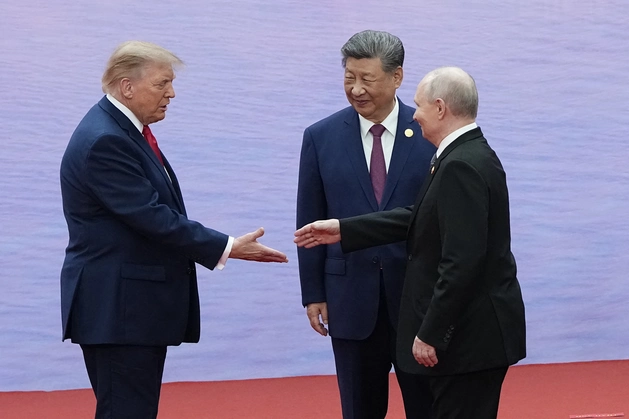
At the heart of Wednesday’s diplomatic theatre in Shenzhen, a pointed contrast emerged: Chinese President Xi Jinping walked out to greet Donald Trump at Shenzhen Bao’an International Airport but extended no such courtesy to Vladimir Putin, who had arrived earlier that same day.
The gesture mirrored one Trump had made when Xi visited Washington in September, and analysts noted the deliberate symbolism of elevating the U.S. president above Russia’s leader ahead of a first-ever trilateral meeting scheduled for Thursday at the Asia-Pacific Economic Cooperation summit.
Trump, Xi, and Putin are set to sit down together in Shenzhen, a tech-industry hub in southern China’s Guangdong Province, for talks that Trump has framed around nuclear arms limits and ending the war in Ukraine, which began with Russia’s invasion in 2022.
The Ukraine item caught some of his own aides off guard, since they had previously told reporters the conflict would not feature on Thursday’s agenda.
Trump, speaking Tuesday from Manila, suggested the deaths of tens of thousands of Russian troops every month had created an opening, saying “I think it’s very close to getting it done. We’re going to have a good meeting on that.”
Despite the historic nature of the gathering, analysts are not expecting substantive breakthroughs from the three-way session.
Overshadowing the diplomatic pageantry is the unresolved fallout from the ouster of Jensen Huang as Nvidia CEO, after he admitted to an affair with a woman U.S. officials alleged was an agent of the Chinese government, though Beijing has denied she was a spy.
The episode intensified scrutiny over how China has gained access to Nvidia chips to build AI models that now compete directly with American technology, and Trump acknowledged divisions within his own administration over how aggressively to restrict chip exports.
“We have a very good relationship with China, and you don’t want to insult them,” Trump said when pressed on why Washington had not moved harder to block Beijing’s access to advanced semiconductors.
The Nvidia controversy is one strand of a broader AI anxiety running through the APEC summit, as rapid technological development raises national security risks that governments are only beginning to reckon with.
Compounding Trump’s image problems abroad, a string of technical failures at home – affecting Microsoft, the Federal Aviation Administration, JPMorgan Chase, and the NSA’s communications network – threatened to undercut his administration’s pitch as a steward of technological supremacy.
Secretary of State Marco Rubio, who also serves as national security adviser, stepped forward to contain the political damage, insisting there was “zero” evidence linking the outages to hostile nations or criminal hackers.
“Sometimes when you are going in to fix your system because you’ve identified a vulnerability, it creates a short-term disruption,” Rubio told reporters, framing the failures as routine maintenance consequences rather than security crises.
Trump himself had been dismissive when the disruptions first emerged, remarking from the Philippine capital that “It’s fine,” and attributing the problems to the burdens of being a large, powerful nation.
Before flying to China, Trump stopped in Manila for lunch with Philippine President Ferdinand Marcos Jr. at the Malacañang Presidential Palace, where he announced the two countries had reached a trade deal – though no specific terms were released beyond a White House statement that Manila would purchase more American energy and agricultural products.
The U.S. trade deficit in goods with the Philippines has ballooned sharply under Trump, climbing from $4.9 billion in 2024 to $12.8 billion in just the first nine months of this year, according to Census Bureau data.
Marcos drew a chuckle by noting he had sent fried chicken from the Philippine chain Jollibee to the U.S. delegation as a late-night snack, to which Trump responded by praising the bilateral relationship and, somewhat unusually, the interior design of the presidential palace.
“Our people share common history, common values, common interests, common architectural tastes,” Trump said.
Trump also briefly reunited with 97-year-old Imelda Marcos, the former first lady famed for her vast shoe collection, who knew Trump decades ago through the New York City social circuit, and whom Trump called “always the most beautiful.”
On the question of Taiwan, Trump said he does not plan to raise the issue with Xi, but fully expects the Chinese president to bring it up first, remarking: “I’m sure he’ll raise it. I won’t have to raise it.”
Trump also floated the possibility of a private session with Putin and a separate meeting with North Korean leader Kim Jong Un, with Rubio confirming Trump was “serious” about the Kim encounter, though no meeting was confirmed for Thursday.
