
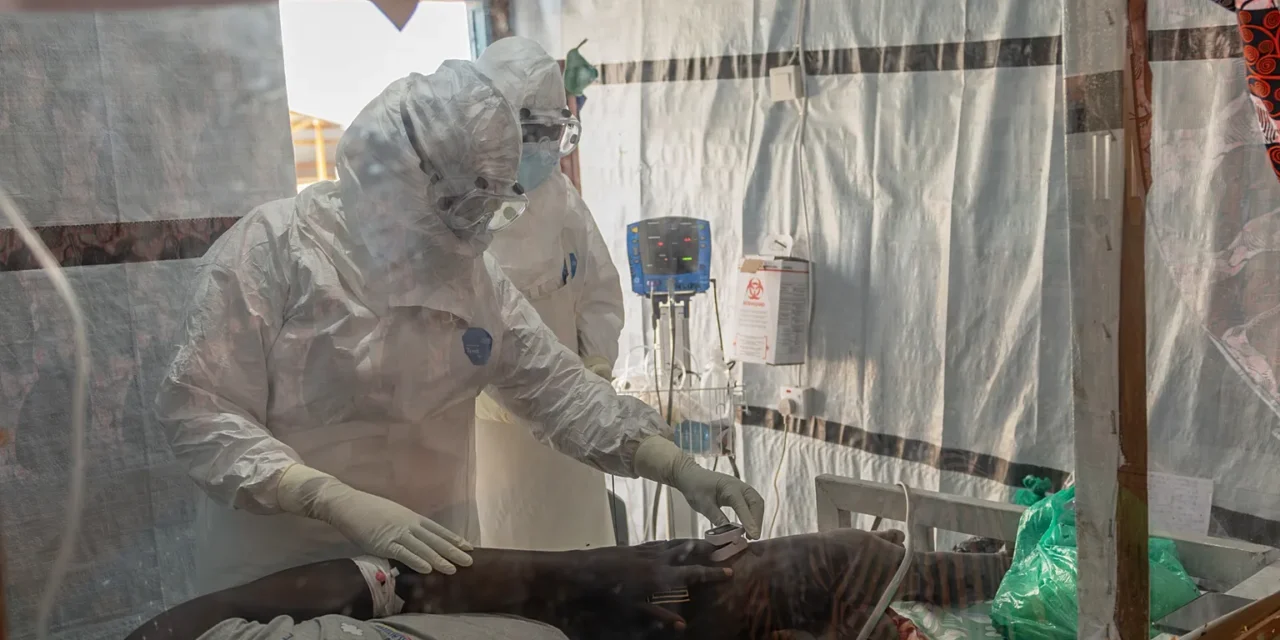
Switzerland’s government has directly challenged the official narrative surrounding Africa’s latest Ebola scare, disputing Uganda’s claim that a confirmed Nigerian patient had visited the Democratic Republic of Congo.
The Swiss Federal Department of Foreign Affairs issued an unambiguous rebuttal, stating that the infected woman and her husband “did not travel to the Democratic Republic of the Congo,” where a separate Ebola outbreak is already underway.
The woman at the center of the dispute is a Swiss national of Ugandan origin married to a Swiss diplomat stationed in Abuja, and Swiss authorities believe she contracted the virus during travel in Uganda alongside her husband.
Uganda’s Health Ministry has pushed back, maintaining in an October 20 statement that “travel through Uganda does not establish that infection occurred here” and that “the location of exposure remains under investigation.”
Both the World Health Organization and the Africa Centers for Disease Control and Prevention said they had not received confirmed information placing the woman in the DRC, leaving the question of her exposure unanswered.
What investigators have established is that the Nigerian patient and Kenya’s first confirmed Ebola case both transited Entebbe International Airport on October 3, a coincidence now driving urgent cross-border inquiries.
Wessam Mankoula, head of emergency preparedness and response at the Africa CDC, confirmed the shared travel date and said investigators are examining whether the two patients were present at the airport simultaneously and whether their movements overlapped.
Kenya’s Ebola patient, who died in Nairobi on October 5 after traveling from the DRC through Uganda, has left behind at least one unresolved thread: a Ugandan national identified as a contact of the deceased who authorities cannot locate.
Kenya’s director-general for health, Patrick Amoth, told local media that officials have identifying details but remain unable to make contact, noting that “we know him by name and passport number and from his phone but we are not able to reach him,” with the search further complicated by the man’s use of a South Sudanese telephone number.
In Nigeria, Health Minister Muhammad Ali Pate announced the country’s confirmed case in Abuja, saying “today we are confirming that there has been one imported case of Ebola virus disease in the Federal Capital Territory,” with the patient having developed symptoms on October 7 before testing positive and being isolated for treatment.
Nigerian authorities have since identified 44 contacts, spanning healthcare workers, caregivers, fellow patients, and individuals who may have encountered the woman during her travels.
On the streets of Abuja, the confirmation has stirred genuine anxiety, with resident Jonathan Steven capturing a broader sentiment: “Because now people are not even worried about sickness anymore, people are worried about surviving.”
Uganda, which shares an extensive border with the DRC and sits at the crossroads of several major regional travel routes, insists its surveillance systems have detected no confirmed active infections domestically.
The WHO notes that Ebola-infected individuals are not considered contagious until symptoms emerge, meaning airport transits alone do not confirm transmission, yet tracing movements across multiple jurisdictions remains a formidable logistical challenge.
To address the growing complexity of the outbreak’s spread, the Africa CDC has scheduled an extraordinary virtual meeting of national health officials for October 28 to coordinate the continent’s response.
