
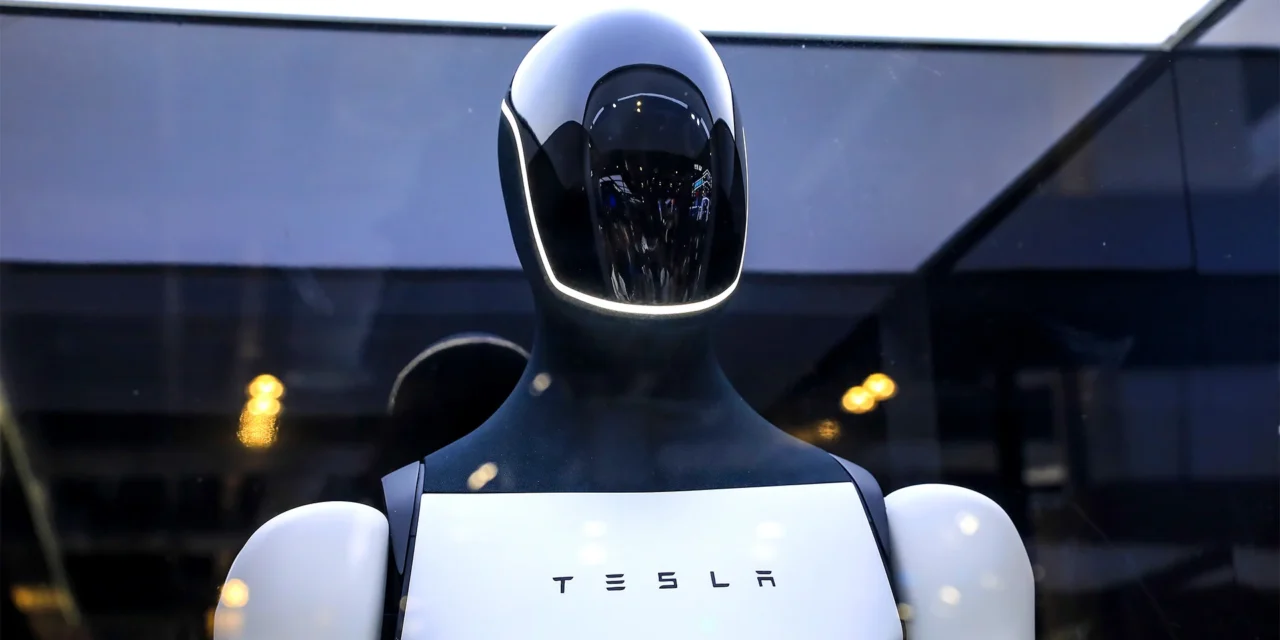
Andrew Kang, CEO of RoboStrategy, Inc., says investors focused on Tesla Inc’s (NASDAQ: TSLA) artificial intelligence capabilities are missing the company’s most durable competitive strength.
Kang argues that Tesla’s real advantage in humanoid robotics is rooted in something far less discussed in investor circles.
“It is their manufacturing competency and resources,” Kang told Benzinga in an email, laying out a thesis that cuts against the prevailing narrative in the robotics sector.
Most industry observers and investors tend to frame the humanoid robotics race primarily around AI breakthroughs, with manufacturing treated as a secondary consideration.
Kang’s view challenges that framing directly, suggesting that the ability to build robots at scale will ultimately matter more than which company produces the most impressive AI demonstration.
Manufacturing at scale, he argues, creates a structural moat that few competitors will be able to replicate once Tesla’s production lines ramp to full capacity.
His perspective also implies that leadership in humanoid robotics will depend as much on operational execution as on technological innovation, particularly as the industry moves from prototype to mass production.
Kang extended his argument beyond the factory floor, connecting Tesla’s manufacturing scale directly to the quality and volume of data available for training AI models.
While acknowledging that “there have not been many public releases of long-horizon autonomous capability from Optimus yet,” he pointed to a critical feedback loop that scale enables.
“A key input to AI models are large amounts of robot data which Tesla will have an advantage in procuring given their scale,” Kang said, outlining how manufacturing output and AI development are deeply intertwined.
The logic suggests that deploying more robots into real-world environments generates more operational data, which in turn trains more capable robot foundation models over time.
Rather than treating manufacturing and AI as separate competitive pillars, Kang’s framework positions one as the engine that continuously strengthens the other.
For investors, this reframes the key question around Tesla’s Optimus program from what the robot can do today to how quickly Tesla can get robots into the field and harvesting meaningful data.
As Optimus moves closer to commercial production, the market will be watching closely to see whether Tesla’s manufacturing scale translates into a compounding and lasting lead in the humanoid robotics industry.
