
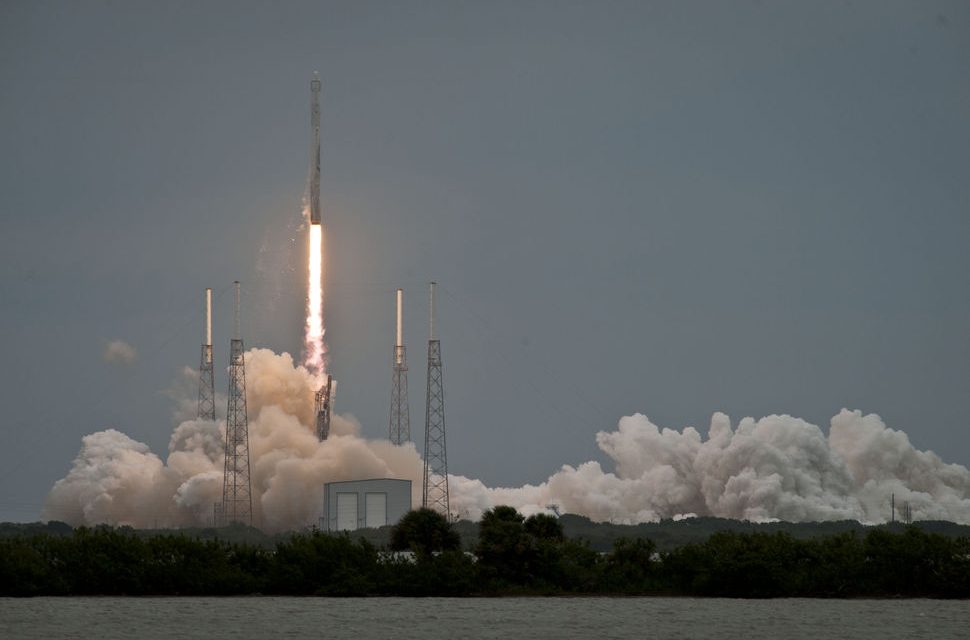
SpaceX priced its IPO at $135 per share, giving it a valuation of roughly $1.77 trillion and making it one of the largest public offerings in history.
That milestone raises a legitimate question for investors: is the dominant player in the space industry worth buying at a near $2 trillion valuation, or does a smaller competitor offer more compelling upside?
There is no disputing that SpaceX has become the most important company in the modern space economy, dominating commercial launch services and operating the rapidly growing Starlink satellite network.
SpaceX also continues developing Starship, a next-generation launch system designed for missions ranging from national security to deep space exploration, further cementing its position at the center of the industry.
However, SpaceX is no longer a pure-play space company, having evolved into something closer to a conglomerate of futuristic technologies spanning satellite internet, launch, and artificial intelligence.
Its S-1 filing claims a $28.5 trillion total addressable market, but 93% of that figure comes from AI and other technologies and businesses that SpaceX currently does not have or operate in.
Starlink remains the real profit engine, generating $4.4 billion in operating income in 2025, while the AI segment lost $6.4 billion in the same year and was burning roughly $2.5 billion per quarter as of Q1 2026.
Investors must also contend with the fact that Elon Musk controls 85.1% of voting power through super-voting shares, leaving shareholders with virtually no recourse if the company’s strategy goes sideways.
For SpaceX to double its valuation from its IPO price, it would need to be worth more than $3.5 trillion, which represents an exceptionally high bar in any market environment.
Rocket Lab (NASDAQ: RKLB), by contrast, presents a far different risk-reward profile, operating as a purer space play with a business spanning launch services, satellites, spacecraft components, solar arrays, and flight software.
The company’s Electron rocket has made it the second-most-used launch provider in the U.S., while its spacecraft components business has grown to account for 68% of total revenue.
Rocket Lab reported record revenue of approximately $602 million in 2025, representing 38% growth year over year, and followed that with a record $200 million in Q1 2026, exceeding management’s guidance across revenue, gross margin, and adjusted earnings.
The company currently holds a backlog valued at more than $2 billion, underpinning confidence that its revenue trajectory has genuine substance behind it.
Its biggest near-term catalyst is Neutron, a medium-lift partially reusable rocket scheduled for its first launch in late 2026 that would put Rocket Lab in direct competition with SpaceX’s Falcon 9 for larger commercial and government contracts.
A successful Neutron debut would open the door to a launch market that SpaceX currently dominates, fundamentally expanding Rocket Lab’s addressable opportunity and its ability to grow into its approximately $70 billion market capitalization.
Risks remain real: Rocket Lab is still unprofitable, and Neutron has already experienced development delays, meaning investors are placing a bet on management’s ability to execute at scale.
At SpaceX’s IPO valuation, both companies trade at comparable price-to-sales multiples in the 100x range, though Rocket Lab’s premium is arguably easier to justify given the room remaining in its growth trajectory.
SpaceX’s own success effectively validates the broader market Rocket Lab is targeting, and growing a $70 billion company is a fundamentally different challenge than growing one already valued at $1.77 trillion.
For investors seeking the highest-quality name in the sector, SpaceX is the clear answer, but for those seeking outsize returns and willing to accept meaningful risk, Rocket Lab presents the more compelling opportunity.
