
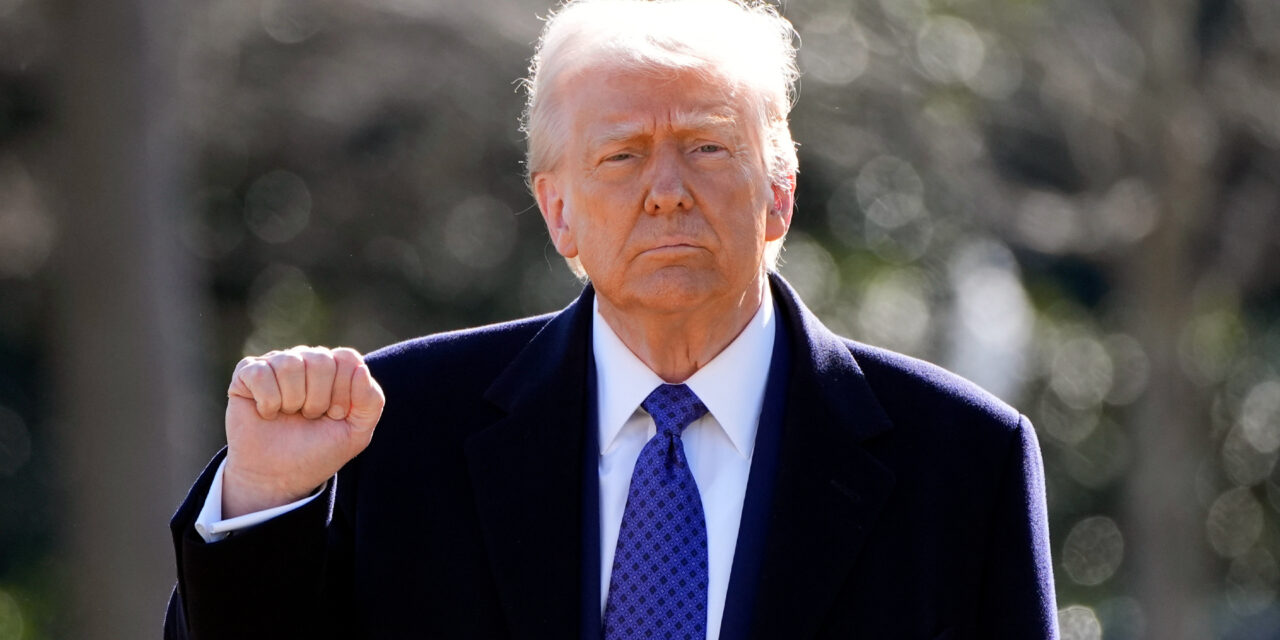
President Donald Trump announced his team is actively exploring ways for artificial intelligence companies to give the American public a direct ownership stake in their firms.
Speaking to reporters aboard Air Force One, Trump said he had discussed a deal with major AI labs in which the federal government “essentially becomes a partner with the companies.”
The administration has already moved in this direction elsewhere, having taken stakes in chipmaker Intel and several rare earth and quantum firms.
Trump named Anthropic, OpenAI, and xAI as companies that would discuss the proposal further at the White House, signaling the conversations are already at an advanced stage.
The idea gained political momentum after Senator Bernie Sanders said he would introduce legislation imposing a one-time 50% tax on AI labs’ stock, with proceeds flowing into a U.S. sovereign wealth fund.
The proposal drew sharp criticism from prominent AI industry figures, including Silicon Valley venture capitalist and Trump adviser David Sacks, who pushed back hard against the Sanders framework.
Trump acknowledged that Sanders’ proposal had resonated with some of his own voters, and suggested the idea could help ease growing public anxiety about artificial intelligence.
For shareholders in major AI firms, a government stake carries a complicated mix of signals, as it can mean dilution, price caps, or political conditions imposed on companies currently generating record margins.
The Chaikin Money Flow, which tracks institutional inflows and outflows, dropped abruptly to -0.16, reversing the positive readings seen in spring and suggesting large funds are trimming positions before deal terms are known.
The put-call ratio adds further confirmation of that caution, with open interest sitting near 0.84, up from sub-0.80 lows in May, indicating that while calls still lead, hedging activity is on the rise.
Nvidia (NASDAQ: NVDA) saw notable options movement following Trump’s June 5 remarks, with the volume ratio falling to 0.39 from 0.76 on June 2, driving a surge in call activity even as open interest leaned toward puts at 0.95.
Oracle (NYSE: ORCL) holds a central position in this developing story as a core Stargate partner in the federal AI infrastructure push and the publicly traded name most directly tied to the government’s flagship AI project.
Unlike Nvidia, Oracle sells compute capacity rather than chips, meaning a larger government role translates to more contracted revenue with comparatively little dilution risk, which helps explain why institutional money appears to be flowing in rather than out.
Oracle trades near $214 and reports Q4 fiscal 2026 results on June 10, with analysts expecting a strong print and TD Cowen having raised its price target to $300 on June 8 ahead of the report.
Microsoft (NASDAQ: MSFT) rounds out the watchlist as the safest proxy for the policy shift, given that it is OpenAI’s largest backer and OpenAI sits at the very center of the government stake discussions.
The White House and OpenAI CEO Sam Altman are in active talks over a possible U.S. government stake in the ChatGPT maker, making Microsoft’s exposure to any outcome both direct and significant.
Trump’s administration has faced broader challenges in settling on a coherent approach to AI regulation, with Trump signing a revised executive order this week asking leading AI developers to voluntarily submit their most capable models for government cybersecurity testing before public release.
Concerns about AI risks have been mounting, fueled in part by Anthropic’s release of its powerful Mythos tool, with experts warning it could significantly accelerate sophisticated cyberattacks, particularly in sectors such as banking that rely on complex and often decades-old technology systems.
