
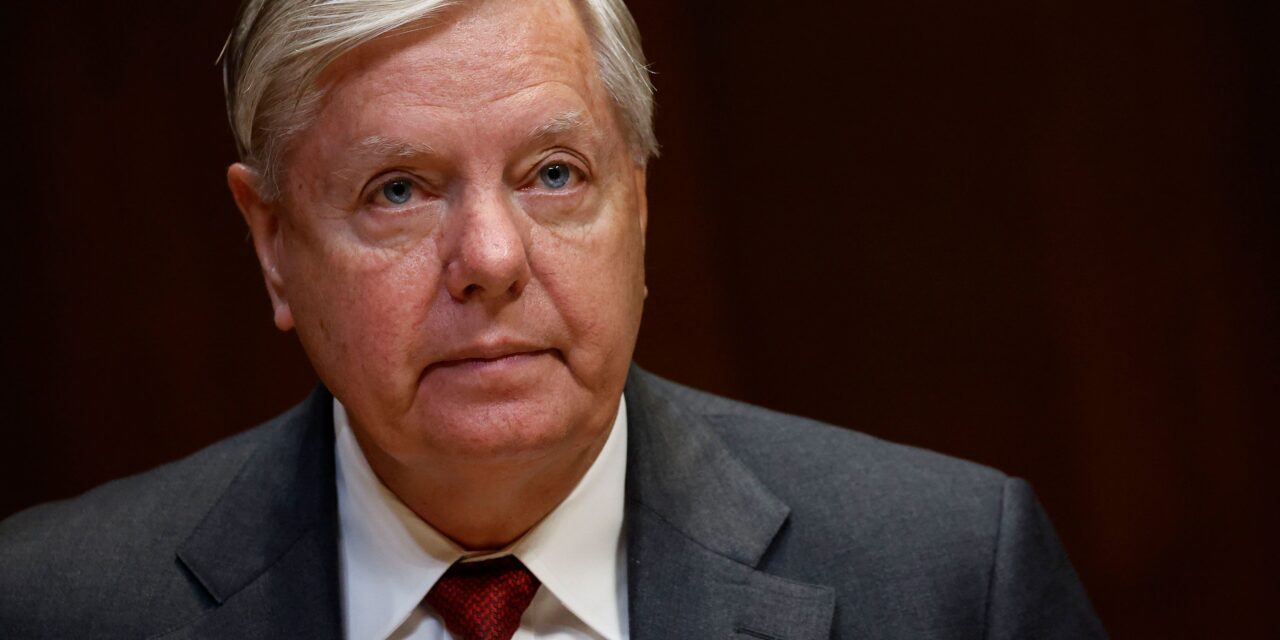
Senator Lindsey Graham, the South Carolina Republican widely regarded as one of Washington’s most committed Iran hawks, delivered an unusually direct defence of President Donald Trump’s controversial Iran war posture on NBC’s Meet the Press on Sunday, comparing Trump’s willingness to disregard American consumers’ financial struggles in favour of strategic objectives to Winston Churchill’s wartime leadership over Nazi Germany.
The appearance cemented Graham’s status as Trump’s most visible congressional ally on the conflict and drew immediate bipartisan criticism.
The episode originated from a Trump remark that had already generated significant political friction, in which the president said, “I don’t think about the American financial situation,” framing his singular focus around preventing Iran from obtaining a nuclear weapon. The comment landed badly at a moment when the national average price for a gallon of gas has reached $4.52, according to AAA, driven in large part by the disruption to oil supply caused by the ongoing conflict and the effective closure of the Strait of Hormuz to normal commercial traffic.
Host Kristen Welker pressed Graham on whether he agreed that Trump should not be accounting for Americans’ financial circumstances when conducting the war. Graham’s response was expansive. “That’s his Churchill moment,” Graham told Welker.
“When Churchill came into power, he promised blood, sweat, toil, heartache until we deal with the Nazis, who are an existential threat to the British way of life. And if Hitler had taken charge of the planet, it would have been the darkest hour in humanity. I believe Iran wants the nuclear weapon. They would use it. So does President Trump.”
Graham acknowledged the economic reality facing American households without flinching. “Do I worry about gas prices? Yes. But, President Trump’s right. The biggest threat to stability in the world is a nuclear-armed Iran, and whatever price we have to pay, we’ll pay,” he said, explicitly drawing the Churchill parallel around bearing costs for an existential strategic objective. He also called for escalation, saying that if the US returned to military action and further weakened Iran, the conflict could be concluded in relatively short order.
The senator’s willingness to attach his own career to the conflict was perhaps the most striking moment of the appearance. When Welker challenged him with polling showing that 70% of Americans believe Trump is doing a poor job on the economy, the number one issue for voters, and asked whether the war was worth losing the midterms over, Graham did not hesitate. “It’s worth losing my job,” he said. “If I had to give my job up to make sure Iran would never have a nuclear weapon, I would do it.”
A recent survey found that 77% of respondents believe current policies have increased the cost of living in their communities, and a clear plurality hold Trump responsible for rising costs. Despite this pressure, Trump has not retreated from the position, telling reporters ahead of his return from a summit in China that his original statement was “a perfect statement. I’d make it again.” He has separately expressed confidence that when the conflict concludes, gasoline prices will “drop like a rock.”
The Churchill comparison drew immediate criticism from Democrats and foreign policy commentators, who argued that the historical analogy misrepresents both the nature of the Iran conflict and the democratic accountability obligations of elected officials during economically damaging military engagements. Churchill, critics noted, did not lead a country whose population was suffering economically because of a conflict he had initiated; the circumstances are not directly comparable.
In a notable development days after the Meet the Press appearance, Graham appeared to soften his stance, posting on social media to encourage Trump to “wind down the war and wind up efforts for an historic peace deal,” a shift that attracted attention as a possible indicator of political recalculation as the midterm pressure intensifies.
