
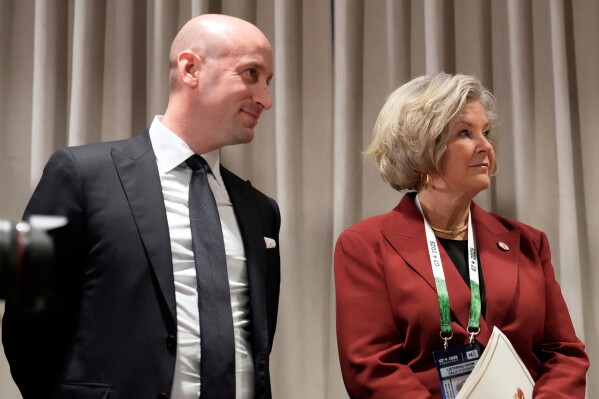
Susie Wiles announced her resignation as White House chief of staff roughly one hour after a former administration insider aired sweeping accusations against her in a two-hour podcast interview.
Calley Means, who stepped down last month as a senior adviser to Health Secretary Robert F. Kennedy Jr., used a Friday episode of “The Joe Rogan Experience” to allege that a network of aides and outside strategists had systematically undermined health-focused policy priorities.
Means argued that political fundraising for the midterms, not public health outcomes, was driving key decisions inside the West Wing, with certain initiatives shelved to protect relationships with industry donors.
His most pointed allegations targeted Wiles directly, whom he accused of being singularly focused on ensuring that special interests kept money flowing to the administration and the Republican Party ahead of the midterm elections.
Wiles’ past career adds texture to those claims: before joining the White House, she worked as a lobbyist whose client roster included a tobacco company, a background Means cited in framing her alleged resistance to health initiatives.
Among the specific policies Means said were blocked or diluted were efforts to regulate kratom, flavored e-cigarettes, and sugary beverages, with one food initiative reportedly delayed because senior aides feared antagonizing sugar-industry donors.
Means also alleged that Wiles’ office pushed to expand the availability of flavored e-cigarettes and vapes, a move he linked to the subsequent exit of former FDA Commissioner Marty Makary.
Beyond Wiles, Means named pollster Tony Fabrizio as one of the most consequential power brokers shaping administration policy, despite Fabrizio’s consulting website listing clients that include Pepsi and major pharmaceutical companies.
Means said Fabrizio dismissed his push for school lunch reform and a formal definition of ultra-processed food, telling him that the MAHA agenda was “not really a big part of our strategy.”
James Blair, who departed the White House to lead the midterm campaign effort, was also named, with Means contending that Blair, Fabrizio, and Wiles built their political playbook around redistricting while subordinating substantive policy to fundraising calculations.
Means charged that Chris LaCivita, who co-managed the Trump campaign alongside Wiles and remained outside the administration, was a consultant “paid heavily by special interests,” and he also flagged Walker Barrett and Richard Walters as influential deputies with ties to lobbying interests.
In his sharpest on-record remarks, Means said: “There is a very concentrated group of people in the Trump administration that are antagonistic to what people voted for and, I think it’s very clear, are doing things for other reasons, particularly in many cases to enrich their families.”
He added that the structure of the current White House amplified the problem, arguing it “has the most centralized control, up to the chief of staff’s office, of any administration in American history.”
President Trump announced Friday that longtime adviser Stephen Miller would succeed Wiles as chief of staff beginning next week, a transition that lands amid the sharpest public rupture yet within the MAHA coalition.
Kennedy, posting to social platform X following Wiles’ departure, pushed back against any suggestion that the administration had abandoned its reform mandate, writing: “President Trump and I intend to keep fighting until the American people—not corporate influence—drive our health policies.”
The White House formally disputed Means’ account, and the allegations remain unproven, though the timing of Wiles’ exit gave fresh momentum to questions about whether industry influence has constrained the administration’s public health ambitions.
