
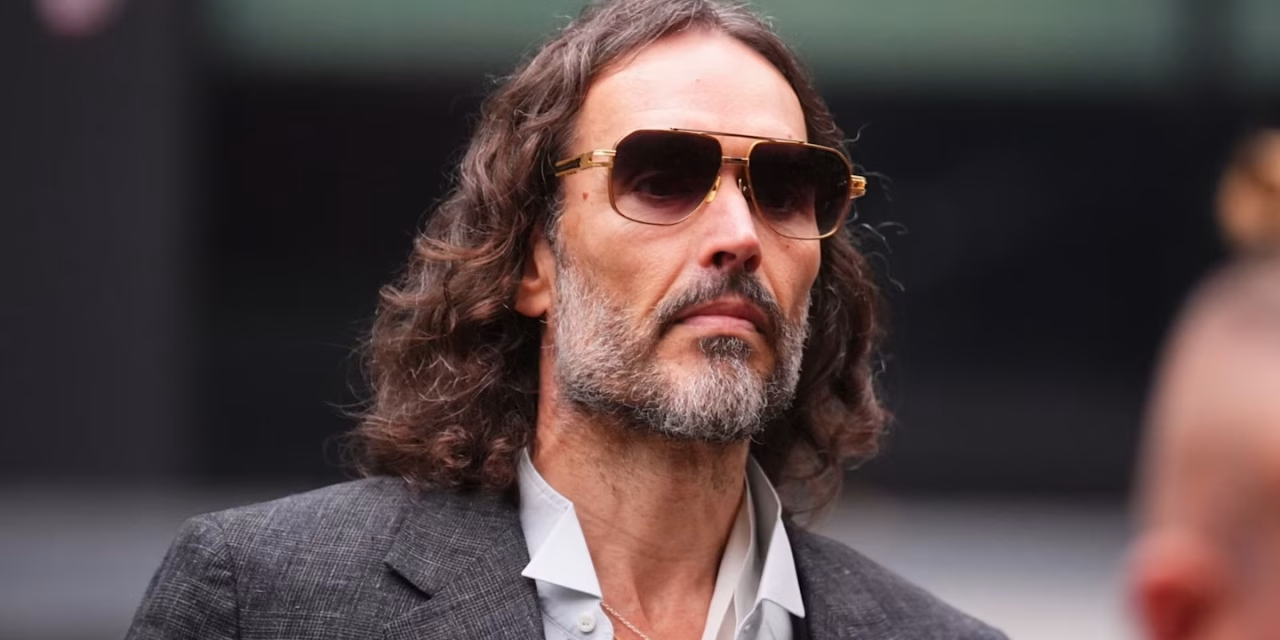
A London judge refused to grant Russell Brand his freedom Thursday, ordering the 51-year-old British comedian into immediate custody after a jury found him guilty on four criminal counts.
Judge Joel Bennathan, presiding at Southwark Crown Court, determined Brand posed a flight risk and denied bail ahead of a Monday sentencing hearing where a “significant” prison term is expected.
The jury of eight men and four women reached its verdict after deliberating more than eight hours across two days, convicting Brand of one count of rape and three counts of sexual assault.
The charges spanned more than two decades, involving four separate women and incidents ranging from a 2004 birthday party at a London bar to a backstage encounter at one of Brand’s own comedy shows in 2009.
Brand was also found guilty of kissing and groping a woman at a London radio station sometime in 2004 or 2005, and of sexually assaulting a woman who alleged he demanded a massage during the filming of an advertisement in 2009.
He was acquitted of two additional rape counts and one count of attempted indecent assault, including allegations tied to a Labour Party conference in the seaside town of Bournemouth in 1999.
Addressing the question of Brand’s children when denying bail, Judge Bennathan was direct: “I regret the hardship caused to the children, of course. But the hardship has been caused by serious criminal offending by their father.”
Brand closed his eyes as the rape verdict was announced but otherwise displayed little visible reaction, and when informed bail was denied, he gestured toward his lawyers and repeatedly said, “I’m good, I’m good, I’m good,” before being led away.
Prosecutor Riel Karmy-Jones had characterized Brand throughout the trial as a ruthless, calculating, manipulative “sexual predator” who exploited his celebrity status to gain access to victims.
Detective Superintendent Andy Furphy of London’s Metropolitan Police described the outcome as “a testament to the extraordinary courage, resilience and determination of the women who came forward and reported what happened to them.”
Furphy added that “Brand used his influence, status and fame to exploit and sexually offend against women,” and that “as his profile grew, so too did his sense of entitlement.”
Brand had denied all charges, testifying that while he once led an openly promiscuous life and was obsessed with sex as a younger man, he had never coerced anyone against their will.
His defense team argued that the women’s credibility was weakened by the lengthy delays before they contacted police, noting that several came forward only after an anonymous-allegations documentary aired in 2023.
Brand’s wife, Laura, appeared in court throughout the proceedings and testified as a character witness, though Brand himself acknowledged that no one with direct relevant evidence was willing to speak on his behalf.
On the stand, Brand described the toll of the legal process, saying, “My entire life has been consumed by these events, these allegations, these accusations.”
Once a fixture of British mainstream entertainment, Brand rose to prominence in the early 2000s through television presenting and a BBC radio show before crossing into Hollywood with films including Forgetting Sarah Marshall and Get Him to the Greek.
His marriage to pop star Katy Perry, which ended after roughly 14 months, kept him in tabloid headlines throughout that period of his career.
In the years since, Brand had largely retreated from traditional media, relocating to Florida and cultivating a substantial online audience through content blending wellness advice, conspiracy theories, and expressions of religious faith.
British law permanently protects the identities of sexual violence victims from media disclosure, and the Associated Press does not name such individuals.
