
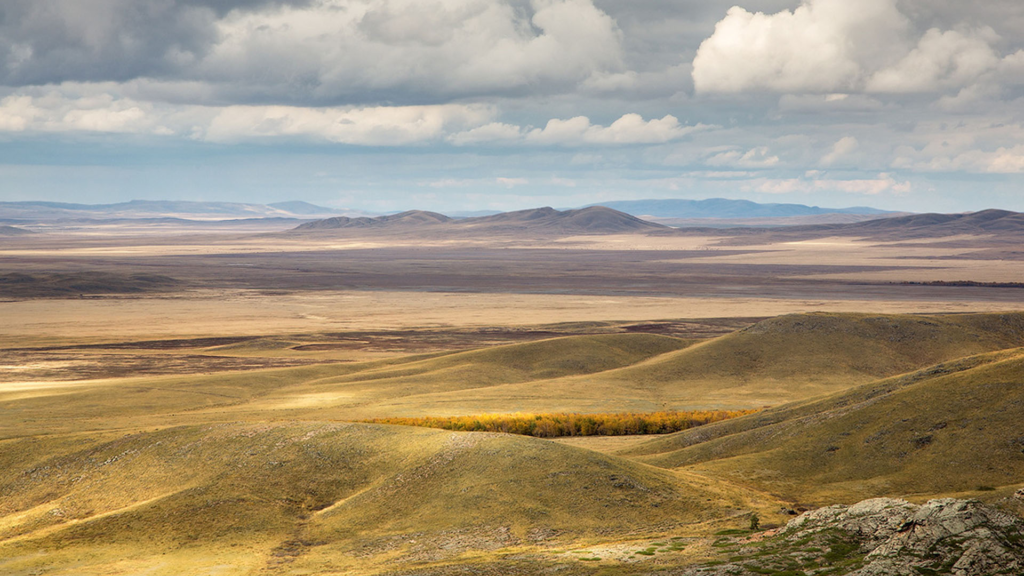
An expanse of Central Asian steppe stretching roughly 22 times the size of New York City was once the footprint of the Soviet Union’s most extensive forced labor network.
The Karaganda Corrective Labor Camp, known as Karlag, processed nearly one million prisoners between 1931 and 1959, and an estimated 10,000 people perished there between 1940 and 1950 alone.
Starvation, extreme cold, disease, and the brutal demands of forced labor claimed those lives inside a complex that doubled as a vast economic and agricultural enterprise for the Soviet state.
Nearby, the Akmolinsk Camp for Wives of Traitors to the Motherland, designated ALZhIR, confined 18,000 women whose only crime was being married to men convicted as enemies of the people.
Among those prisoners were 167 ethnic German women, their stories now largely unknown even to residents of Astana, the Kazakh capital located just beyond the camp’s former gates.
The scale of suffering traces back to 1941, when Soviet dictator Josef Stalin ordered mass deportations of ethnic Germans from Russia and Ukraine following the Nazi invasion, sending over one million people into exile across Siberia and Kazakhstan.
At least 200,000 of those deportees died as a consequence of expulsion, hunger, and forced labor, yet the episode remains poorly understood outside specialist circles and affected communities.
The case of Gertrud Platais illustrates how ordinary lives were destroyed by the machinery of Stalinist repression during the Great Terror of the 1930s.
A print worker with German roots from Lower Silesia, part of modern-day Poland, she had married Karl Eduard Platais and become a Soviet citizen before her husband was arrested in 1938 and she was convicted as a “relative of a traitor to the homeland.”
Platais was transferred to ALZhIR, where summer temperatures reached 40 degrees Celsius and winters dropped to minus 40, and she was compelled to work as an embroiderer until 1946, after which she was banished to Karlag and not rehabilitated until 1956.
Today, 223,000 ethnic Germans remain in Kazakhstan, and a younger generation is working to ensure those histories are not buried beneath the country’s rapid modernization.
Yunna Kinereish, a 22-year-old public relations student in Astana and member of the Wiedergeburt, or Revival, Association of Germans in Kazakhstan, has spent recent years turning that history into art and documentary film.
In 2025, she completed a film specifically about the German women held at ALZhIR, drawing on archival records and personal accounts to reconstruct their experiences.
She has also performed in a youth theater production at the House of Friendship in Astana, the German-government-funded cultural center that offers language courses and supports community memory projects, which dramatized the deportation of her own ancestors from the Ukrainian village of Kleinwärter.
“It’s not easy for me, because it all touches my heart very deeply. I actually feel like crying. But when I’m on stage …, I have to be strong,” Kinereish told DW.
Her motivation is personal as well as historical, rooted in a family line that passed through the worst of the Gulag era.
“My ancestors survived the Gulag system in Kazakhstan,” she said. “So it’s important to me that we don’t forget our roots, and that what our forefathers experienced and suffered is passed on.”
Institutional indifference, however, poses a persistent obstacle to that mission, according to researchers who have spent years mapping the physical remnants of the camp system.
Katherine M. Erdman, an American anthropologist and archaeologist at Nazarbayev University in Astana who has studied the Gulag system for approximately a decade, describes a widespread reluctance to confront Kazakhstan’s Soviet past.
Her team has used drone technology and ground-level interviews to trace where camps once stood, finding that infrastructure built by forced laborers, from factories to housing, still structures daily life across many regions.
“In many regions, the landscape has been shaped by forced labor,” Erdman noted, adding that her team’s findings are frequently met with apathy or outright rejection from local administrations.
“Many people in Kazakhstan, and certain areas of politics, have almost no interest in coming to terms with the country’s often brutal history,” she said, and no state funding has been secured to continue her research lectureship.
The Karlag museum, housed in the former camp administration building roughly 250 kilometers south of Astana near the city of Karaganda, attracts few visitors, and even well-educated young Kazakhs are often unaware it exists.
For Kinereish, who describes herself as both German by ethnicity and Kazakh by mentality, the work of remembrance is inseparable from her sense of identity in a country still negotiating its relationship with a deeply scarred past.
