
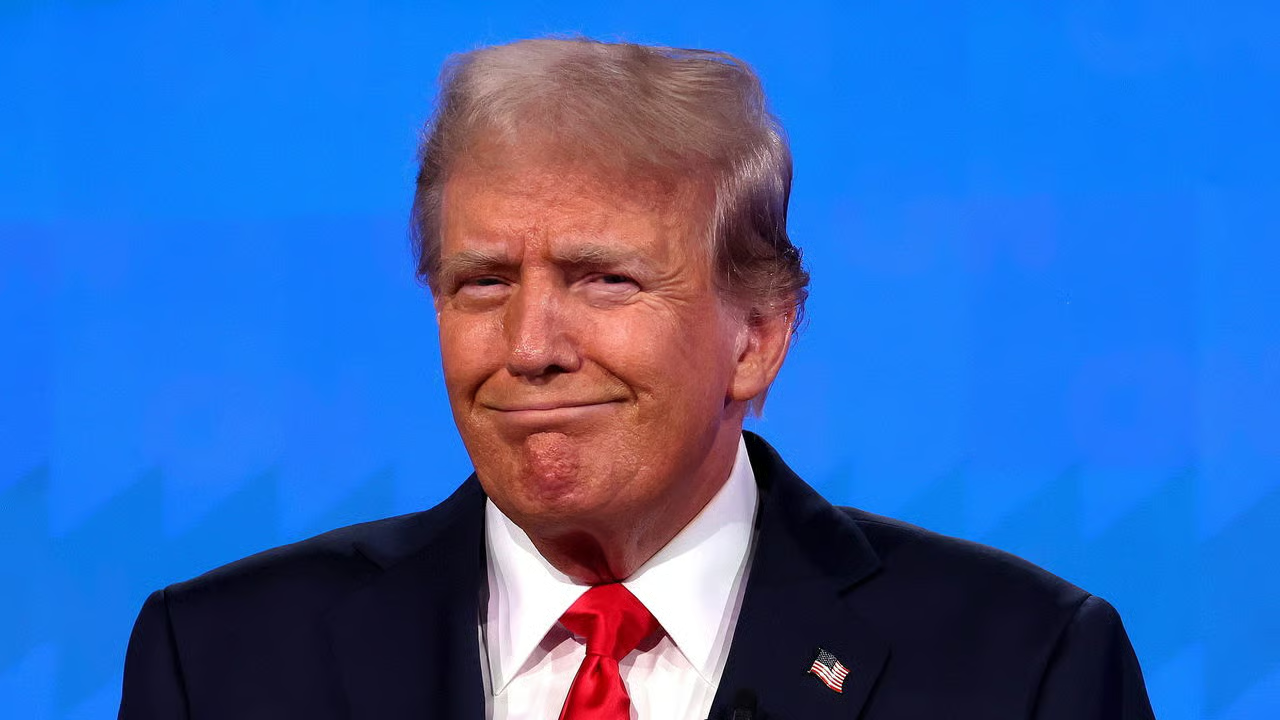
President Trump made a confident pledge in early September, gathering roughly 30 Republican candidates running in competitive races for a dinner in the White House Rose Garden, complete with prime aged beef burgers.
“I’m going to go to every one of those 35 places and we’re going to see if we can get everyone elected,” Trump told the assembled candidates that evening.
The White House has never clarified which specific 35 places the president was referring to, leaving the promise open to interpretation.
Since that dinner, Trump has campaigned with fewer than a third of those candidates, and his travel schedule has tilted heavily toward Republican strongholds rather than contested battleground territory.
On the tarmac between rally stops in Arizona and Montana, Trump attempted to frame his visits to states he won decisively in 2024 as an act of gratitude toward loyal supporters.
“So, I do it to thank them,” Trump said. “I also do it because we have some great people there that are running and I want to make sure they win.”
Trump has openly worried about the drop in Republican turnout in years when he isn’t on the ballot, driving an October rally schedule that has taken him to Ohio twice, Texas twice, Oklahoma, and even Tennessee.
“What the hell am I doing in Tennessee?” Trump mused from the stage to wild cheers, seemingly acknowledging the unusual nature of his itinerary.
The president made an eight-hour flight to Alaska to campaign for Sen. Dan S. Sullivan and Rep. Nick Begich, both facing races that are uncomfortably close in a state Trump won by 13 points in 2024.
“This is worth the 8 hours in a plane,” Trump told the crowd. “And don’t forget I’ve got 8 hours going back. Give me credit for that.”
The Republican National Committee has announced Trump will campaign in Kansas, which now features a toss-up U.S. Senate race that few political observers would have predicted even a month ago.
RNC Chairman Joe Gruters explained the strategic logic behind the president’s travel choices in a call with reporters from a Trump rally in Arizona.
“Just a lot of excitement, a lot of momentum building up on the ground here,” Gruters said. “It’s turnout, turnout, turnout. How do you get the base to show up? You put the president on the ballot. You put him out there.”
Trump’s stump speech varies little from stop to stop, cycling through past election victories, his One Big Beautiful Bill, and a $5,000 dividend proposal for every American adult if Republicans win both chambers of Congress.
That dividend idea, which Trump first floated at the Republican midterm convention, has faced resistance from elected Republicans within his own party.
On Tuesday, Trump was scheduled to campaign in Greenville, North Carolina, even as Republican campaign committees began canceling ad reservations for the party’s Senate candidate there, Michael Whatley, signaling the race may be slipping away.
A congressional district in Eastern North Carolina, redrawn to favor Republicans as part of Trump’s mid-decade redistricting push, has also emerged as an unexpected vulnerability, now rated a toss-up by the Cook Political Report.
“I think it’s going to backfire on them this year in every way shape and form,” said Anderson Clayton, chair of the North Carolina Democratic Party. “He’s trying to drum up any amount of support that he can at the last minute. But I don’t think that North Carolinians are going to fall for it again.”
