
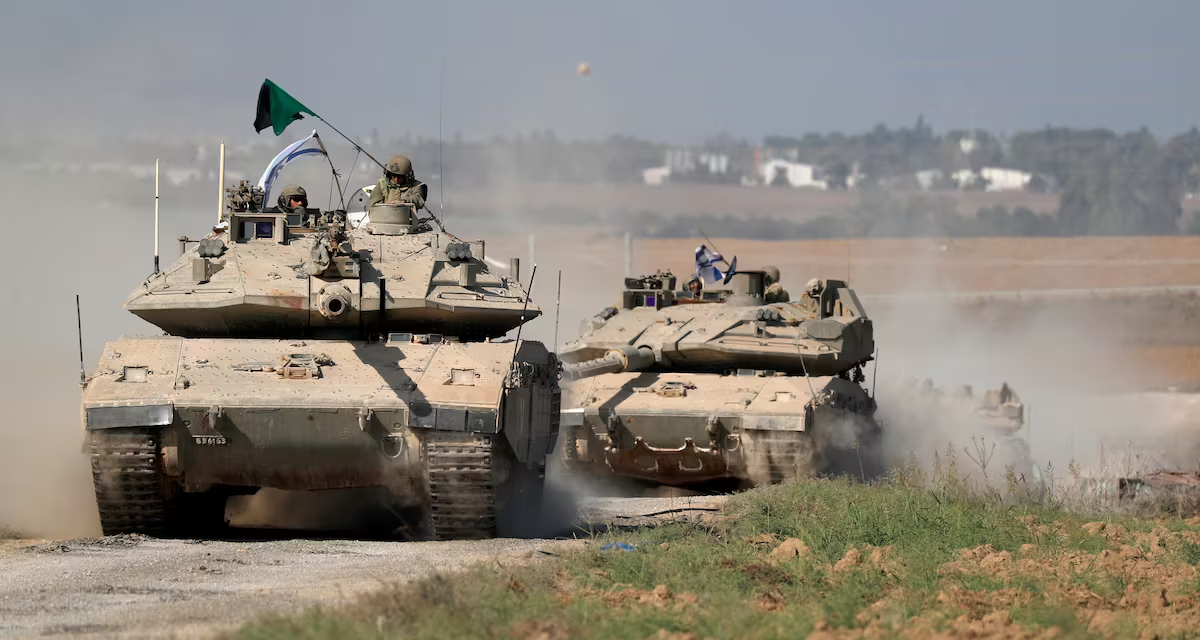
Israel’s military presence in southern Syria has grown significantly since the fall of Bashar al-Assad’s government in December 2024, with incursions rising and locals reporting widespread raids.
Ahmad Hassan al-Din has not seen his son Saddam since April 2024, when Israeli soldiers took the then-17-year-old from farmland near the Israeli-occupied Golan Heights.
“Saddam had gone to feed the animals early in the morning,” al-Din said. “I called him on the phone, and he told me, ‘Everything’s fine.’ But then later we saw with our own eyes how they took the boy, handcuffed and shackled.”
Al-Din filmed the arrest and forwarded the footage, which was later verified by open-source investigators at France24 and by human rights organizations working in the region.
“They said they took him because he was trespassing on the territory of the state of Israel,” al-Din said. “Even though that area is our farmland and we have a valid UN permit to work there.”
Saddam, now 19, is believed to be held in an Israeli prison, with humanitarian organizations only recently able to confirm his likely location after months of uncertainty.
Israel’s military seized control of the UN-patrolled buffer zone after Assad’s fall, with senior Israeli politicians declaring the 1974 disengagement agreement void and framing the deployment as a temporary, defensive measure.
Since then, however, the United Nations Disengagement Observer Force reported in November 2025 that Israel had established 10 military bases in the area, with soldiers conducting near-daily armored patrols into the Syrian provinces of Daraa and Quneitra.
Syrian consultancy Karam Shaar Advisory reported in January that these incursions typically involve armored patrols through populated areas, followed by temporary checkpoints where civilians are stopped, searched, questioned, and have their phones examined, with biometric data sometimes collected.
Quneitra authorities told reporters that Israeli troops had seized more than 200 sheep, destroyed drinking water wells, razed horticultural areas, and demolished buildings across the affected region.
Mousa Khalil, a 65-year-old resident of Quneitra, said Israeli troops completely destroyed his two-story, four-apartment home in Hamidiyah village, leaving him scrambling to support a family of eight.
The Sijil Center, a Syria-based organization documenting Israeli violations of Syrian territory, recorded 818 incidents between August 25 and December 31, 2025, averaging 45 incidents per week across the affected provinces.
Since the start of 2026, the Sijil Center has counted 1,632 incursions, pushing the weekly average to 48 incidents, with Israeli forces also moving deeper into Syrian territory than in previous months.
The center estimates that around 200 Syrians have been detained by Israel since December 2024, with between 40 and 50 believed to remain in Israeli jails at this time.
Experts say transferring detained citizens of another country to domestic prisons constitutes a clear breach of international law, and organizations including Amnesty International and Human Rights Watch have described Israel’s actions as possible war crimes.
The Israeli military has previously stated it “apprehended individuals where there was reasonable suspicion of their involvement in terrorist activity” and acknowledged building new bases to prevent attacks and smuggling.
“The area is a playground for terror organizations, armed groups and militias,” a senior Israeli officer told Israeli outlet Ynet.
Elizabeth Tsurkov, a senior non-resident fellow at the Washington-based New Lines Institute, said Israel’s approach is shaped by the trauma of October 7 and by its reading of the new Syrian government as hostile and aligned with Turkey.
“Because Israel reads the government in Damascus as jihadist and subservient to Turkey, its overarching goal is a central government too weak to threaten it,” Tsurkov wrote in an analysis published this week.
Syria’s Foreign Minister, speaking to Axios after Israeli jets bombed the Abu Duhur military air base in northern Syria, said significant progress had been made during year-long security negotiations before Israel withdrew from talks.
“Security cannot be one-sided,” he said. “Just as we take Israeli security concerns into account, Israel must also take Syrian security concerns into account and seriously address our concerns regarding its expansionist policy and military operations inside Syrian territory.”
Syrian think tank Etana noted that Israel’s post-Assad positioning now gives it direct or indirect access to most surface water resources in Quneitra and western Daraa, as well as surveillance reach over Lebanon from Mount Hermon.
H.A. Hellyer, a senior associate fellow at the Royal United Services Institute in London, warned that Israeli security zones have historically transformed into permanently occupied or annexed territories over time.
“They’re continuing on the diplomatic track because they know very well that they have no military option here,” Hellyer said of Syria’s government, adding that the situation reflects “Israeli paramountcy” in which laws and rules are effectively set aside by superior military force.
