
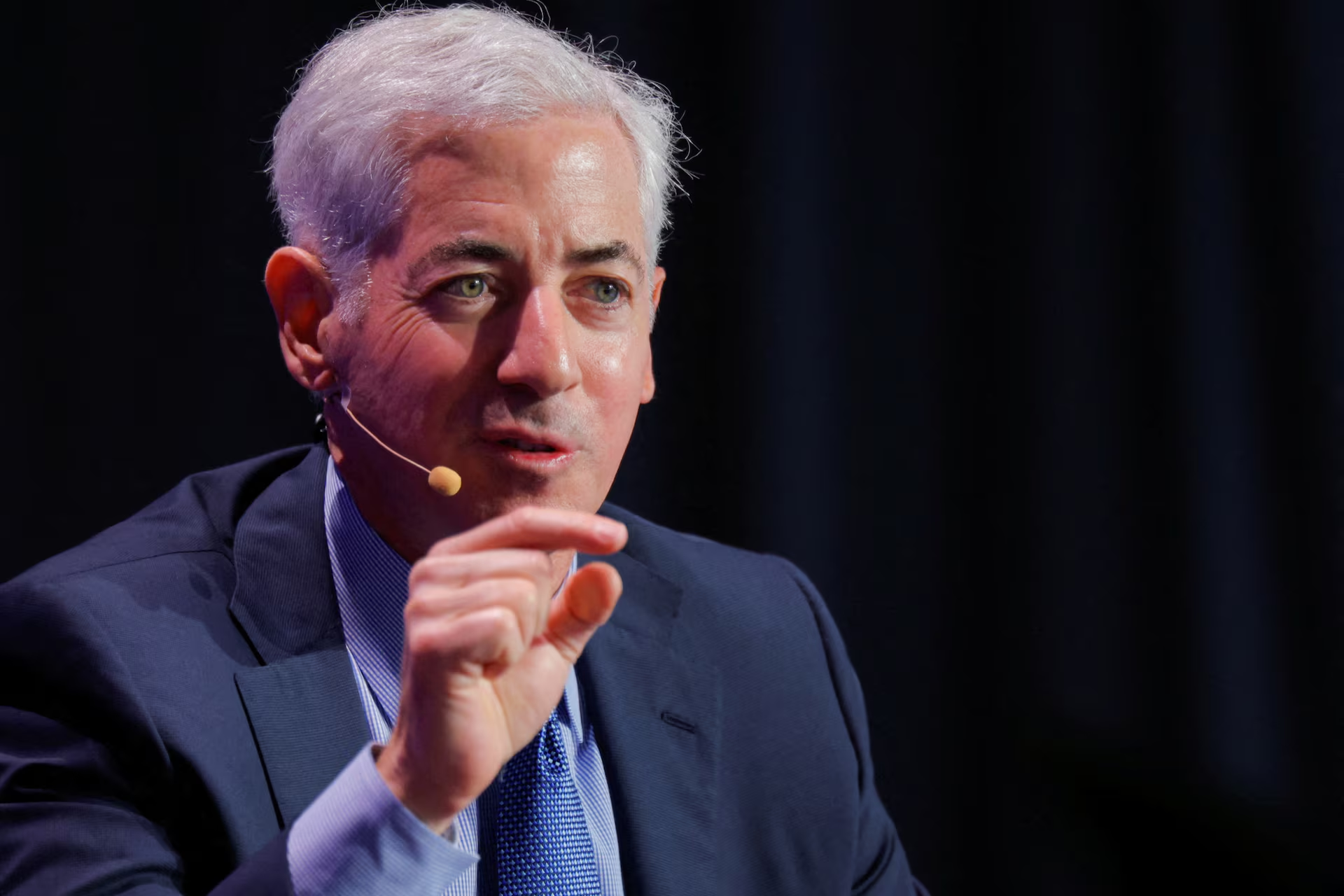
Pershing Square CEO Bill Ackman has re-entered Netflix (NASDAQ: NFLX), purchasing a new stake four years after selling his original position at a loss exceeding $400 million.
The new Netflix position represented 4.9% of Pershing Square’s portfolio as of June 30, marking one of the most high-profile investment reversals on Wall Street in recent memory.
Ackman and Pershing Square chief investment officer Ryan Israel stated in the firm’s semiannual report that “Netflix has since effectively won the streaming wars.”
The firm expects double-digit revenue growth from Netflix, with content expenses projected to rise more slowly than overall revenue, improving the company’s financial profile considerably.
Ackman first invested in Netflix in January 2022, committing more than $1 billion after disappointing subscriber projections drove the stock sharply lower.
Just three months after that initial purchase, Netflix revealed it had lost 200,000 subscribers in the first quarter, marking the company’s first subscriber decline in a decade and sending its stock down 35% in a single session.
Ackman responded by selling all 3.1 million shares, crystallizing a loss of more than $400 million and writing that “we have lost confidence in our ability to predict the company’s future prospects with a sufficient degree of certainty.”
Several developments ultimately convinced Ackman to reverse course, including Netflix’s crackdown on password sharing and the introduction of a lower-priced advertising tier aimed at price-conscious consumers.
Netflix expects advertising revenue to reach approximately $3 billion in 2026, giving the platform a meaningful and growing income stream beyond traditional subscription fees.
Pershing Square also argues that Netflix’s enormous subscriber base allows it to outspend rivals on content while distributing those costs across far more customers than any competitor can match.
The firm began rebuilding its Netflix position after shares fell nearly 50% from their 2025 peak, with Pershing Square now describing the stock’s valuation as a “substantial discount.”
Netflix is one of six companies added during what Ackman has described as his largest portfolio overhaul in years, alongside Visa (NYSE: V), Mastercard (NYSE: MA), Alcon (SWX: ALC), S&P Global (NYSE: SPGI), and Intercontinental Exchange (NYSE: ICE).
Ackman believes these companies are positioned for strong earnings growth, which he considers the single most important driver of investment value over time.
His recent performance, however, underscores how difficult concentrated stock picking can be, with Pershing Square USA down 3.5% for the year through July and Pershing Square Holdings down 9.2%, while the S&P 500 total return index gained 10% over the same period.
Ackman’s dramatic reversal on Netflix offers a broader lesson for ordinary investors about the risks of timing individual stocks, even when guided by sophisticated analysis and enormous resources.
The SEC defines dollar-cost averaging as investing equal portions at regular intervals regardless of market conditions, a strategy that removes much of the emotional guesswork involved in deciding when to buy or sell.
Vanguard has calculated that a hypothetical $100,000 invested in the S&P 500 across the 37 years ending in 2024 would have grown to approximately $4.9 million, but missing only the 10 best trading days would have reduced that figure to $2.3 million.
For most investors, building a portfolio around diversified, low-cost index funds and maintaining regular contributions may ultimately prove more reliable than attempting to replicate the moves of even the most closely watched hedge fund managers.
