
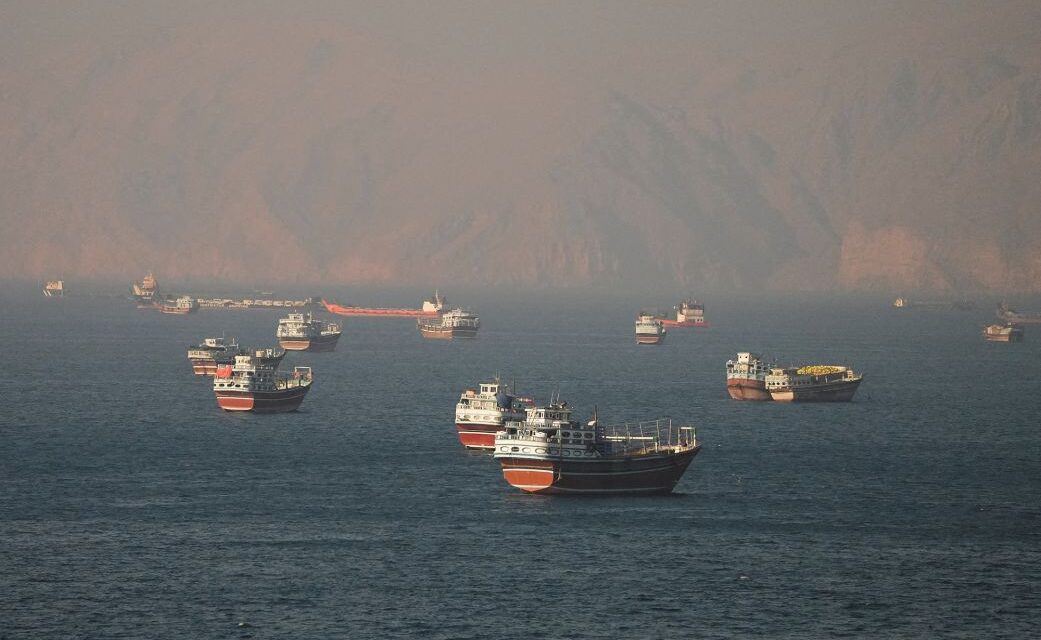
Vessel traffic through the Strait of Hormuz increased by approximately 8% in the week of 27 July to 2 August compared to the previous week, according to new data from maritime intelligence firm Kpler, though a substantial share of transits continued to occur with automatic identification system (AIS) transponders switched off.
Kpler recorded 106 crossings by 96 distinct vessels over the latest complete week, averaging just over 15 crossings per day. Of these, 45 vessels were entering the Middle East Gulf while 61 were exiting.
The daily figures showed significant volatility: 9 crossings on 27 July, rising to 21 on 28 July and 25 on 29 July, before dropping sharply to 8 on 30 July, then climbing again to 23 on 31 July, and falling back to 11 on 1 August and 9 on 2 August.
Of the 106 total crossings, 43 — or approximately 41% — were classified by Kpler as “Route Undetermined,” commonly referred to as “dark AIS,” meaning the vessels’ routes could not be tracked through transponder data. The remaining 63 crossings had identifiable routes.
The latest week compares with 98 total crossings recorded between 20 and 26 July, representing the roughly 8% week-on-week increase. The share of route-undetermined crossings also fell, from approximately 49% the previous week to 41% in the most recent period.
By vessel type, liquid tankers accounted for the largest share of transits at 40, followed by 24 bulk carriers, 15 special-purpose service vessels, 9 LPG tankers, 5 container ships, 5 tug and towage vessels, 4 general cargo ships, 3 LNG tankers and 1 multipurpose vessel.
Dimitris Ampatzidis, Maritime Risk & Compliance Manager at Kpler, cautioned that while the decline in dark AIS activity is encouraging, it is premature to characterise it as evidence of a durable shift in shipping behaviour.
“This is a modest positive development, although the daily figures remain volatile and it is still too early to describe it as a sustained return to normal operating behaviour,” Ampatzidis told Foreign Policy Journal.
Asked whether vessels are likely to stop transiting the Strait dark in the near term, Ampatzidis said the calculus for shipowners extends well beyond the immediate security picture.
“I do not think it is simply a matter of the threat from Iran being removed,” he said.
“For most vessels to return to normal AIS transmission, operators would need to see a sustained, not temporary, reduction in the risk of attack, detention, misidentification and other forms of interference, alongside clear and predictable transit arrangements.”
He added that rebuilding confidence across the maritime industry will take time, even if political conditions improve.
“Confidence would also need to return among shipowners, flag states, insurers, charterers and crews,” Ampatzidis said.
“Even after a ceasefire or political agreement, operators would probably want to see that the de-escalation is holding in practice before changing their security procedures. Normal AIS behaviour may therefore recover more slowly than the overall number of crossings.”
Oman and Iran are understood to be “very close” to agreeing a deal on how to manage vessel traffic via the Strait of Hormuz, but it’s unclear what such a deal might consist of and if it will lead to a significant increase in vessel crossings.
