
The global space economy reached $439.1 billion last year and is forecast to hit $462.4 billion this year, according to Global Market Insights, with projections pointing toward $851.8 billion by 2035.
That growth trajectory represents a 7% compound annual growth rate over the forecast period, drawing increasing attention from institutional and retail investors alike.
The industry’s strategic focus is shifting away from rapid deployment toward building reliable, sustainable systems capable of meeting long-term operational and national security needs.
Two companies in particular are drawing strong analyst attention after completing significant acquisitions that analysts believe meaningfully expand their respective business models.
Rocket Lab USA (NASDAQ: RKLB) has built its reputation as one of the leading private space companies in the United States, specializing in end-to-end launch services for small satellites and spacecraft targeting low-Earth orbit.
The company’s Electron rocket, a reusable small-payload platform rated as the second-most frequently launched U.S. rocket, has completed 91 launches and delivered more than 200 satellites to orbit.
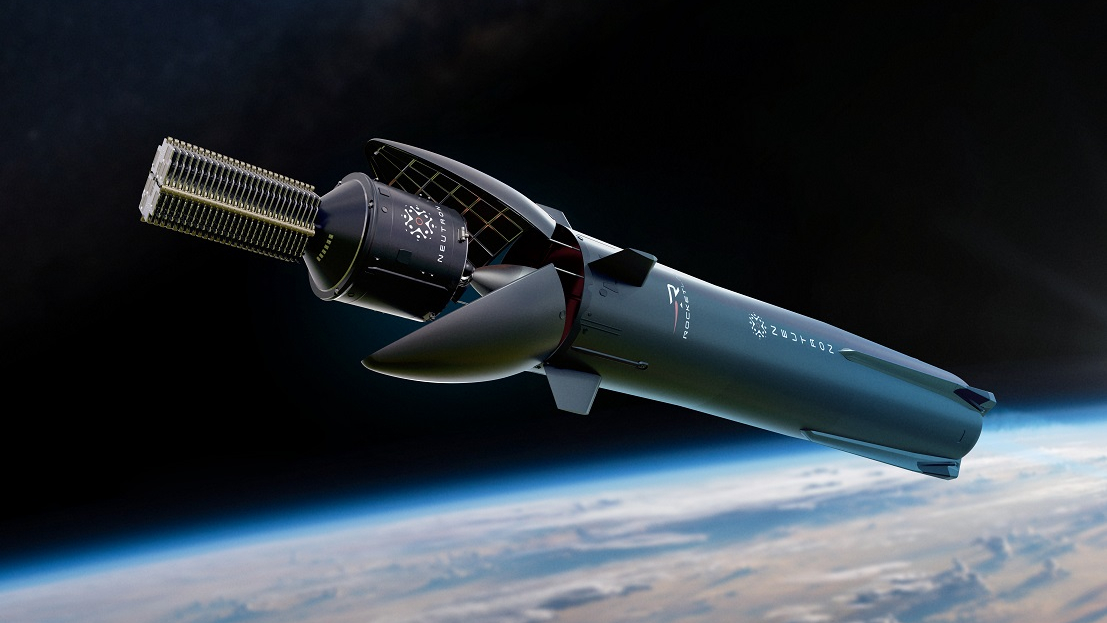
Rocket Lab is also developing Neutron, a far larger reusable launch vehicle designed to carry a 13,000-kilogram payload to low-Earth orbit, with a first launch targeted before the end of this year.
First-quarter 2026 results showed record financial performance, with revenue exceeding $200 million, a 63.4% year-over-year increase that beat forecasts by $10.89 million, though the company recorded a GAAP EPS loss of $0.07, which still beat expectations by one cent.
The company announced on June 29 the acquisition of Iridium Communications in a stock-and-cash deal valuing Iridium at $54 per share, representing an enterprise value of approximately $8 billion.
Morgan Stanley analyst Kristine Liwag, who carries a five-star rating, described the transaction as transformative, writing, “The most important recent development is RKLB’s announced acquisition of Iridium. Beyond the immediate financial implications, we believe the transaction materially enhances Rocket Lab’s strategic positioning by expanding its presence beyond launch into satellite connectivity.”
Liwag added that investors should “increasingly evaluate Rocket Lab not solely as a launch company, but as an emerging integrated space platform,” noting that Iridium posted approximately $872 million in revenue and $495 million in EBITDA in 2025.
Liwag maintains an Overweight rating on RKLB with a $105 price target, implying roughly 33% upside, while the broader analyst consensus of 13 Buys against 3 Holds produces a Strong Buy rating with an average target of $113.43.
York Space Systems (NYSE: YSS) entered public markets in January through an IPO that placed 18.5 million shares at $34 each, raising $629 million in gross proceeds, though the stock has since declined nearly 37% amid earnings misses and share dilution concerns.
York focuses primarily on national security and government agency customers, operating three spacecraft classes capable of carrying payloads ranging from 85 kilograms to over 1,000 kilograms, with the company having flown 74 missions and logged more than 4 million hours of in-orbit operation.
In June, York closed its $67 million acquisition of Solestial, a space solar technology firm, gaining access to high-level space-based solar power generation systems, with the deal including over $57 million in stock and more than $9 million in cash.
York’s second acquisition, of satellite communications terminal provider ALL.SPACE, closed on July 8 in a deal valued at approximately $300 million, comprising $155 million in cash plus 5.9 million shares of YSS common stock.
First-quarter 2026 revenue came in at $116.34 million, up 9% year-over-year and $6.73 million ahead of estimates, though the net loss of $114.84 million was significantly wider than the $11.73 million loss reported in the prior-year period.
Jefferies analyst Sheila Kahyaoglu, ranked in the top 3% of Wall Street analysts by TipRanks, called the strategic logic of the ALL.SPACE deal compelling, stating, “integrating ALL.SPACE’s jam-resistant, multi-link terminal technology with York’s space infrastructure creates an assured communications ecosystem across space, land, air, and maritime domains.”
Kahyaoglu also pointed to York’s broader positioning, noting, “York remains a low-cost LEO satellite and mission-prime platform levered to national security, PWSA, Golden Dome, and intelligence-customer demand,” with FY26 revenue guidance of $545 million to $595 million supported by more than 70% tied to existing backlog.
Kahyaoglu rates YSS a Buy with a $32 price target implying approximately 50% upside, a view supported by the broader Wall Street consensus of 7 Buys and 2 Holds and an average analyst price target of $34.33.
