
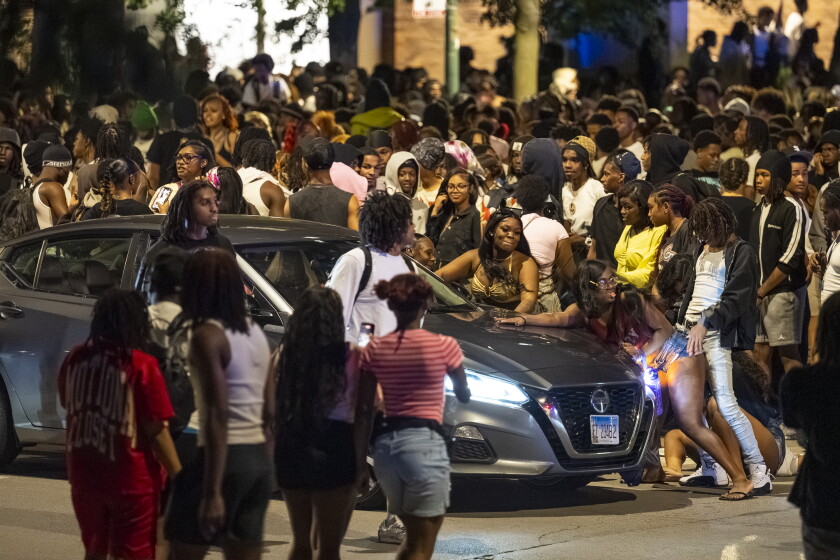
American cities are confronting a growing and poorly understood phenomenon: large, sudden gatherings of young people that frequently erupt into disorder and defy easy categorization.
In Raleigh, North Carolina, Police Chief Rico Boyce described a scene outside a patrol car at 1:30 a.m. on a Sunday that shook even his seasoned instincts, telling city leaders at a public meeting, “It was chaotic.”
Raleigh is among a rising number of cities wrestling with so-called teen takeovers, where swarms of young people descend on public spaces, often with little warning and unpredictable results.
The gatherings are typically organized through social media flyers, allowing large crowds to mobilize rapidly in ways that were not possible for previous generations of teenagers.
On July 4, police officers clashed with a crowd of juveniles and young adults in Newport Beach, California, resulting in over 400 arrests in a single incident.
Researchers have cautioned that the violent episodes attracting widespread news coverage represent the exception rather than the rule, though the images remain powerful enough to force political responses.
Samuel Abrams, a teacher and senior fellow at the American Enterprise Institute, points to the Covid-19 pandemic as a defining force shaping the behavior of today’s teenagers.
“If you are a teen today, you grew up, or you came of age, during Covid, when you were locked down,” Abrams said, framing the current unrest as a consequence of years of enforced isolation during key developmental years.
“Your social space is a screen; you are lonely; you are probably a little depressed,” Abrams added, suggesting that these gatherings may reflect a desperate search for real-world connection and social outlet.
Experts broadly agree that teenagers congregating in large groups is not a new phenomenon, but social media has dramatically accelerated the speed and scale at which this generation can organize.
Police departments across the country have responded by deploying drones, enforcing curfews, and monitoring social media platforms in an effort to anticipate and intercept planned gatherings before they escalate.
City officials face the compounding difficulty of crafting policy responses to a problem that resists a single definition, spanning everything from harmless congregation to serious public disorder.
The challenge for local governments is balancing legitimate public safety concerns with the recognition that many of the young people involved are simply seeking social engagement in a world that left them isolated at a formative age.
