
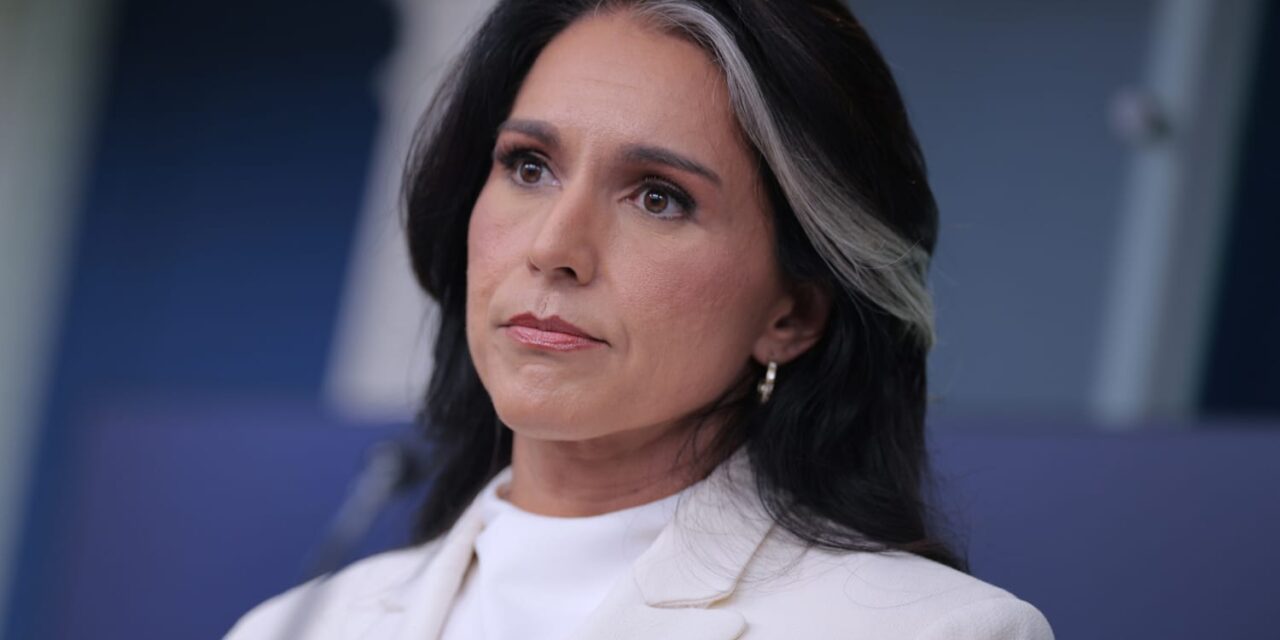
Tulsi Gabbard announced her resignation as Director of National Intelligence on Friday, May 22, citing the recent diagnosis of her husband Abraham with an extremely rare form of bone cancer as the reason for stepping down from the position she has held for approximately a year and a half.
Gabbard informed President Trump of her decision during a meeting in the Oval Office on Friday afternoon and posted her formal resignation letter to her account on X, expressing deep gratitude for the trust placed in her and the opportunity to lead the Office of the Director of National Intelligence.
Her last day at the ODNI is expected to be June 30, 2026, giving the administration approximately five weeks to confirm a successor or interim arrangement through Principal Deputy Director of National Intelligence Aaron Lukas, whom Trump indicated would serve in an acting capacity.
Trump confirmed the departure in a post on Truth Social, saying Gabbard had done a great job and that he had no doubt her husband would soon be better than ever, describing the couple as fighting a tough battle together.
As Director of National Intelligence, Gabbard oversaw all 18 of the United States’ intelligence agencies, a role that required her to coordinate information flows from the CIA, NSA, FBI, and the rest of the intelligence community and to present the president with the daily national security briefing.
Her tenure was notable for significant controversy, including the firing of officials at the National Intelligence Council shortly after it published a report that contradicted the administration’s claims about Venezuela’s government and its alleged coordination with the Tren de Aragua gang.
Gabbard had also been under pressure from the intelligence and national security establishment over her decision to defend the Trump administration’s conduct of the Iran war, maintaining publicly that the president rather than the intelligence community is responsible for determining what constitutes an imminent threat.
Reports emerged in April 2026 that Trump had been polling Cabinet members about whether Gabbard should be replaced, following congressional testimony that had reportedly irritated the president, though those discussions appeared inconclusive before the cancer diagnosis made her departure a personal rather than political decision.
Gabbard was a Democratic congresswoman from Hawaii between 2013 and 2021 and ran for the Democratic presidential nomination in 2020 before shifting to supporting Trump and eventually joining his administration, making her one of the most unusual Cabinet picks of his second term and a persistent focus of bipartisan debate about intelligence community independence.
Her departure leaves the ODNI in transition at a particularly sensitive moment, with the US-Iran war ceasefire negotiations ongoing, the Russia-Ukraine conflict escalating with fresh Oreshnik missile strikes, and the intelligence community’s role in advising the president on each of those situations directly affected by the leadership change.
