
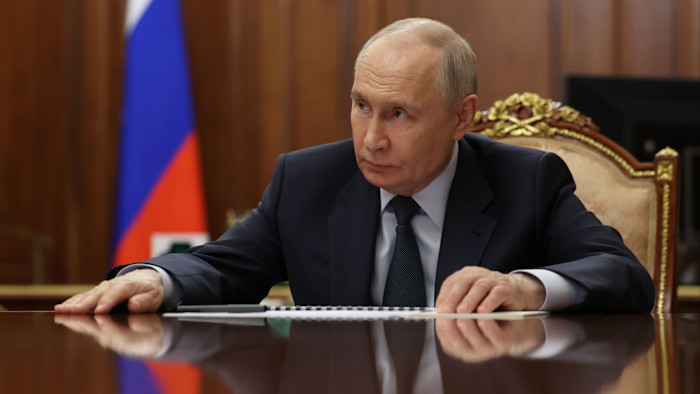
Russian President Vladimir Putin met with Kazakh President Kassym-Jomart Tokayev in Moscow on May 8, with Tokayev attending celebrations marking the 81st anniversary of Victory in the Great Patriotic War.
Putin described Tokayev’s presence at the Victory parade as evidence of the strong state of relations between the two countries, while Tokayev in turn noted Kazakhstan is actively preparing to host Putin on an official state visit at the end of May.
The meeting arrives at a moment when Kazakhstan’s foreign policy sits at a delicate crossroads, as Astana attempts to maintain its comprehensive strategic partnership with Moscow while simultaneously tightening compliance with Western sanctions and deepening ties with the European Union, China, and Gulf states.
Kazakhstan occupies a uniquely complex position in the international order: it shares one of the world’s longest land borders with Russia, remains a member of both the Eurasian Economic Union and the Collective Security Treaty Organisation, yet has emerged as an increasingly sought-after diplomatic and economic partner for Western capitals.
The country’s geopolitical importance has grown substantially since the US withdrawal from Afghanistan, the start of the Ukraine conflict, and the EU’s urgent need to diversify hydrocarbon imports away from Russian suppliers.
Astana has transformed from a peripheral post-Soviet republic into what analysts describe as a middle-sized regional power capable of attracting diplomatic and investment interest simultaneously from Moscow, Beijing, Washington, and Brussels.
For Russia, the relationship with Kazakhstan has taken on heightened strategic value precisely because Western sanctions have compressed Moscow’s economic options, making Caspian transit routes and Kazakh infrastructure essential to sustaining trade and energy flows.
Moscow sees three specific areas where Kazakhstan is indispensable: energy transit, including the export of Kazakh crude through Russian ports and potential gas re-export schemes involving Uzbekistan; overland connectivity through the International North-South Transport Corridor linking Russia to South Asia and the Persian Gulf via Turkmenistan and Iran; and long-term technological lock-in through the proposed construction of Kazakhstan’s first nuclear power plant by Russia’s Rosatom.
Each of these dimensions has a direct or indirect Caspian Sea component, either by routing flows through littoral states or by reshaping the energy balance of the broader basin.
Kazakhstan’s strategy in navigating this relationship is one of managed proximity rather than full alignment, with Astana signalling cooperation with Western compliance frameworks while preserving access to Russian markets and infrastructure to avoid being caught between the two economic blocs.
Two scenarios are emerging as the most plausible trajectories for the Caspian region in the medium term.
In the risk scenario, if Western authorities conclude that Kazakhstan is functioning as a significant hub for sanctions circumvention through Caspian and North-South routes, targeted secondary sanctions could hit Kazakh banks, logistics firms, and specific energy projects, which would push Astana closer to Russia and China out of necessity and slow Trans-Caspian diversification efforts.
In the opportunity scenario, if Russia’s capacity to deliver on promised projects erodes due to domestic economic strain or the ongoing costs of the Ukraine conflict, Kazakhstan may be positioned to accelerate its pivot toward EU, Turkish, Chinese, and Gulf partners, gradually diluting Russia’s structural dominance in the Caspian basin even while maintaining formal alliance language.
The Putin-Tokayev meeting does not resolve which of these trajectories will prevail, but analysts at SpecialEurasia suggest it crystallises the fundamental tension: Russia is working to anchor Kazakhstan more firmly within its sanctions-era economic architecture, while Kazakhstan is attempting to convert that embrace into leverage rather than dependency, with the Caspian Sea as one of the primary arenas where that balance will ultimately be tested.
