
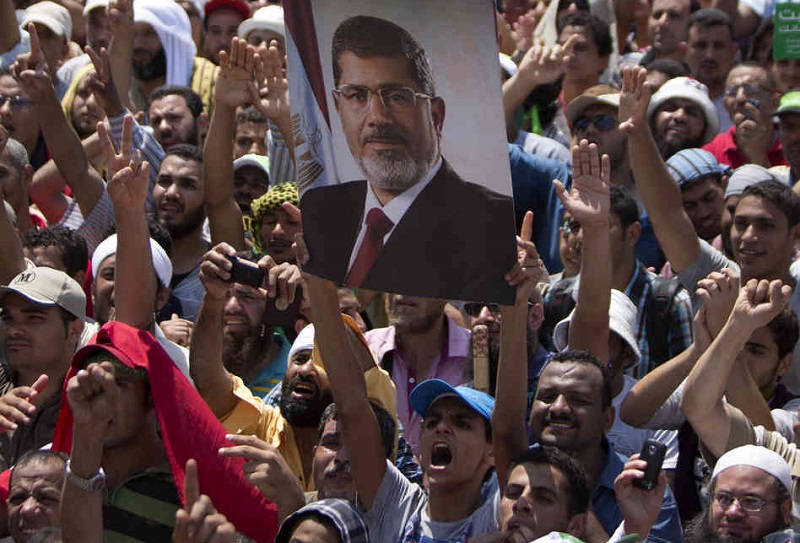
In these morbid days, there are some home truths that are worth reflecting upon.
True, even an efficient and sensitive Morsi government would likely have lost some of its popularity due to the difficulties any leadership would have faced during this period, but it would not have been overthrown, nor would its political base be criminalized and crushed by a post-coup bloody campaign of merciless state terror.
It is impossible to assess the plausibility of such a counter-factual, but I have my extreme doubts. It is notable that with few exceptions those who claimed to be most outraged by the strong arm tactics and incompetence attributed to the Morsi government have averted their eyes from and even mandated the far bloodier tactics of the el-Sisi regime, shouting such banal slogans as ‘the army and the people are one hand.’
After the Coup: A Genocidal Mentality?
Although much is unknown, the sequence of four massacres when softer alternatives were readily available to restore order, the moves to criminalize the MB (detaining Morsi, arresting MB leaders, and calling on the public to demonstrate so as to give its authorization for adopting such a strategy of oppression against the Brothers and their supporters), and recourse to the language of ‘terrorism’ to demonize demonstrators peacefully seeking to uphold constitutional rights and demand a return to constitutional government form a toxic pattern. Such behavior confirms the extreme alienation on the part of the coup leaders.
In effect, it was more than a coup, less than a counter-revolution (as old governmental order had remained in place forming the Egyptian deep state). If polarization poisoned the well of democratic legitimacy, then its accelerated momentum led to the emergence of a genocidal climate of opinion in Egypt, and the old fulool bureaucracy played its assigned part.
In such an atmosphere, it is almost to be expected that many of the coup supporters among the mass of Egyptians find nothing wrong with the tactics of the security forces since July 3rd. They endorse these tactics by an enthusiastic call for el-Sisi to become the next president of the country, and view the followers of the MB as undeserving of being treated as ‘Egyptians,’ belonging outside the pale of humanity deserving no mercy and entitled to no rights. In this murderous atmosphere, anything goes.
I suppose in this evolving Egyptian mêlée we can learn about the way the state-centric world operates by noting which governments are silent, which are approving and supportive, and which ridiculously continue to call on both sides to show ‘maximum restraint.’ We still live in a world where hard power strategic calculations in the inner counsels of government almost always outweigh soft power affirmations associated with democracy, human rights, and nonviolence. It is not a pretty picture, whether one questions the crude pragmatism of such Islamic stalwarts as Saudi Arabia and the Orgnization of the Islamic Conference or the equivocations of such liberal advocates of human rights and democracy as the United States, the European Union, and even the UN Secretary General.
These Egyptian developments also raise awkward questions about whether there exist outer limits to the politics of self-determination, which has authenticated many national movements against European colonialism and oppressive rule. Egypt is in the throes of what might be described as a process of Satanic self-determination, and there is no prospect that humanitarian intervention could restore constitutional normalcy to Egypt even if genuine empathetic motivations were present, which they are not.
Which among the governments of the region or the world would have the temerity to seek an application of the norm of the MB? Remember how in 2011, leading NATO countries relied upon R2P at the UN to obscure their primary mission, which was to destroy Qaddafi’s regime in Libya. At this stage, R2P is not an emergent principle of international law, as advocates claim, but an operative principle of geopolitical convenience that becomes relevant when it serves the political and economic interests of the West.
The ethos of human solidarity means that none of us dedicated to human rights, to the accountability of leaders for crimes against humanity, and to the quest for humane governance should abandon Egypt in this tragic hour of need. At the same time, we need to admit that there is no politics of human solidarity capable of backing up a protective ethos even in the face of genocidal tremors. Our responsibilities as ‘citizen pilgrims’ extend beyond lamenting the failures of world order to serve the wellbeing of the Egyptian people. At least, we need to raise our voices, engage fully in witnessing, and support whatever soft power initiatives can be mobilized on an emergency basis.
