
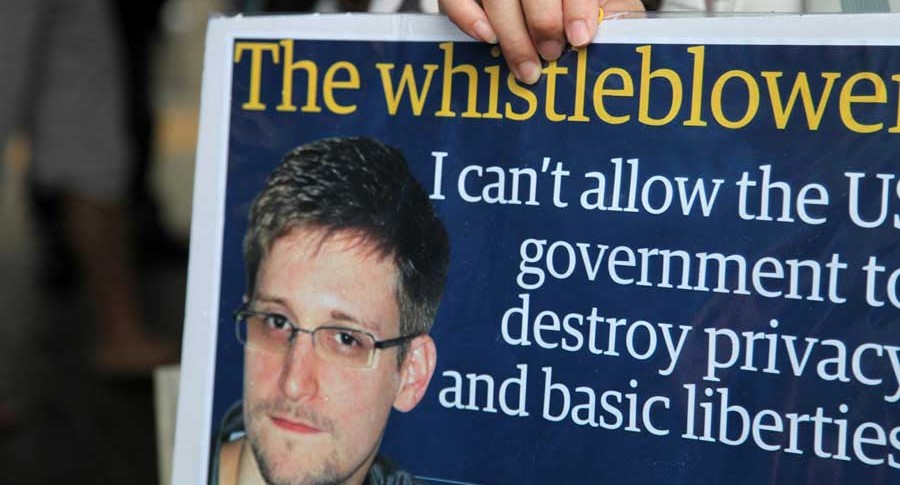
‘Political Crimes’ are Non-Extraditable and Snowden’s Transfer to the United States for Prosecution would have been a Setback for Human Rights and International Law
If these elements had been clearly articulated, the United States Government would have seemed ridiculous to complain about the willingness of some foreign governments to give Snowden asylum, and worse than complain, to use its diplomatic leverage in relation to small and vulnerable government to induce them to do the wrong thing. The Obama administration and Senate hotheads could call Snowden a traitor and bemoan his unavailability for prosecution to their heart’s content, but such behavior would be then seen for what it was: a petulant empire exhibiting its rage and frustration because its hard power global presence was of no use, and its policy options were effectively constrained because other countries abided by the rule of law. Under these conditions, to be threatening foreign governments with adverse diplomatic consequences if they refuse to play ball is not only exhibiting a child’s frustration, but it is self-defeating. If properly presented, those countries that offered asylum or refused Washington’s demand for the transfer of Snowden to American custody were behaving in accord with the best teachings of human rights. What should be surprising is that more governments were not forthcoming, leaving it to such small countries as Bolivia, Venezuela, and Nicaragua to withstand the strong arm tactics of the United States, perhaps signaling a welcome new resolve throughout Latin America to no longer accept their former regional identity of providing a backyard for the benefit of the colossus of the North.
If anything, President Vladimir Putin, considering the nature of the Snowden disclosures about the global reach of American surveillance systems, acted with an exceptional respect for the sensitivities of the United States. Instead of merely pointing out that Snowden could not be transferred to the United States against his will, Putin went out of his way to say that he did not want the incident to harm relations with the United States, and beyond this, to condition a grant of temporary asylum on Snowden’s unusual pledge to refrain from any further release of documents damaging to American interests.
Such a tactful approach to a delicate situation hardly merits the hyperbolic aggressive words of the supposedly liberal Democratic senator from New York, Charles Schumer: “Russia has stabbed us in the back. Each day that Mr. Snowden is allowed to roam free is another turn of the knife.” We should ask these deeply aggrieved senators for honest answers, including John McCain and Lindsey Graham, who added their own fiery denunciations of both Snowden and Russia, what they would have done if the situation had been reversed—if a comparable Russian whistleblower had revealed a Russian surveillance system that was listening in on secret government deliberations in Washington as well as invading the privacy of ordinary Americans. I suspect they would have demanded that Obama cancel the meeting because of what such disclosures revealed about Russia’s wrongdoing.
I would expect that the righteous indignation surrounding such revelations and the gratitude in the United States that would be bestowed on a Russian Snowden would know few bounds. The American media, too, in that situation would have been quick to produce experts on a nightly basis explaining why extraditing such a person would be wrong, and that there existed a contrary duty to provide sanctuary from the harsh workings of the Russian criminal justice system. Pious suggestions would be made that this Russian Snowden is deserving of the Nobel Peace Prize.
In a not so subtle way, the Snowden diplomacy is yet another illustration of American exceptionalism: that is, there is an obligation for others to do what our government would never think of doing—what might be called ‘the iron law of hegemony.’ International law and morality operate on a contrary logic: equal situations should be treated equally. Revealingly, American domestic law is clear about its commitment to protect a Russian Snowden: “No return or surrender shall be made of any person charged with the commission of any offense of a political nature” (18 United States Code §3185). The United States has repeatedly shielded even individuals associated with violent political acts if the target involves a hostile government or its citizens and property, most notoriously Cuba.
