
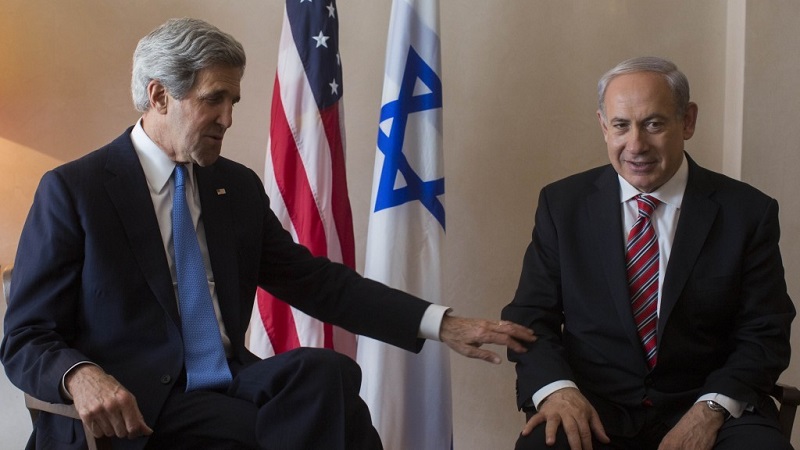
Part of Kerry’s efforts has been to get the Arab League on board with a return to the “peace process”. He successfully managed this apparently by agreeing to publicly urge Israel to consider the 2002 Arab Peace Initiative. “Israel needs to look hard at this initiative,” Kerry said in Amman, “which promises Israel peace with 22 Arab nations and 35 Muslim nations—a total of 57 nations that are standing and waiting for the possibility of making peace with Israel.”
The 2002 proposal was along the lines of the international consensus on a two-state solution, without any mention of the possibility of minor and mutually agreed changes from the ’67 lines to the final border. The Arab League recently reiterated the initiative, still calling for a full Israeli withdrawal to the armistice lines, but this time with the explicit allowance for the possibility of border renegotiation.
While the Arab League has taken Kerry’s bait, there is no possibility that the U.S., which has long rejected the two-state solution, is serious about seeing the Arab Peace Initiative move forward.
The U.S. has implicitly accepted Israel’s precondition for talks that Palestinians must recognize Israel a “Jewish state”, which effectively means that they must accept that the 1947-49 ethnic cleansing of 750,000 Arabs from Palestine by Zionist forces and the unilateral declaration of the existence of the state of Israel were legitimate and that they must renounce the internationally recognized right of return of Palestinian refugees to their homeland.
The U.S. also accepts Israel’s invalid unilateral interpretation of Resolution 242 that withdrawal from the occupied territories is conditional upon Palestinians first coming to an agreement on final borders. In other words, the U.S. and Israeli position is that Palestinians must negotiate while under foreign military occupation, with most of the territory of the West Bank falling under Israeli administrative and security control, and with Israel’s illegal continually expanding colonies there prejudicing the outcome of any such negotiations on borders.
Last month, Kerry reiterated during a press conference that the U.S. was seeking “a solution that will strengthen Israel’s security and it will strengthen its future as a Jewish state”. Talk of Israel’s “security” by U.S. officials is a euphemistic way of expressing support for Israeli annexation of Palestinian land under the accepted premise that a return to the ’67 lines would render Israel with “indefensible borders” and an allusion to the U.S. acceptance of Israel’s interpretation of Resolution 242 that “secure and recognized borders” must be established before it will withdraw from Palestine. In the same press conference, Kerry said that, in the Obama administration’s view, the issue of Israeli settlements in the West Bank was not the main obstacle preventing Israel and Palestine from returning to talks.
The focus of Kerry’s efforts has been to get the Palestinians to agree to return to talks “without preconditions”, meaning without any cessation of Israel’s illegal activities in the West Bank. The U.S. and Israel both reject the notion that international law should be part of the framework for talks, as the Palestinians are seeking. This is a continuation of the longstanding U.S. role in the “peace process”, which has been to essentially advocate for Israel and pressure the Palestinians into conceding to Israel’s demands.
While declaring Israel’s violations of international law not to be the main obstacle to peace talks, Kerry also emphasized, according to Haaretz, that “it is Abbas, rather than Prime Minister Benjamin Netanyahu, who is considered by the Obama administration to be the recalcitrant party that is impeding the American efforts. Kerry made it clear that if his efforts fail, he won’t hesitate to hold Abbas largely responsible.”
