
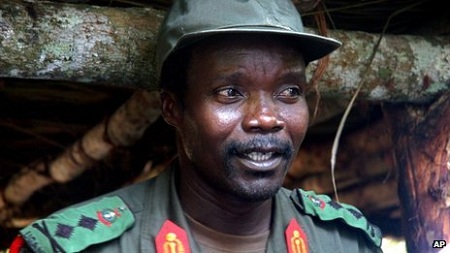
Interestingly, the same manufacturers of public opinion who report minutiae about Kony’s atrocities and his bizarre conduct seldom if ever devote serious attention to the oddities of the war conducted against Kony and the LRA. The African Union has designated “up to” 5,000 soldiers from Uganda, South Sudan, Congo and Central African Republic to this task force. That said, an ambassador of the African Union deplored the fact that these soldiers are lacking practically everything commonly expected for contemporary military operations – including rations, uniforms, boots, and even basic training in some cases.[66] The African Union now appeals to the U.N. Security Council to provide funding and equipment for the African Kony task force “no later than December 2012.”
On President Obama’s orders, the U.S. provided 100 special forces troops including Navy SEALS and Green Berets to the overall search effort. It took them four months to set up their jungle camp in the Central African Republic. Ten months after the launch of their mission, Kony has not even been traced, much less localized. U.S. forces never came in direct contact with Kony loyalists. Pursuant to their mandate as advisers, U.S. special forces rarely leave the vicinity of their camp and, although well-armed, are not permitted to engage in any combat aside from self-defense. But since the LRA purposely forgoes any form of electronic communication and communicates only through foot messengers dispatched to previously agreed rendezvous points regardless of the fact that this method of communication sometimes takes weeks to accomplish,[67] even the capture of one of Kony’s lieutenants, Caesar Acellam, in mid-May 2012[68] did not lead to significant useful intelligence gains against Kony and his remaining hard-core fighting force now estimated to number about 200. Acellam had no ability to provide directly relevant information to the Kony dragnet because his knowledge underwent planned obsolescence by the time it was acted upon.[69] Notwithstanding all these circumstances and especially the seemingly impenetrable Garamba forest terrain that serves as Kony’s hideout and to which he is extremely well adjusted, the cost of an international expeditionary force dwarf any amount of bounty that would be required to secure a betrayal of the fugitive. Long as the search for Osama bin Laden may have taken, it did not take very long from the moment interest in using him as an enduring justification for the prosecution of the war abated. As a matter of experience, people on the run do not last that long, even in the jungles of Central Africa, without state protection. The same was true of Osama Bin Laden who could not possibly have continued to live with a sizeable family for five years in Abbottabad within walking distance of Pakistani military installations without the connivance of that government or at least significant elements in its security forces. In Kony’s case, some evidence, including continued weapons shipments,[70] is believed to point to the (North) Sudanese government of Omar al-Bashir,[71] himself the first sitting head of state indicted personally by the ICC in March 2009 for crimes of war, crimes against humanity, and in a second indictment also for his role in the Darfur genocide.[72] Indeed, Kony is rumored to enjoy a secure retreat in Bahr Gazel in Khartoum-controlled territory.[73] In another interesting parallel to the hunt for Osama Bin Laden, it almost appears as if the international expeditionary force tasked with the apprehension of Kony is lingering in the Garamba forest and other jungle areas because the difficulties of the terrain there provide more credible justifications for continued failure to arrest their man, while Kony’s de facto immunity on Sudanese territory could not be resolved by a low-level engagement with an ill-equipped force of 5,000, especially not in light of the fact that numerous governments in the region and elsewhere have chosen to ignore the ICC’s arrest warrant for al-Bashir and continue to receive him with diplomatic courtesies.[74]
The Ugandan Army offered all of $11,000 reward for information leading to Kony’s capture – not even in Uganda a very significant amount.[75] And for good reason: it is well known that Kony himself has not been in Uganda since long, and that was already true at the time of making ‘Kony 2012.’ If it had done even a distant resemblance of homework, Invisible Children had to know that calling for sending a U.S. military contingent to Uganda “to stop the bloodshed and catch Kony” who is already known not to be in Uganda makes very little rational sense.
But considering that the estimated number of LRA soldiers does not exceed 500,[76] the futility of efforts to capture Kony for a quarter century also suggests that the UPDF might not really be all that interested in eliminating the local conflict caused by the LRA that keeps the tormented Acholi population from engaging in meaningful political activity. The strife also serves as a pretext and justification for restricting Ugandan civil liberties widely and permanently, harassing the opposition, and rallying southern support for the Museveni government.[77] The interest of foreign NGOs is generally higher in countries marred by humanitarian crises, and $33 million in cash obtained by the UPDF out of U.S. aid for military purposes could scarcely continue to be justified without a compelling cause such as Joseph Kony.[78] For some U.S. interests, the ‘hunt for Joseph Kony’ is the perfect excuse for militarizing oil-rich Uganda, the likely reason why the Bush administration acted early and swiftly by placing Kony and the LRA on the U.S. Treasury Department’s list of Specially Designated Global Terrorists (SDGT List) administered by the Office of Foreign Assets Control– an amazing designation hardly evocative of a group of less than 500 ragtag fighters that is active only in East Central Africa.[79]
It hardly seems that any of the vocal ‘Kony hunters’ seriously wishes to succeed in their quest. They merely desire to create the appearance of ‘doing something’ while very little is actually accomplished. It begs the pressing question why this chase is on, and whom it serves. As the economics and prosecution of the Kony wars appear contradictory and yet interrelated in unexpected ways, it is unlikely in the extreme that the true controlling reasons for it are those offered and accessible to the public. In particular, the notably stark contrast between the quality of the propaganda masterpiece that is ‘Kony 2012’ and the sophomoric amateur footage the same Invisible Children moviemakers had produced before and even after ‘Kony 2012’ leaves us with serious unanswered questions about the interests that may have supported the unprecedented attention paid to this campaign of a previously little-known California “charity.” Was ‘Kony 2012’ an unexpected one-off thunderbolt of genius? One may or may not think so. It would appear to be a conjecture worthy of further exploration whether these superficially incoherent observations do not suddenly make sense by concluding that someone really wanted the Kony story to get out so that the U.S., arguably acting on behalf of petroleum interests, could readily justify sending significant troops to East Central Africa with broad public approval, a move that would otherwise assuredly have encountered classical responses from the voting public, not least ‘why do we need another war?’ and ‘who is going to pay for it?’
Notes
[1] “Kony 2012.” http://www.youtube.com/watch?NR=1&feature=fvwp&v=KArCWQUJerw.
[2] Schomerus, Mareike; Allen, Tim; Vlassenroot, Koen. “Kony 2012 and the prospects for change: Examining the viral campaign.” Foreign Affairs, March 13, 2012. http://www.foreignaffairs.com/articles/137327/mareike-schomerus-tim-allen-and-koen-vlassenroot/kony-2012-and-the-prospects-for-change.
[3] Maupas, Stephanie. “Traque aux criminels de guerre comme Joseph Kony sur les réseaux sociaux.” Le Monde, March 12, 2012. http://www.lemonde.fr/afrique/article/2012/03/12/traque-aux-criminels-de-guerre-sur-les-reseaux-sociaux_1656720_3212.html. Others claim that it all started when Oprah Winfrey tweeted her 10 million followers. Other celebrities followed, and the numbers shot up: “How ‘Kony 2012’ went viral (Infographic).” Huffington Post, April 12, 2012. http://www.huffingtonpost.com/2012/04/12/kony-2012-viral-infographic_n_1421812.html.
[4] Vampouille, Thomas. “Mobilisation mondiale contre un criminel de guerre africain.” LeFigaro, March 7, 2012. http://www.lefigaro.fr/international/2012/03/07/01003-20120307ARTFIG00528-twitter-mobilisation-mondiale-contre-le-criminel-de-guerre-africain-joseph-kony.php.
[5] Available at http://visiblechildren.tumblr.com.
[6] Branch, Adam. “Dangerous ignorance: The hysteria of Kony 2012.” Al Jazeera, March 12, 2012. http://www.aljazeera.com/indepth/opinion/2012/03/201231284336601364.html/
[7] http://www.invisiblechildren.com
[8] Judah, Tim. “Child soldiers, sex slaves, and cannibalism at gunpoint: the horrors of Uganda’s north.” The Independent, October 23, 2004 http://www.independent.co.uk/news/world/africa/child-soldiers-sex-slaves-and-cannibalism-at-gunpoint-the-horrors-of-ugandas-north-6159396.html?printService=print.
[9] Cappa, Maria. “Buscando a Joseph Kony.” El Mundo, March 9, 2012. http://www.elmundo.es/elmundo/2012/03/08/solidaridad/1331200870.html.
[10] ”Capturado uno de los generales del señor de la guerra Joseph Kony.”El Pais, May 13, 2012. http://internacional.elpais.com/internacional/2012/05/13/actualidad/1336921395_553909.html.
[11] Hebel, Christina. “Ohne Stiefel auf Kony-Jagd.” Der Spiegel, June 28, 2012. http://www.spiegel.de/politik/ausland/rumpf-truppe-jagt-ugandischen-rebellenchef-joseph-kony-a-841275.html.
