
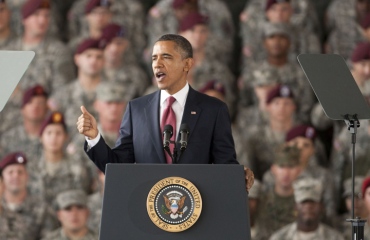
President Obama’s most bizarre statement at Ft. Bragg occurred when he declared that “what makes us special as Americans [is that] unlike the old empires, we don’t make these sacrifices [during the Iraq war] for territory or for resources. We do it because it’s right.”
Being an empire of a new type, the U.S. did not plan to transform Iraq into an old-type colony. Bush’s intention in invading was to convert Iraq into a subservient satellite. Washington already had handpicked a puppet regime of exiles to take over. The next step was to use a swift Pentagon victory as a jumping off point for bringing about regime change in Iran and other countries. This was supposed to be the culmination of America’s geopolitical ambition to rule over the entire petroleum-rich Persian Gulf region and entire Middle East. One byproduct was to enhance the position of U.S. corporations. Another was to denationalize the oil reserves mainly to benefit American oil companies if possible.
The invasion quickly succeeded. Given the imbalance of power how could it not? But much else of Bush’s imperialist adventure turned out to be a huge exploding cigar in Uncle Sam’s unsuspecting face, at a cost at least $5 trillion (when future decades of veterans’ benefits and interest payments are included). Obama knows this, of course, just as he knows it’s ridiculous to depict U.S. foreign policy as selfless. But he has a major defeat to cover up, and the fact that the troops withdrew with heads held high doesn’t entirely do the trick.
It’s true Obama opposed the war as a member of the Illinois state legislature, though he was fairly quiet as a U.S. Senator and voted in favor of funding the incredibly expensive calamity year after year. During the 2008 campaign his critique of the Iraq conflict was a major factor in the defeat of warhawk Sen. Hillary Clinton for the Democratic nomination, and or his election victory.
Both Democratic superstars now are leading hawks on behalf of keeping Iraq under Washington’s thumb, and for the Afghan war, the drone attacks on Pakistan, Yemen and elsewhere, NATO’s regime-change war in Libya, threats against Iran, the suppression of the Palestinians, support for pro-U.S. dictatorships, and most recently the dangerous new policy of “containing” China.
Iraq’s future and U.S. intentions
President Obama emphasizes that he ended the Iraq campaign, but he actually fulfilled the withdrawal agreement to pull out by the end of 2011 that was signed in December 2008 by outgoing President Bush and the Baghdad government. The Bush Administration labored long to compel President Nouri al-Maliki to agree that many thousands of U.S. troops could remain in the country after the bulk of forces withdrew, but the Iraqi leader ultimately refused. As a compromise, the concord contained a stipulation allowing U.S. troops to remain if requested by Iraq’s government.
The Obama Administration then applied pressure on Maliki to “request” that 20,000 or so American troops remain indefinitely, but its plans fell through in October. Reflecting the views of the Iraqi people, Baghdad politicians insisted that only a small number of troops may remain to train the Iraqi army. They added, however, that the troops would now be subject to the Iraqi legal system if they broke laws. The U.S. does not permit this in the many countries where its military is stationed. Washington thus was obliged to give up on retaining the troops.
The decision was an important setback for the Obama administration but a victory for Iraqi independence and a most agreeable outcome for neighboring Iran, which has considerable influence in Iraq. Washington’s principal concern is that Shi’ite Iran and majority Shi’ite Iraq will in time enter in a close and relatively powerful alliance that would oppose U.S. hegemony in the Persian Gulf, perhaps backed by China and Russia.
According to IPS news analyst Gareth Porter, Dec. 16: “The real story behind the U.S. withdrawal is how a clever strategy of deception and diplomacy adopted by Prime Minister Maliki in cooperation with Iran outmaneuvered Bush and the U.S. military leadership and got the United States to sign the U.S.-Iraq withdrawal agreement.”
Iran, which supported Bush’s overthrow of Ba’athists, is a country against which Washington has held a grudge since 1979, when a popular revolution ousted the Shah of Iran, occupied the U.S. embassy in Tehran, and held 62 American personnel for 14 months. The Shah had been reinstalled on the Peacock Throne in 1953 by the U.S. and UK after they arranged for a monarchist coup against the democratically-elected Prime Minister Mohammad Mosaddegh, crushing Iranian democracy and denationalizing the country’s petroleum fields to benefit British and American oil companies.
The U.S. and Israel (which had very close relations with the Shah’s regime) have long been seeking the opportunity to replace the anti-imperialist Islamic regime with a pro-American government, lately with threats of war, subversion, support for opposition elements, and ever tightening extreme sanctions in response to unproven allegations that Iran is constructing a nuclear weapon.
Obama told the troops that “Iraq is not a perfect place… but we’re leaving behind a sovereign, stable and self-reliant Iraq, with a representative government that was elected by its people…. This is an extraordinary achievement… and today we remember everything that you [the troops] did to make it possible.”
After the first false justifications for the invasion were exposed, and the Pentagon was settling in for a long occupation since notions of quick victory had had gone up in smoke like a bombed out Iraqi home, Bush Administration neoconservatives discovered that the “real” reason for the war was to “democratize” Iraq.
Iraq had been a one-party state run by the secular Ba’ath Party with Saddam Hussein as the president. Hussein crushed the Communists, then the left and other vocal opponents and organizations. The Ba’athists brooked no political opposition. They favored the minority Sunni over the majority Shi’ite Muslims. Hussein led Iraq into an unjust, unnecessary war against Shi’ite Iran throughout the 1980s, with U.S. backing.
Domestically, the Ba’athists embraced a program of social services for the people. Oil reserves and certain enterprises had been nationalized and profits provided a broad array of support for the masses, such as subsidized food. Iraq boasted the best public educational system in the Middle East. It maintained a far-reaching national healthcare system for all citizens. Iraqi women were considered to be the most equal and liberated in the Arab world. Internationally, the Ba’ath Party practiced an anti-imperialist foreign policy. For many years it upheld Pan-Arabism until its decline throughout the region, and was critical of Israel and supported the Palestinian people until the end.
Historically, the U.S. supported and continues to back several dictatorships in the Middle East. It’s 30-year tacit alliance the Mubarak regime in Egypt (and current backing for the quasi-military junta now in power) was hardy the worst. What set Iraq apart for Washington was its strategic geopolitical position, opposition to certain U.S. goals in the vicinity, possession of great petroleum resources, anti-Israel focus, and by 2003 its helpless military vulnerability.
Today, after 20 years of U.S. wars, Iraq is a ruin. The country was virtually crippled after the destruction caused by Washington’s first Iraq war in 1991 followed by debilitating sanctions and occasional bombings until the second war which started in March 2003.
The education system has been shattered. Healthcare is now poor to nonexistent for much of the population. Many rights for women have been wrenched away. Infrastructure is a wreck. Energy from the battered electrical grid remains sporadic or not available. Businesses and a number of government tasks have now been privatized to the detriment of the people. Oil has been denationalized. Poverty and inequality are widespread. Corruption is endemic. The new “democratic” political system is frequently undemocratic, and great injustices exist throughout society. Torture is a frequent tool of the police.
In addition, Washington’s divide-and-conquer tactics have greatly exacerbated religious tensions, leading to near civil war at one point, and engendered the continual terrorist violence that exists to this day. The war opened the door for al-Qaeda terrorists to enter Iraq for the first time, and they are still there. The Ba’athists in power would not tolerate their presence, but the chaos of the occupation was a virtual invitation. Divide-and conquer also increased national and gender antagonisms.
America’s formal war is now over but it hardly is the last of the U.S. in Iraq. Obama told the troops that “We’re building a new partnership between our nations.” The Bush Administration’s initial “partnership” was based on becoming a virtual behind-the-scenes government in Baghdad — one of its many failures.
But Washington retains considerable power in Iraq — from economic support and credits, to arms sales, military training, trade opportunities, a connection to America’s many allies and dependencies in the Middle East and worldwide and more.
Part of that partnership is the newly built largest embassy in the world and a staff of nearly 17,000. This includes a security force of over 5,000 personnel, and 150-200 U.S. troops remaining in Iraq as part of a “normal embassy presence.” (By comparison, the capital city of Albany, N.Y., with a population of nearly l00,000, is served by 340 police officers.) It has been reported that much of the diplomatic staff works with Iraqi government departments or is engaged in activities for the U.S. intelligence network.
